A tandem kayak is useful if you want to paddle with a partner, child or nervous beginner, but the best choice depends heavily on storage, launch sites and how often you will use it. Inflatable tandems are easier to store and transport, while hardshell tandems track better and last longer if you have space. This guide compares the best tandem kayaks for UK buyers across budget, family and touring use.
Quick Answer: The Sevylor Riviera is the best tandem kayak for most casual UK paddlers because it is stable, easy to store and affordable. Choose the Intex Explorer K2 only for calm, occasional use, the Perception Tribe 13.5 if you want a durable hardshell sit-on-top, and the Gumotex Solar if you want a higher-quality inflatable for regular trips.
In This Article
- How to Choose a Tandem Kayak
- Best Tandem Kayaks for 2026
- Inflatable vs Hardshell: Which Should You Buy?
- Essential Gear for Tandem Kayaking
- Tandem Kayaking Tips for Beginners
- Frequently Asked Questions
The best tandem kayak for UK buyers depends entirely on what you plan to do with it. A family messing about on the Norfolk Broads needs something completely different from a couple tackling Grade 2 rapids in Wales.
If you want one tandem kayak that handles almost everything — calm lakes, gentle rivers, the odd coastal potter — the Sevylor Riviera is the one to buy. It’s inflatable (so storage isn’t a nightmare), stable enough for nervous beginners, and costs around £250–£300 from Amazon UK or Go Outdoors. But it’s not the right call for everyone, so let’s break down what matters and which models suit different paddlers.
How to Choose a Tandem Kayak
Before you start comparing models, nail down these four things. Get them wrong and you’ll end up with a kayak that lives in the garage after two outings.
Hardshell vs Inflatable
This is the big decision, and it mostly comes down to storage and transport. A hardshell tandem kayak is typically 3.5–4.5 metres long. That’s longer than most cars. You’ll need roof bars, a decent pair of J-cradles, and ideally two people to lift it. If you’ve got a garage and a car with a roof rack, brilliant. If you live in a terrace with no off-street parking, forget it.
Inflatables pack into a rucksack or holdall. Most weigh 12–18 kg and inflate in 10–15 minutes with the included pump. The trade-off? They’re slower on the water, more affected by wind, and you won’t get the same tracking (straight-line paddling) as a rigid boat. For casual paddlers on lakes and gentle rivers, that’s a perfectly acceptable compromise. For anything more serious, you’ll want hardshell.
If you’re weighing up inflatables specifically, our guide to the best inflatable kayaks for UK rivers and lakes goes deeper on that category.
Sit-On-Top vs Sit-Inside
Sit-on-top kayaks have a moulded open deck — you sit in a shallow recess on top. They’re self-draining, almost impossible to capsize in flat water, and dead easy to get on and off. Perfect for families, warm-weather paddling, and anyone who doesn’t fancy the feeling of being wedged inside a boat. The downside: you get wet. Splash, spray, and the occasional wave will soak your legs.
Sit-inside designs put you lower in the hull with your legs enclosed. They’re drier, warmer in cold weather, and faster because of the lower centre of gravity. But they’re harder to re-enter if you capsize, and some people — particularly larger paddlers — find them claustrophobic. For UK paddling from April to October, sit-on-top makes sense for most people. If you’re paddling through winter or want to cover proper distances, sit-inside is worth the learning curve.
Weight Capacity
Tandem kayaks carry two people plus gear, so capacity matters more than with singles. Add up both paddlers’ weight, then add 15–20 kg for kit (dry bags, food, camera, the dog’s treats). You want a kayak rated for at least 20% more than that total. Overloading a kayak makes it sluggish, unstable, and miserable to paddle.
Where You’ll Actually Paddle
Be realistic here. Most UK tandem kayaking happens on canals, lakes, and gentle rivers — the kind of water where stability matters more than speed. If that’s you, prioritise a wide, stable hull over a sleek touring shape. If you’re planning coastal trips or longer river journeys, look at touring tandems with better tracking and storage. Our kayak hull shapes guide explains how different hull designs affect performance.
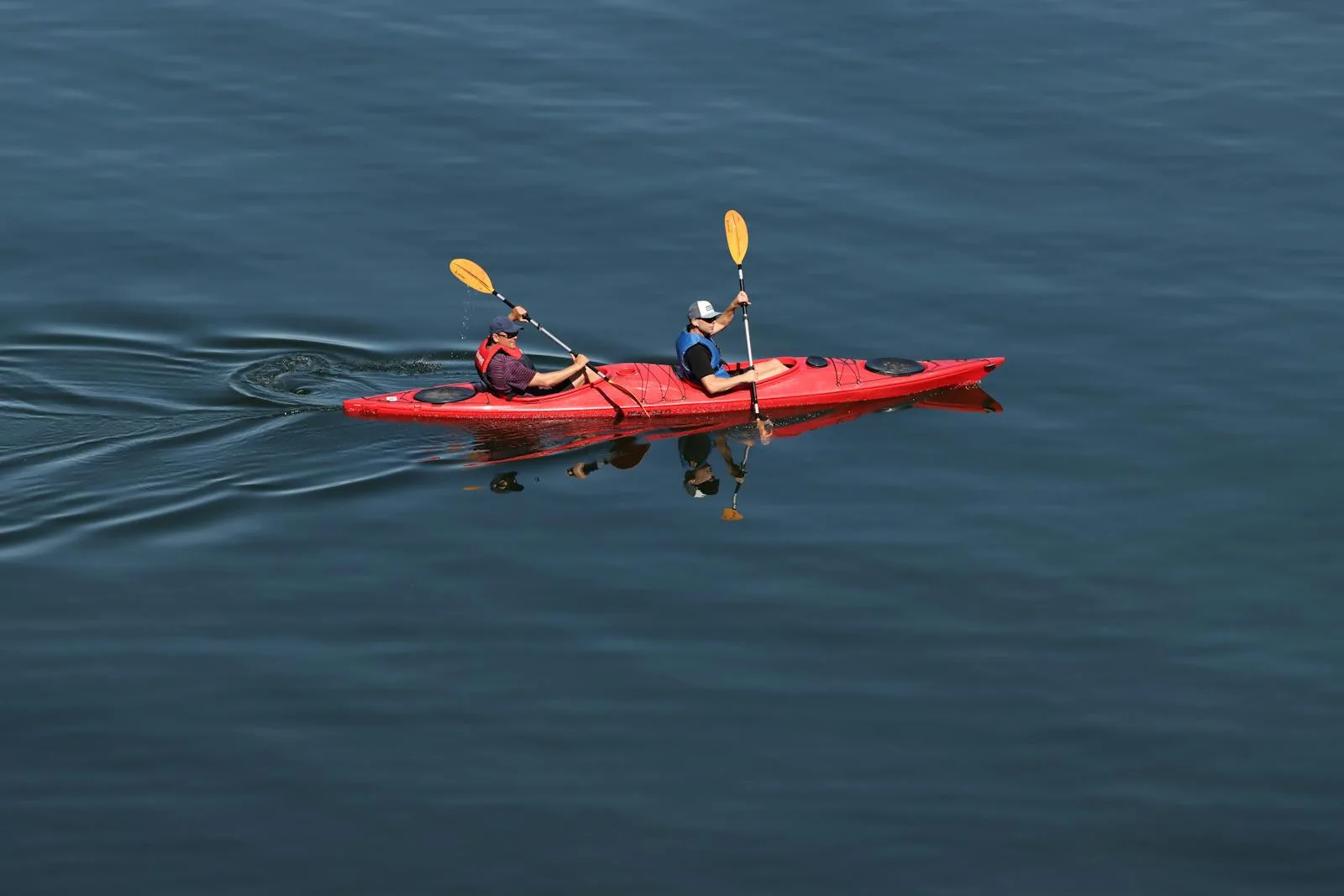
Best Tandem Kayaks for 2026
Sevylor Riviera — Best Overall
- Price: £250–£300
- Type: Inflatable sit-on-top
- Weight: 11.3 kg
- Capacity: 200 kg
The Riviera keeps topping recommendations for good reason. It’s really easy to set up (about 8 minutes once you’ve done it a few times), remarkably stable on flat water, and comfortable enough for a full afternoon without your back screaming at you. The Boston valves inflate and deflate quickly, and the whole thing packs into the included carry bag.
On the water, it tracks reasonably well for an inflatable — better than the cheaper Bestway alternatives, though not as well as the Itiwit models. Handling crosswinds on open lakes is its main weakness. If there’s a breeze above 15 mph, you’ll spend more energy correcting your course than actually going anywhere. For a related angle, see our Best Fishing Kayaks 2026 UK: Pedal, Paddle & Motorised guide.
Where to buy: Amazon UK, Go Outdoors, Decathlon
Verdict: The best all-rounder for couples and families who want hassle-free paddling on calm water. Not exciting, not flashy — just works.
Intex Explorer K2 — Best Budget Option
- Price: £90–£130
- Type: Inflatable sit-inside
- Weight: 16.5 kg
- Capacity: 180 kg
Let’s be upfront — the Explorer K2 is marketed as a two-person kayak, but it’s tight for two full-sized adults. If you’re both under 5’10” and fairly slim, you’ll be fine. Two big blokes? You’ll be touching knees all day. That said, for the price, it’s remarkable. The bright yellow colour makes you visible on the water (not a small thing for safety), the inflatable I-beam floor is surprisingly rigid, and it comes with two aluminium paddles that are functional if not pretty.
It’s best suited to canals, sheltered lakes, and very gentle rivers. Take it anywhere with current and you’ll feel how little directional control you have. The included skeg helps a bit but isn’t adjustable.
Where to buy: Amazon UK, Argos
Verdict: Brilliant entry point if you’re not sure whether tandem kayaking is for you. Spend £100, try it for a season, then upgrade if you catch the bug.
Ocean Kayak Malibu Two XL — Best Sit-On-Top
- Price: £700–£850
- Type: Hardshell sit-on-top
- Weight: 27 kg
- Capacity: 227 kg
The Malibu Two XL is one of those products that just nails its brief. It’s wide (86 cm), stable enough that your kids can fidget without capsizing everyone, and has three seating positions — so it converts from a tandem to a solo with a better central seat position. The Tri-Form hull is flat enough for stability but has enough shape to track decently.
At 27 kg, two people can carry it from car to water without drama, though roof-racking solo is a two-trip job. Build quality is excellent — These are common on rental fleets because they tolerate heavy use and still stay serviceable. Scupper holes keep the deck drained, though they also let cold water up on chilly days (scupper plugs cost about £8 and are worth every penny).
Where to buy: Specialist kayak retailers, eBay (good second-hand market)
Verdict: If you have the storage space, this is the tandem sit-on-top to beat. Buy it once, use it for years.
Decathlon Itiwit x100+ 2-Person — Best Value Inflatable
- Price: £300–£350
- Type: Inflatable sit-on-top
- Weight: 14 kg
- Capacity: 200 kg
Decathlon’s Itiwit range has quietly become one of the best-value options in UK paddlesports. The x100+ has drop-stitch construction on the floor, which makes it noticeably stiffer than standard inflatables like the Sevylor. That translates to better paddling efficiency — less energy lost to the hull flexing with each stroke.
The seats are comfortable with proper back support and multiple adjustment points. There’s a removable centre fin for tracking, and the grab handles are positioned well for carrying. My only complaint is the pump — the included double-action pump works but takes effort. Budget an extra £30–£40 for an electric pump and you’ll thank yourself every trip.
Where to buy: Decathlon stores and decathlon.co.uk
Verdict: Spends a bit more than the Sevylor but you feel the difference on the water. The better choice if you’ll paddle regularly.
P&H Scorpio Tandem MV — Best Touring Tandem
- Price: £1,800–£2,200
- Type: Hardshell sit-inside
- Weight: 32 kg
- Capacity: 250 kg
This is where things get serious. The Scorpio Tandem is a proper touring kayak — 5.2 metres long, with sealed bulkheads, day hatches, deck lines, and enough storage for multi-day trips. It paddles like a much shorter boat thanks to the efficient hull shape, and the adjustable skeg lets you dial in tracking for different conditions.
It’s not a beginner boat. The sit-inside design, combined with the length, means you need some paddling experience and confidence in rescues. But if you and your partner want to tackle the Pembrokeshire coast, paddle the Caledonian Canal, or do proper weekend expeditions, nothing else on this list comes close.
Where to buy: Specialist dealers, P&H direct
Verdict: The dream tandem for experienced paddlers who want to go places. Not cheap, but built to last decades.
Inflatable vs Hardshell: Which Should You Buy?
This is the question I get asked most, so here is the practical answer broken down by scenario.
Buy inflatable if: you live in a flat or terraced house with no garage, you drive a small car, you paddle fewer than 20 times a year, you mostly stick to calm lakes and canals, or you want to take a kayak on holiday (some inflatables can fly as checked luggage).
Buy hardshell if: you have storage space (garage, large shed), you paddle regularly, you want to tackle coastal water or moving rivers, you care about speed and tracking, or you’re buying for a rental/activity business.
The performance gap between inflatables and hardshells has narrowed over the past five years, particularly with drop-stitch technology. But it’s still there. A hardshell will always track straighter, paddle faster, and handle rough water better. The question is whether that difference matters for your paddling.
Essential Gear for Tandem Kayaking
You’ve got the kayak — now don’t forget the bits that make the difference between a great day and a miserable one.
- Buoyancy aids — not optional. Canal & River Trust canoeing and kayaking guidance wearing a correctly fitted buoyancy aid every time you’re on the water. Budget £30–£50 each from Decathlon or Go Outdoors.
- Paddles — inflatables usually include paddles, but they’re often heavy and flexy. Upgrading to a decent aluminium or fibreglass paddle (£40–£80) makes a huge difference. Our guide on choosing the right paddle length will help you pick the correct size.
- Dry bags — your phone, car keys, and sandwiches will get wet. A 10-litre dry bag costs about £8–£12 and saves so much grief.
- Spray deck (sit-inside only) — keeps water out of the cockpit. Essential for anything beyond flat calm conditions.
- Roof bars and straps (hardshell only) — budget £150–£250 for a decent set of bars plus kayak-specific cradles or foam blocks.
Tandem Kayaking Tips for Beginners
Paddling with a partner is brilliant fun, but it comes with its own challenges. The most common issue? Rhythm. The front paddler sets the pace, and the rear paddler matches it. If you’re both doing your own thing, you’ll zigzag like you’ve had three pints.
The rear paddler does most of the steering. A sweep stroke on one side will turn the kayak, and it’s much more effective from the back seat. Front paddler — your job is power and keeping a steady rhythm. Resist the urge to correct the steering from up front.
Start on flat, calm water. A sheltered lake or canal is perfect — save the rivers for when you’ve got your coordination sorted. And talk to each other. “Paddling left” or “stopping” saves a lot of arguments. If you’re completely new to kayaking, our beginner’s guide to choosing a kayak covers the fundamentals.
One more thing — dress for the water temperature, not the air temperature. UK water stays cold well into June. If you capsize in 12°C water wearing just a t-shirt and shorts, cold water shock is a real risk. A wetsuit or at minimum a cagoule and quick-dry layers are sensible from March through to late May.
Frequently Asked Questions
Can one person paddle a tandem kayak? Yes, but it's not ideal. Tandem kayaks are heavier and wider than singles, so solo paddling is slower and harder work. Sit-on-top models like the Ocean Kayak Malibu Two XL have a central solo seat position that helps, but a purpose-built single kayak will always be more efficient for solo use.
How much should I spend on a tandem kayak in the UK? For a decent inflatable tandem, expect to pay £250-£350. Budget hardshell sit-on-tops start around £500, with quality models costing £700-£900. Touring sit-inside tandems range from £1,200 to over £2,000. The Intex Explorer K2 at around £100 is the cheapest usable option.
Are inflatable tandem kayaks safe? Modern inflatables with multiple air chambers are very safe for appropriate conditions — calm lakes, canals, and gentle rivers. They're actually harder to capsize than many hardshells due to their wide, stable shape. The main safety risk is using them in conditions they're not designed for, such as strong winds, tidal waters, or fast-moving rivers.
Do I need a licence to kayak in the UK? It depends where you paddle. Most canals and some rivers managed by the Environment Agency or Canal & River Trust require a licence or permit. British Canoeing membership includes waterway licences for many locations. Open sea, most lakes, and some rivers are free to paddle. Check the specific waterway before you go.
What weight limit should I look for in a tandem kayak? Add both paddlers' weight plus 15-20 kg for gear, then choose a kayak rated for at least 20% more than that total. For example, if two paddlers weigh 75 kg each (150 kg combined, plus 20 kg gear = 170 kg), look for a kayak rated to at least 200 kg. Most quality tandems handle 200-250 kg.