You’ve bought the board, inflated it in the back garden, and maybe even managed to stand up without falling in. But now you’re out on the water and going… nowhere useful. Your board zigzags, your arms burn after ten minutes, and that couple on the matching paddleboards just glided past you like they were on rails. The difference? They’ve nailed their sup paddle stroke technique — and it’s easier to learn than you’d think.
Good paddle technique isn’t about fitness or strength. It’s about using the water efficiently, which means less effort for more speed and far better control. Get this right early and you’ll paddle further, stay drier, and actually enjoy your time on the water instead of fighting it.
Why Technique Matters More Than Fitness
Most beginners assume they need to paddle harder when they’re struggling. They grip the paddle like they’re trying to strangle it, hunch forward, and windmill their arms until their shoulders scream. Sound familiar?
The thing is, paddleboarding is a core sport, not an arm sport. Your torso, hips, and legs do most of the real work — your arms are just the connection between your body and the paddle. Once you understand that, everything changes.
Poor technique causes three problems that compound on each other:
- Zigzagging — paddling with arms alone pushes the nose sideways with every stroke
- Early fatigue — small arm muscles tire in minutes; your core can go for hours
- Poor balance — hunching forward shifts your centre of gravity and makes the board wobble
If you’re new to the sport, our complete beginner’s guide to stand-up paddleboarding covers board selection and getting started. This article picks up where that one leaves off — with the strokes that turn a wobbly beginner into a confident paddler.
Getting Your Grip and Stance Right
Before we get into strokes, two things need sorting: how you hold the paddle and where you stand. Get these wrong and no amount of technique will save you.
Paddle Grip
Here’s where nearly every beginner goes wrong — they hold the paddle backwards. The blade should angle away from you, not towards you. It feels counterintuitive, but the blade’s designed to release water cleanly at the end of each stroke. Backwards, it scoops and stalls.
Your top hand grips the T-bar handle at the very end. Your bottom hand goes on the shaft, roughly shoulder-width apart. A quick way to check: hold the paddle above your head with both arms — your elbows should be at about 90 degrees. If you need guidance on shaft length, our guide on how to choose the right paddle length breaks it down properly.
Foot Position
Stand in the middle of the board, feet parallel and hip-width apart, toes pointing forward. Your feet should be either side of the carry handle — that’s the board’s balance point. Knees slightly bent. Not crouching, just soft. Think “ready position” in tennis, not “sitting down”.
Keep your head up and eyes on the horizon. The moment you stare at your feet, you’ll wobble. Your body balances better when your eyes have a fixed reference point in the distance.
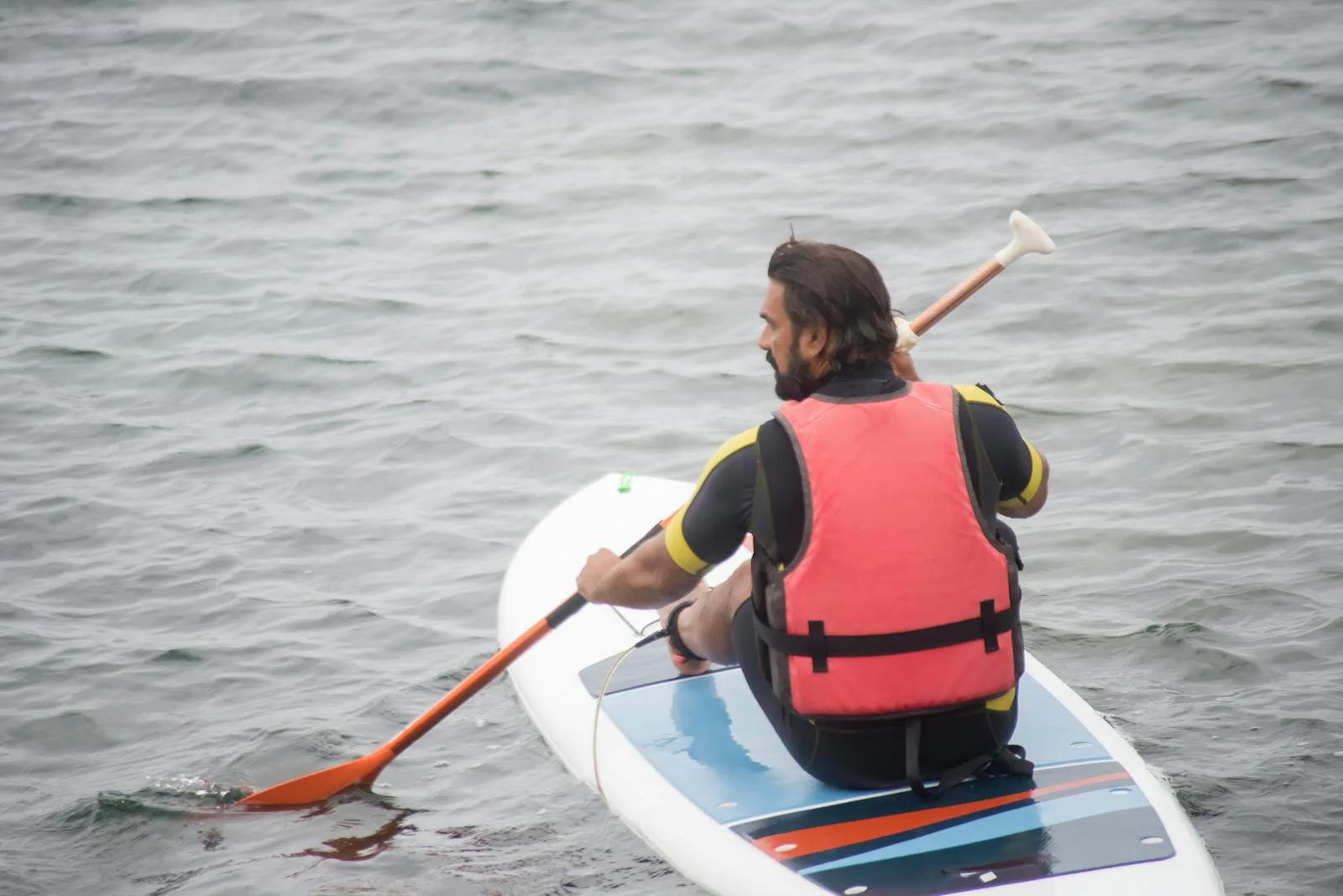
The Forward Stroke — Your Bread and Butter
This is the stroke you’ll use 90% of the time, so it’s worth getting right. Think of it as three phases: the catch, the power phase, and the recovery.
The Catch
Reach forward — properly forward, not just dropping the blade next to your feet. Rotate your torso so your paddle-side shoulder extends towards the nose of the board. Plant the blade fully in the water about 60cm ahead of your front foot. You want the whole blade submerged before you start pulling.
Here’s the bit most people miss: the catch isn’t a gentle dip. Plant the blade firmly, like you’re sticking a shovel into wet sand. That solid connection with the water is what gives you power.
The Power Phase
This is where “paddle with your core” actually means something. Instead of pulling the paddle back with your arms, think about rotating your torso. Your top hand pushes forward while your hips and core unwind. Your bottom arm stays relatively straight — it’s a lever, not a pulling mechanism.
Pull the blade along a straight line parallel to the rail (edge) of the board, keeping it close to the side. The further out the blade drifts, the more your board turns instead of going straight. For a related angle, see our How to Edge a Kayak: Turning Technique guide.
Stop the stroke when the blade reaches your feet. Dragging it further back past your body lifts water and actually slows you down. This is the single most common mistake — people think a longer stroke means more power, but everything behind your feet is wasted energy that pulls the tail down.
The Recovery
Slice the blade out of the water sideways (not lifting straight up — that’s heavy and throws water everywhere). Swing it forward through the air, rotate, and plant again.
Three to five strokes per side before switching is a good rhythm for beginners. More experienced paddlers might do seven or eight, but starting with fewer switches keeps you straighter while you’re learning.
The Reverse Stroke — Your Brake and Reverse Gear
Exactly what it sounds like — the forward stroke, backwards. Drop the blade in beside your feet and push it towards the nose. This slows you down quickly and can bring you to a complete stop in two or three strokes.
A couple of things to keep in mind:
- Plant the blade fully before pushing — skimming the surface does almost nothing
- Keep weight centred — the temptation is to lean back, but that destabilises the board
- Use it for quick direction changes too — one reverse stroke on the right turns you sharply right
You’ll use this more than you expect, especially in crowded waterways or when the wind picks up and you overshoot where you wanted to stop.
The Sweep Stroke — Turning With Control
The sweep stroke is how you turn the board without losing all your momentum. Instead of paddling in a straight line along the rail, you sweep the blade in a wide arc from nose to tail (or tail to nose).
Forward Sweep
Reach towards the nose and plant the blade. Now sweep it in a wide semicircle away from the board, all the way back to the tail. Keep the blade at a consistent depth throughout — about 15cm submerged is plenty.
A forward sweep on the right turns the board left. On the left, it turns right. One strong sweep can rotate you 30-40 degrees.
Reverse Sweep
Same arc, opposite direction. Start at the tail, sweep forward to the nose. This is more powerful for turning because it also brakes slightly, tightening the turn. Useful when you need to spin quickly — combining a forward sweep on one side with a reverse sweep on the other can turn you almost on the spot. Our How to Choose a Kids’ Paddleboard guide is useful alongside this.
Tips for Better Turns
- Bend your knees more during turns — the lower centre of gravity keeps you stable
- Look where you want to go — your body follows your eyes, and the board follows your body
- Step back slightly for tighter turns — shifting your back foot towards the tail lifts the nose and lets the board pivot more freely (this is advanced, so only try it on calm water first)
The Draw Stroke — Moving Sideways
This one’s less glamorous but dead useful. Need to pull up alongside a dock? Sidle up next to a friend’s board? The draw stroke moves you laterally without turning.
Reach out to the side, about 60cm from the rail, and plant the blade parallel to the board (face pointing towards you). Pull it straight in towards the rail. Just before the blade hits the board, slice it back out to the starting position and repeat.
Keep your core engaged and your weight centred over the board. It feels awkward at first, but after a few sessions it becomes second nature. Practice it on calm water — a flat lake or sheltered canal is ideal.
Common Mistakes and How to Fix Them
After coaching dozens of mates through their first paddleboarding sessions (and making every one of these mistakes myself), here are the big ones:
- Gripping too tight — a death grip on the paddle tenses your forearms and shoulders. Hold it firmly but not white-knuckled. Think of holding a bird: tight enough it can’t escape, loose enough you don’t crush it
- Standing too far back — the nose lifts out of the water and you drag the tail, which is exhausting. If the nose is pointing skyward, shuffle forward
- Short, choppy strokes — reach further forward and commit to each stroke. Quality over quantity
- Blade not fully submerged — if you can see the blade during the power phase, you’re skimming the surface. Push it down until the shaft meets the water
- Switching sides every stroke — this causes constant zigzagging. Commit to 3-5 strokes per side minimum
- Looking down — eyes up, horizon forward. Always. Your balance will thank you
Building a Practice Routine
You don’t need hours of practice to improve. Twenty minutes of focused work beats two hours of mindless paddling.
Session One — Forward Stroke Focus
Head out on flat water and spend the whole session just on forward strokes. Focus on full blade immersion, core rotation, and stopping the stroke at your feet. Count strokes per side — aim for consistency. If you’re zigzagging badly, try four strokes per side and see if that straightens things out.
Session Two — Turning
Find an open area and practise forward sweeps until you can spin 360 degrees. Then try reverse sweeps. Then alternate: forward sweep on one side, reverse sweep on the other. Set yourself a target — a buoy, a tree on the bank — and try to turn to face it in as few strokes as possible.
Session Three — Putting It Together
Plan a short route with at least four turns. A loop around a small lake is perfect. Focus on smooth transitions between forward strokes and turns. Try to maintain some speed through turns rather than stopping and restarting.
The British Canoeing website at britishcanoeing.org.uk has information on local clubs and beginner courses across the UK if you want structured coaching. Many waterway centres offer taster sessions for about £25-40 per person. We cover a similar decision in How to Get Fit for Kayaking.
Conditions and Where to Practise in the UK
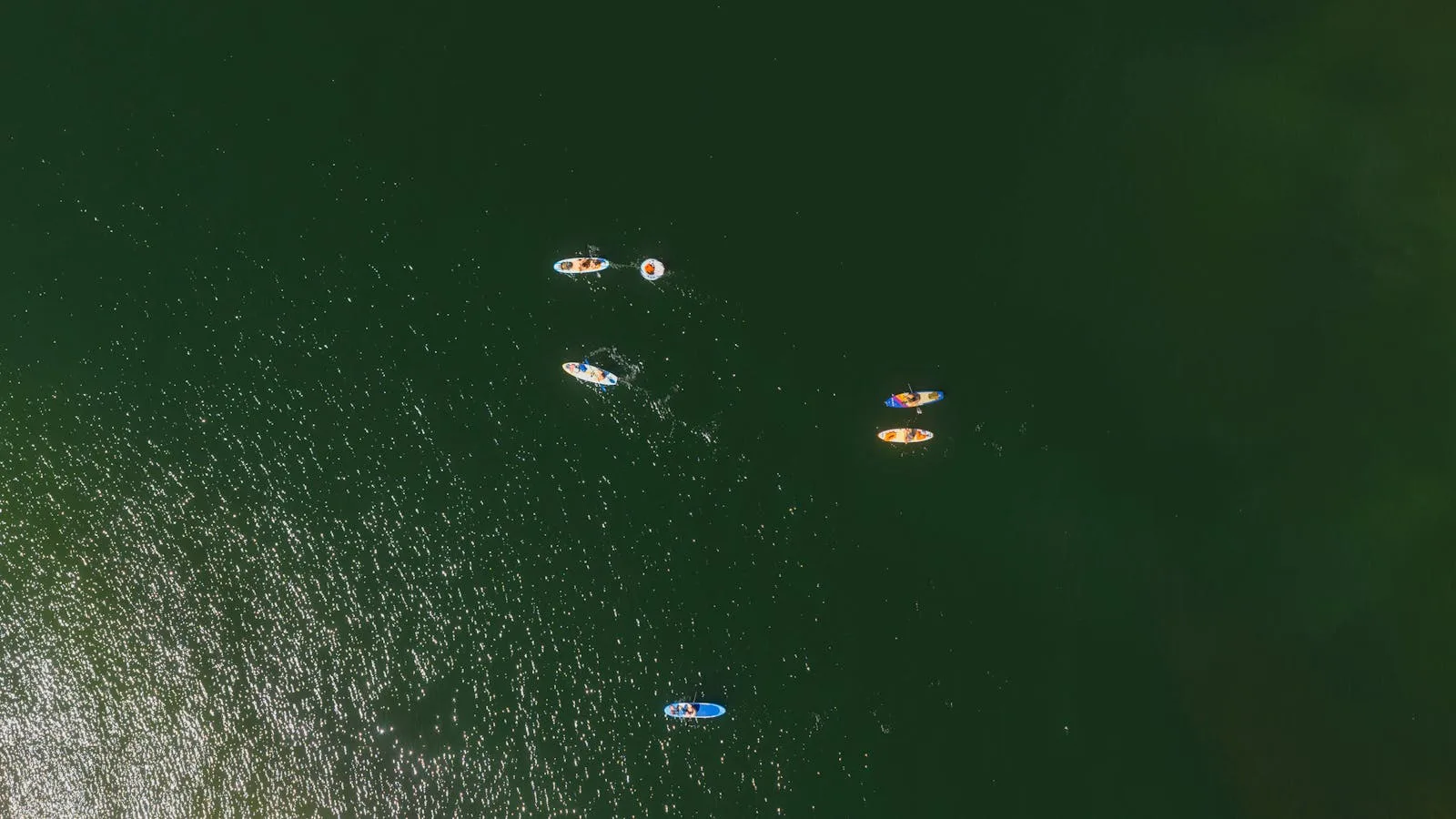
Your technique will develop fastest on calm, flat water. Canals, sheltered lakes, and gentle rivers are ideal — save the coast for when you’re confident.
Some top spots for beginners:
- The Thames above Teddington Lock — calm, flat, with multiple access points
- Windermere (sheltered bays) — beautiful and usually manageable in summer mornings
- Bray Lake, Berkshire — purpose-built watersports centre with SUP hire and lessons
- Salford Quays, Manchester — urban but sheltered and beginner-friendly
- The Norfolk Broads — flat water, gorgeous scenery, and plenty of room
Wind is the beginner’s biggest enemy. Check the forecast and aim for days under 10mph. If the wind picks up while you’re out, kneel down — it halves your wind profile and is far easier than standing in a gust. No shame in it. Experienced paddlers kneel in heavy wind too.
Water temperature matters if you’re in the UK, especially outside summer. A 3/2mm wetsuit (about £60-100 from Decathlon or Amazon UK) makes spring and autumn sessions comfortable. In winter, consider a 5/4mm or stay on flat indoor water if available.
Essential Gear for Better Technique
You don’t need much beyond a board and paddle, but a few things help:
- A properly sized paddle — too long or short ruins your stroke mechanics. Adjustable paddles (about £40-80) let you experiment
- A coiled leash — keeps the board attached to your ankle. Flat water always uses a coiled leash; straight leashes are for surf only
- A buoyancy aid — legally required on many UK waterways and just good sense. Basic ones start at about £25 from Decathlon
- Sun protection — you’re on reflective water. A rash vest and decent suncream, even on overcast days
The Bottom Line
SUP paddle stroke technique isn’t complicated — it just needs a bit of deliberate practice rather than winging it. Focus on core rotation, full blade immersion, and stopping each stroke at your feet. Those three things alone will transform how your board moves through the water.
Start on flat, sheltered water. Practise one stroke type per session. Don’t rush to the coast or try to keep up with more experienced paddlers. The technique will come, and when it does, you’ll wonder why you ever thought paddleboarding was hard work.
Frequently Asked Questions
How many strokes should I do on each side before switching? Start with 3-5 strokes per side. As your technique improves and each stroke becomes more efficient, you can increase to 7-8 before switching.
Why does my board keep turning when I paddle straight? The blade is probably drifting away from the rail during your stroke. Keep it close to the board and pull in a straight line, not an arc. Also check you’re not standing off-centre.
Should I paddle with my arms or my core? Your core. Arms are the connection between body and paddle — your torso rotation is what drives the stroke. This is why paddleboarding is such brilliant core exercise.
What should I check first with SUP Paddle Stroke Technique for Beginners? Start with the real use case, then check size, compatibility, running costs and maintenance. A product that looks good on paper can still be the wrong fit if it does not suit the room, routine or budget.
How do I avoid wasting money on SUP Paddle Stroke Technique for Beginners? Avoid buying on one headline feature alone. Compare the practical details, read the warranty or returns terms, and choose the option that solves your main problem rather than the one with the longest specification list.