US Box vs Slide-In SUP Fins is a compatibility choice before it is a performance choice: a replacement fin is only useful if its base and lock match the fin box already fixed to your board. A US box uses a channel, retaining plate and screw; a slide-in system typically uses a shaped rail and separate clip or pin. Choose by the actual box and board model, not by the blade’s length or a seller’s claim that a fin is “universal”.
In This Article
- US Box vs Slide-In SUP Fins: the fitting difference
- Identify the fin box on your actual board
- How US box fins fit and lock
- How slide-in fins fit and lock
- Compatibility checks before ordering a fin
- Other fin systems that can look similar
- Fitting, removal and troubleshooting
- Which replacement should you choose?
- Frequently Asked Questions
US Box vs Slide-In SUP Fins: the fitting difference
Both systems put a removable blade under a paddleboard, but the interface is different. On a conventional US fin box, a fin base runs in a long channel. A retaining plate sits inside that channel and a screw connects the fin to it at the maker’s specified position. On a slide-in system, the fin base travels along rails or a slot and is retained by a fitting such as a removable pin or clip. The exact rail shape, insertion direction and lock vary by brand and model.
The box sets the first rule
Start with the fin-box opening and lock, ahead of blade shape, colour or length. Turn the board over on a clean, padded surface to inspect both ends of the track. A fin can be the perfect depth for the water yet useless when its base misses the box profile or its lock has nowhere to seat. That distinction matters especially with second-hand boards, where the original fin or screw may have gone missing.
Aqua Marina’s SUP equipment range lists slide-in centre fins, a US-fin-box racing fin and a different Swift Attach family. That range is a concrete example of why “SUP fin” is too broad a description for a compatible replacement. Each part still needs a board-model match within the brand.
Performance comes after a secure fit
Once compatibility is established, a shorter fin may suit shallower water and a deeper fin may change straight-line tracking. Compare blades within the compatible fitting family first. A secure lock and an intact box are prerequisites for any performance discussion. A fin that can slide out unexpectedly turns a minor upgrade into a lost part or damaged box.
Our how to choose a paddleboard guide explains board shape and intended use. This page stays narrower: it helps you identify the fitting and avoid buying a replacement that cannot be safely fitted to your particular board.
Identify the fin box on your actual board
Use the physical box, the board’s full model name and the manual together. Model families can change fittings across years, sizes or special editions. A product listing for a visually similar board is weaker evidence than the serial label and instructions that came with yours. If the board was bought used, check whether the box itself has been repaired or replaced.
Look for the locking feature
A US box generally has a long open channel with room for a small plate and a screw passing through the fin base. The plate may be loose in the channel or supplied as part of a fin kit. A slide-in box often has a more visibly shaped track and a transverse hole, pin slot or clip point near one end. Examine the entire box, including any small locking part still present. Dirt or sand can hide the hole or make the track look different from a clean product photo.
Some brands use hand screws, captive screws or other variants around a US-style channel. Equally, a removable pin is a clue rather than proof that a fin from another slide-in range will fit. Record the details instead of guessing from a single feature. If you have the original fin, its base and retaining hardware are the most useful comparison pieces.
Find the model evidence
Photograph the underside, both ends of the box and the old fin base alongside a ruler. Note the board brand, full model code, size and approximate purchase year. Search the manufacturer’s manual or parts page for that exact variant. A dealer who can see the photos may identify a compatible replacement where a generic search result cannot. Ask specifically whether the quoted fin includes its screw, plate, clip or pin.
The Red Paddle Co fin-system guide illustrates why brand and board range matter: it separately describes moulded iFins, Click Fins and US fin-box fins on different ranges. A logo on the deck alone therefore cannot settle the replacement choice. The box on your board is the final physical check.
How US box fins fit and lock
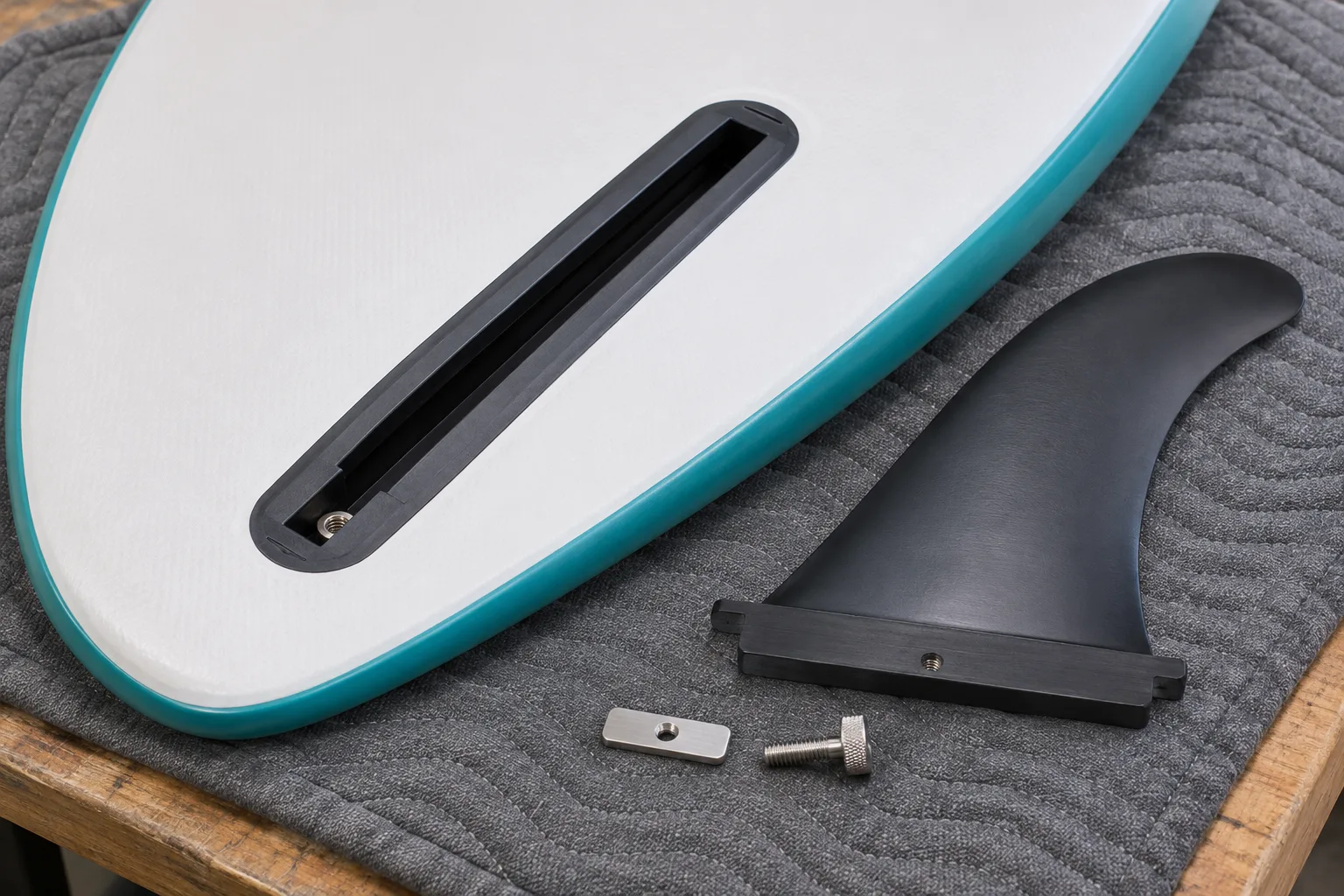
A US box is attractive because it offers a widely used channel-style interface and room to adjust the fin position on compatible boards. Yet “US box” names a fitting family rather than a guaranteed fit. Compare fin-base thickness, channel width, screw location and available box length for the exact board. The board and fin maker’s instructions decide the usable range.
Understand the parts
A typical assembly has the fin blade and base, a plate that sits in the channel, and a screw that passes through the fin’s tab into the plate. The base runs along the channel and settles at a position the box permits. Some fins place the screw at the front and some at the rear. Some boards use a tool-free screw in place of a small screw requiring a tool. If a seller shows only the blade, assume nothing about the included hardware until the listing states it.
A missing plate is a common reason a correct-looking fin stays loose. Buying the plate separately is possible for some boxes, but its dimensions and thread must match the screw and channel. Improvising a screw with the wrong thread risks damaging the plate or leaving the fin insecure. A fin that goes into the channel but cannot lock has failed the compatibility test.
Match base and board, then blade to use
Measure the old fin base where possible, not merely the visible blade height. Compare length, width, thickness and the distance from the screw hole to the ends of the base. Then compare the new fin’s specified base dimensions and hardware with the board manual. Blade dimensions alone cannot establish whether the foot fits the slot.
Aqua Marina identifies a fibreglass racing fin in its equipment range as a US fin-box item, while listing a separate slide-in river fin. These are different fitting routes for different boards and uses. Buying the “racing” one for a board with a slide-in rail would require a maker-approved adaptor or a different board box; a similar-looking blade cannot make it compatible by itself.
There are aftermarket adaptors for certain systems, but they add their own fit requirements. Use one only where the adaptor maker explicitly supports your board box and the fin you want to fit. A catalogue adaptor only covers the specific systems named in its fitting guidance.
How slide-in fins fit and lock
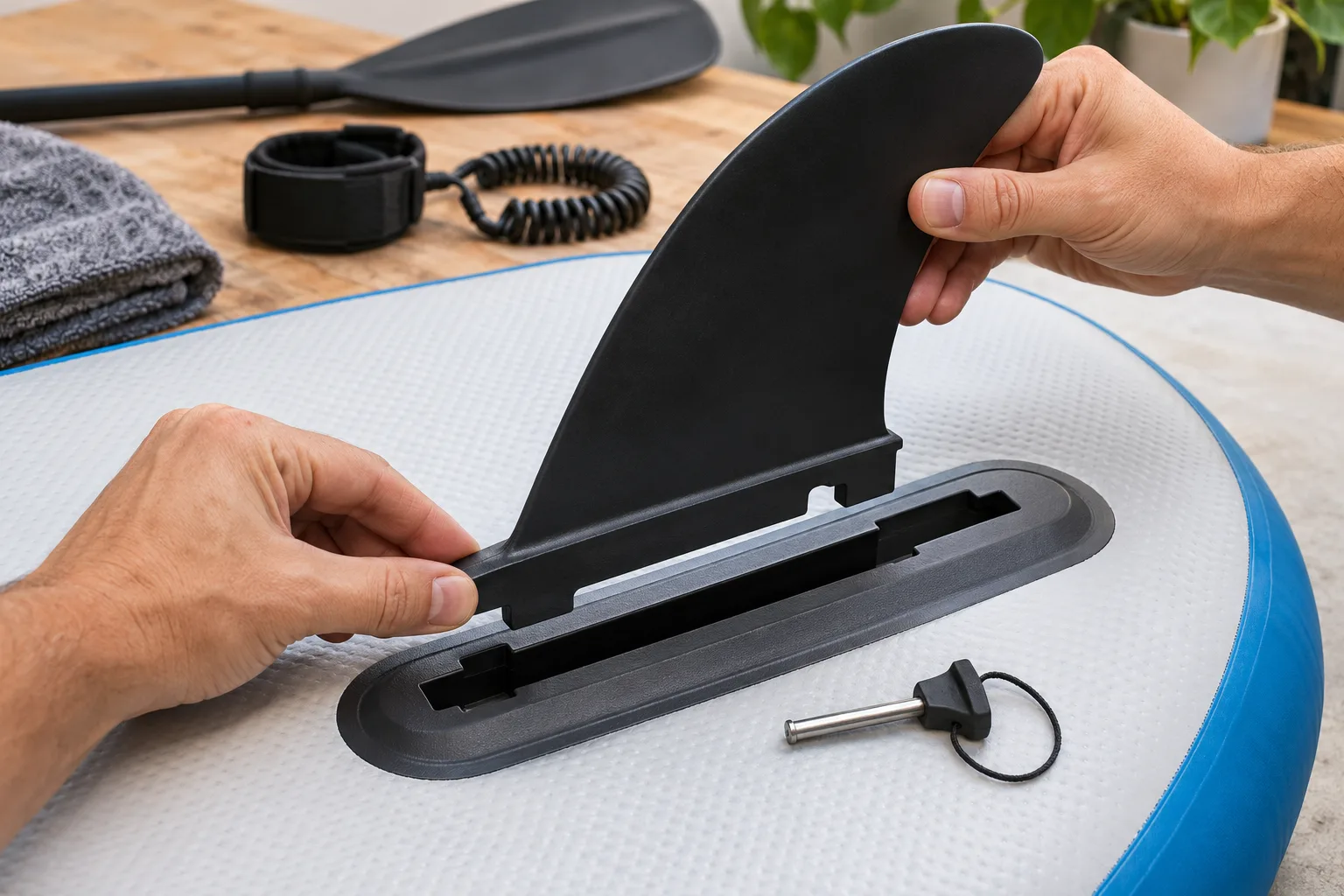
“Slide-in” describes a movement; rail and lock designs vary. Many inflatable boards use a shaped plastic fin base that enters a matching track and is held by a push-in pin or clip. Another board can call its attachment slide-in while using different rails or a different locking point. The only safe purchase shortcut is an exact model-compatible replacement from the board maker or a seller who specifies the same interface and dimensions.
Inspect rail profile and locking part
Compare the width and shape of the fin base with the opening of the box. Check whether the fin enters from the front or rear in the board instructions, and how its lock engages once fully seated. Where the design calls for a retaining pin or clip, fit it fully: an unpinned fin may leave the track in use. A tiny difference in hole position can prevent the pin seating even when the rest of the base slides into place.
Aqua Marina describes some current boards, such as the Fusion range, as having a removable slide-in centre fin for tool-free installation. Its SUP equipment catalogue also distinguishes slide-in parts from Swift Attach components. The manufacturer uses several attachment routes, and compatibility still depends on the exact box and model year.
Why board-model matching matters
Inflatable SUPs are often sold as kits, so it is tempting to search for “inflatable paddleboard fin” and buy the first cheap blade. Yet the box is bonded to the board and the fin base is moulded for a particular track. The board’s marketing name may appear on several generations, and a kit seller may change supplied hardware. Ask for the exact board model and a photograph of the underside when the original paperwork is missing.
If a listing gives no base measurements, clear underside photographs or compatibility list, it cannot resolve the fit question. A seller’s broad phrase such as “fits most SUPs” should lead to a precise follow-up: which box, which retaining pin and which board models? A trustworthy compatible part should answer those questions before it is shipped.
Compatibility checks before ordering a fin
A short evidence trail saves a wasted purchase. Work from the board outwards, then compare the proposed part with the box and old fin. Keep this as a buying check; leave the box unmodified. If the board manual is unavailable, a specialist paddle shop can often help from clear photos and measurements.
- Record the board identity: note brand, full model code, size, year if known and any label near the valve or fin box.
- Photograph the box: capture the length, opening, rail shape and each end with a ruler for scale.
- Photograph the old fin and hardware: include its base, screw and plate or retaining clip and pin.
- Check the maker’s documentation: match the exact board or fin-box model to a stated replacement part.
- Compare the proposed replacement: check base dimensions, insertion direction, hole position and included lock rather than blade length alone.
- Dry-fit gently at home: follow the manual and confirm the intended lock seats without force before taking the board to water.
Measurements that answer a real question
For a US box, useful measurements include the channel’s usable length, the fin-base width and thickness, and the screw-and-plate arrangement. For a slide-in box, compare track width and profile, base length and locking-hole position. Record measurements in millimetres and take photos rather than relying on a vague “standard size”. The right measurements depend on the design. Bring these three items to a retailer or manufacturer support desk:
- Board identity: full model code, size and approximate purchase year.
- Box evidence: clear ruler photographs of the opening, side profile and locking point.
- Original part: fin-base photos and every surviving screw, plate, clip or pin.
Use the maker’s diagram as a guide to what to compare.
If the board is an inflatable, also inspect the surrounding box bond for lifting, cracks or damage before inserting a new fin. A replacement fin cannot repair a loose box. Follow the board maker’s repair route if the box itself is compromised. Our paddleboard care guide covers cleaning and storage, which help prevent gritty tracks and avoidable damage between paddles.
What to ask the seller
Send the photos and ask: “Does this fin, with the supplied locking hardware, fit this exact board model and fin box?” Request the part number or a written compatibility list. If they can only confirm that the blade is a familiar SUP shape, the main question remains unanswered. A clear returns policy helps, but secure fit deserves evidence before ordering.
Other fin systems that can look similar
The choice is wider than a simple two-column chart. Click, quick-lock, Swift Attach, FCS-style and permanently moulded fins all exist in the SUP market. Some use a sliding motion during installation but have a distinctive latch or moulded base. A board with fixed side fins may also have a removable centre fin using another system. Identify the specific centre box before ordering.
Click and quick-lock designs
A click system may use a spring or latch instead of the loose pin associated with some slide-in designs. The fin can appear to slide partly into a track, but the latch geometry is a different fitting requirement. Red’s fin guide describes Click Fins for its Compact range and says those particular offset boxes are compatible with standard FCS fins. That is a specific manufacturer’s statement about specific boxes, not a claim that every click box accepts FCS or US-box hardware.
Aqua Marina separately lists Swift Attach parts alongside its slide-in and US-fin-box items. Treat such branded names as compatibility clues: find the matching box and listed replacement rather than substituting a visually similar part. Avoid treating “tool-free” as a technical standard. Both a sliding pin and a proprietary click latch can be tool-free while remaining incompatible.
Fixed fins and adaptors
Some inflatable boards have permanently moulded fins, at least on the sides. Red describes its iFin as a built-in design. A bent or damaged fixed fin calls for the maker’s care or repair guidance rather than a removable blade. An adaptor may make a particular removable fin family usable with a different box, but only when the adaptor’s published fit covers both sides of the connection.
This distinction is useful if you are comparing inflatable and solid paddleboards. Construction style alone cannot identify the fin fitting; check the actual board. A rigid board may have a US box, while inflatable ranges can use several removable or fixed systems.
Fitting, removal and troubleshooting
Fitting should feel deliberate and controlled. Work with the board supported, clean the box and fin base, then follow the board and fin instructions. Use the specified lock and verify it is fully engaged. A tight or gritty fit calls for cleaning and inspection. Sand, a bent pin, an incorrect base or a damaged box can all create the same symptom at first touch.
A careful home dry-fit
For a US box, confirm that the correct plate is in the channel and that the fin base and screw line up at an allowed position. Tighten according to the maker’s instructions; use the specified tightening method to avoid stripping a small screw. For a slide-in system, orient the fin as shown in the board manual, advance it along the track and seat the prescribed pin or clip completely. The exact sequence differs, so the model manual takes precedence over a generic online demonstration.
After fitting, gently test for movement in the manner the maker recommends. A little movement may be normal in some assemblies, but a fin that can slip along the track, a loose screw or a half-seated pin needs attention before launch. Check again after transport. A missing fin on the water can change tracking and handling, especially on a board designed around a centre fin.
When a fin will not enter or release
Stop if the base will not align with the track. Compare the underside of the new and old fins, clear visible grit with fresh water and inspect for a warped base or damaged rail. Leave the fin and box unmodified; seek the correctly matched replacement instead. If the original fin is stuck, follow the board maker’s removal instructions and seek a specialist if the box looks damaged. Pulling hard against a bonded inflatable-board box can turn a simple replacement into a repair.
Rinse and dry removable components after use, especially after salt water, and store the locking parts where they will be found for the next trip. Our transport and storage advice for paddleboards covers the broader packing routine; removing the fin as instructed can prevent pressure on the blade or box in a bag.
Which replacement should you choose?
If the actual board has a US box, buy a fin whose base, screw and plate are explicitly compatible with that box. If it has a slide-in track, buy the board maker’s exact replacement or a part with verified matching rail dimensions and lock. If it has a click, Swift Attach, FCS or fixed-fin system, follow that system’s own parts guidance. Blade shape comes second to interface fit.
The simplest reliable route
For a recent board, start with the manufacturer or the original retailer and the full model code. For a second-hand board with missing paperwork, photographs of the clean box and old fin base are worth more than a marketing name. A specialist UK paddle retailer can compare those details; Decathlon or the original supplier may also carry maker-specific spares for boards they sell. Ask whether the little locking piece is included, because losing a pin or plate is often the entire problem.
The biggest buying mistake is treating “slide-in” as an industry-wide plug shape. A close-looking fin can jam, fail to lock or leave the box mid-paddle. US boxes offer a broader family of compatible fins in principle, yet they still require a matching base and hardware. The practical final answer is deliberately less glamorous than a performance ranking: copy the fitting you have, verify the lock, and only then choose the blade suited to your water.
If you are considering a different board because the current fitting limits replacement choices, our inflatable paddleboard buying guide puts fin systems in the wider context of board use. Replacing a fin alone should remain a precise parts decision.
Frequently Asked Questions
Can a US-box fin fit a slide-in SUP box? Generally no: the base and locking hardware differ. Use a manufacturer-approved adaptor only if it explicitly matches the board box and the intended fin.
Are all slide-in paddleboard fins interchangeable? No. Rail profile, base dimensions, insertion direction and locking-pin or clip position can vary. Match the exact board model or verify all interface details.
How can I tell whether my board has a US box? Inspect the clean underside for a long channel that accepts a fin base plus a retaining plate and screw, then confirm the fitting in the manual for the board’s exact model.
What if I have lost the fin’s screw or pin? Identify the box and original hardware before buying a replacement. A correct blade without its specified plate, screw, pin or clip may not lock securely.
Should a new fin need force to slide into its box? No. Stop, clean the track and compare the new base with the old one and the maker’s fit instructions. Forcing an uncertain part can damage the fin or box.
Does a fin’s blade length prove it will fit? No. Blade length relates to use in the water; compatibility depends first on the base, box and locking hardware.