J-Cradle vs Flat Kayak Roof Rack comes down to roof space, hull support and a lift you can manage: a J-cradle saves bar width by carrying a kayak on its edge; flat saddles support it horizontally and can make rear loading more manageable. For one heavy or awkward boat, I would start with correctly matched cushioned saddles. For two lighter kayaks on compatible bars, J-cradles often make better use of the roof. The right answer still depends on the boat, vehicle, rack and the person lifting it.
In This Article
- J-Cradle vs Flat Kayak Roof Rack: the practical difference
- Which carrier fits your kayak hull and weight?
- Roof space, bar fit and vehicle limits
- Which is easier to load on your own?
- Securing the kayak and checking road clearance
- Where J-cradles work better
- Where flat saddles work better
- Final choice and pre-trip checklist
- Frequently Asked Questions
J-Cradle vs Flat Kayak Roof Rack: the practical difference
The decision is about the position and support of the kayak, rather than a claim that one rack is universally safer. A J-cradle holds the boat at an angle against an upright, leaving more usable bar width beside it. A flat carrier usually means a pair of shaped, cushioned saddles that support the hull horizontally. It may include rollers or another loading aid. Both styles need a correctly fitted roof-bar system and a restraint method approved for the particular carrier.
Flat saddles are different from bare crossbars
A kayak lying directly on unpadded crossbars has a very different support surface from purpose-made flat saddles. Shaped pads distribute contact across the part of the hull they are designed to hold; bare bars create narrow contact points and offer no cradle profile. Some manufacturers sell separate padded supports or foam blocks for specific uses, but their instructions and ratings still matter. Do not turn a general preference for horizontal transport into permission to strap any hull straight onto bare metal.
Thule’s kayak-carrier guide distinguishes vertical/J-shaped carrying from horizontal carriers, and describes cushioned, adjustable saddles on its DockGrip. Its examples show the geometry; confirm any named unit against your own car and boat.
Think of the whole system
There are four interfaces to check: kayak to carrier, carrier to crossbar, crossbar to vehicle, and restraint to suitable points. A good-looking cradle can fail the buying test at any one of those interfaces. Width matters, but so do bar shape, usable bar length, front-to-rear bar spacing and permitted loads. The boat’s real carrying weight includes attached gear that stays with it on the roof.
For a beginner choosing a boat as well as a rack, our guide to choosing a first kayak helps separate inflatable, sit-on-top and enclosed-hull trade-offs. Base the roof-carrying decision on the actual boat specification.
Which carrier fits your kayak hull and weight?
Start with the kayak manual and the carrier’s published boat-width, weight and hull guidance. A broad fishing sit-on-top, a narrow sea kayak and an inflatable all present different support surfaces. A photograph alone cannot show whether the hull will settle securely in a given cradle. Some hulls have pronounced chines, keels or fittings that influence where the supports can contact them.
Check the contact points before the capacity number
For a J-cradle, confirm where its padded arms meet the kayak when the boat is at the intended angle. The hull should rest in the supported position described by the manufacturer, without a rail, handle, rudder assembly or fragile fitting taking the load. A saddle needs its supports adjusted to the hull shape within the maker’s adjustment range. Some are made to pivot; others use a fixed pad. A mismatch is a reason to choose another carrier, even when the headline weight rating looks generous.
J-cradles suit smaller or lighter boats for side loading, while saddles hold the boat flat and some permit rear loading. Thule’s guide shows these as distinct ways of carrying a kayak. That is a useful starting distinction, but the exact kayak and carrier manuals take precedence.
Check the kayak’s own weight and its payload rating separately
The kayak’s own weight and its maximum paddler-and-gear capacity are different numbers. Look for the boat’s unloaded weight, then account for anything deliberately left fitted: seat, rudder, fishing rails or other accessories. Remove loose kit before driving. Our kayak weight-limits explainer discusses on-water capacity, which is a separate limit from roof transport.
A long or wide boat can be awkward even when it sits below a carrier’s stated maximum. It may exceed the carrier’s width guidance or be difficult to position without scraping the vehicle. If the maker lists a boat-length or hull-shape restriction, treat that as a fitting rule. A high capacity number cannot override a poor physical fit.
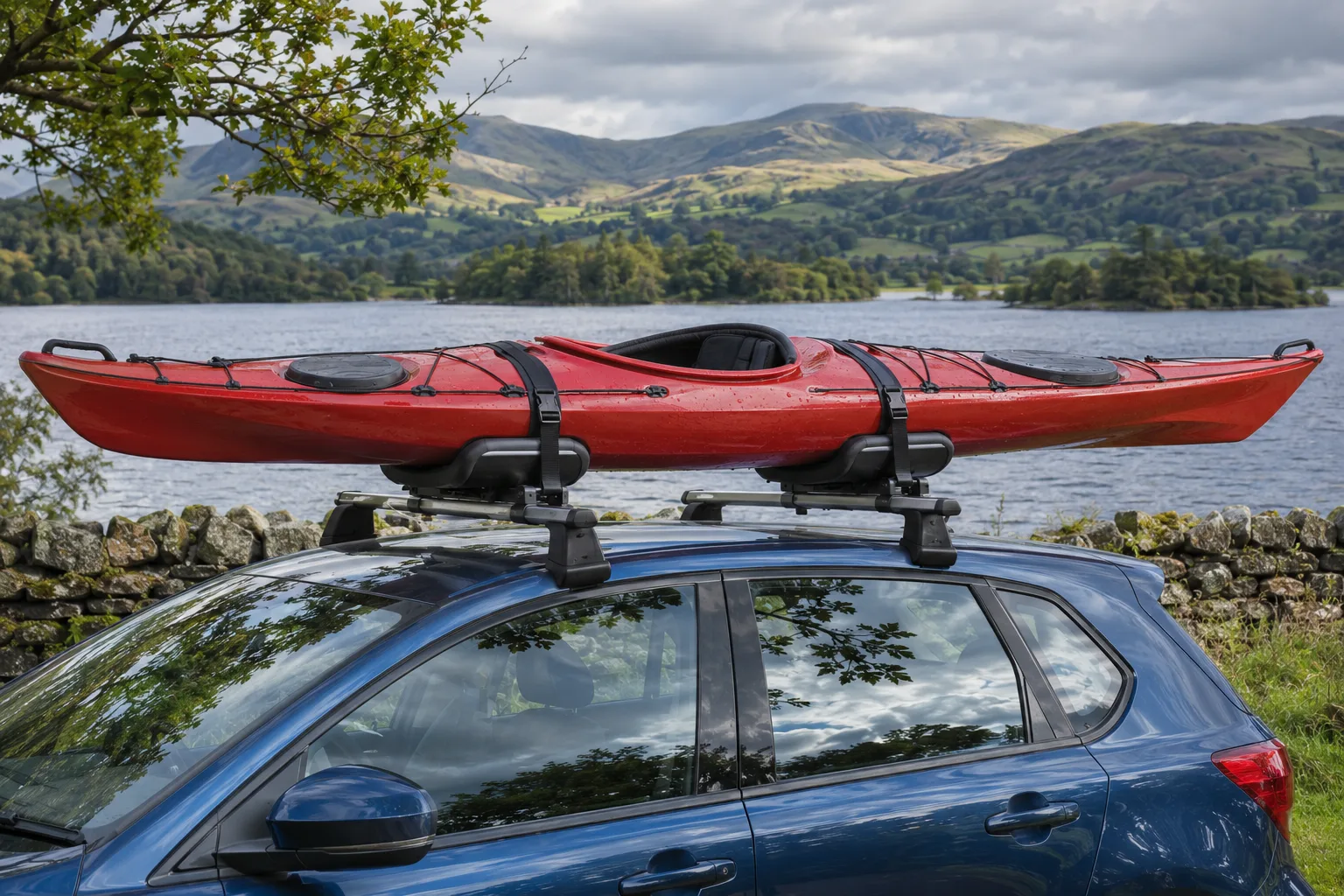
Roof space, bar fit and vehicle limits
J-cradles win their clearest advantage when roof width is scarce. Carrying the kayak angled may leave room for a second carrier or compatible accessory. Flat saddles occupy more width because the boat lies across the bars. Neither arrangement guarantees a two-kayak setup: the available bar length, approved mounting positions, boat widths and total load must all work together.
Confirm the bar fitting first
Crossbars vary in profile and dimensions. A carrier may use clamps, a T-track fitting or different hardware for different bars. Check the carrier maker’s fitting list and the bar maker’s permitted mounting position. Flush-ended bars can leave less accessible length than bars that extend beyond their feet. If you already own a roof box or bike carrier, measure the usable bar space with those mounts in place rather than dividing a catalogue bar width by two.
Carrier fittings must match the roof bars; longer through-bars can also ease access during loading. A dealer fit checker narrows options; the exact car and rack instructions settle installation details. Glass roof, roof-rail and bar-foot variations are vehicle-specific. There is no reliable universal layout diagram for all cars.
Roof load is a combined limit
Add the weight of the crossbars, both carriers, both kayaks and anything else mounted on the roof. Then compare that total with the permitted vehicle roof load, the rack-system limit and each carrier’s individual rating. The lowest applicable limit governs. Thule’s roof-rack guidance explicitly points readers to both the vehicle and rack capacities and says to include carriers and cargo in the calculation. The owner’s manual and current fitting instructions supply the figures for your exact setup.
For example, two boats that individually fit two cradles could still make the complete roof system too heavy. Conversely, a low roof-load allowance may rule out a heavier loading-assist assembly before the kayak is added. Avoid copying another driver’s roof-load number, even for a similar-looking car. Model year, roof configuration and rack kit can change the answer.
A kayak also projects beyond the support points. Assess its position relative to the front and rear of the vehicle, hatch opening, aerial and any accessories using the relevant carrier and vehicle instructions. Keep to the approved bar span and overhang in the relevant instructions.
Which is easier to load on your own?
The easiest carrier is the one you can load and secure without losing control of the boat. Body height, car roof height, kayak weight and access around the parked vehicle matter as much as the carrier shape. The sensible test happens at home with a helper available, before a windy launch-site car park makes the decision for you.
Side loading a J-cradle
Most J-cradles are approached from the side. A lighter kayak on a lower vehicle can be lifted into the angled cradle with a controlled movement. The upright then helps hold the boat while straps are arranged. The drawback is the height and reach needed to raise the boat over the outer arm. A broad or heavy kayak can make that movement unstable. Two people may be the right loading method even when one person can technically lift the boat off the ground.
Take care around doors, mirrors and roof edges. Set down and reposition if the lift starts to twist. A folding cradle can be convenient when empty; the loaded boat may still need a full-height lift. Check the carrier’s instructions for its loading position and lock state.
Rear loading onto saddles
Some flat systems permit a kayak to be slid forward from behind the car, potentially with a roller or rear support. This can reduce the overhead lift: one end rests on a protected support while the other end is advanced. The rear bar position affects whether this works; check the loading route for the exact vehicle and carrier. A rear-loading claim is therefore a feature of a particular vehicle and carrier combination, not all flat racks.
Protect the vehicle at the contact points specified by the loading-aid maker. Check hatch clearance before sliding a long boat forward. If the kayak has a rudder, skeg or projecting fitting, plan where that fitting travels during loading. A supposedly easy slide can damage a hull if the path catches a hard edge.
When neither feels manageable
A heavy fishing kayak on a tall SUV may be an awkward solo load in either style. A purpose-designed lift-assist system, a second person or a different transport plan may be more sensible than choosing whichever carrier advertises the bigger number. Make the decision based on a realistic lift under your own conditions. Keep the kayak under control through the whole movement, including unloading after the trip when you may be tired.
Securing the kayak and checking road clearance
Once the boat is supported, the restraints keep it there. Use the straps, routing, attachment points and any front-and-rear lines required by the carrier and kayak makers. A strap wrapped around the boat in a plausible-looking way is no substitute for the actual instructions. Keep buckles away from paint and inspect the strap path for twists, sharp edges and moving parts.
Restraint is more than downward pressure
The carrier’s prescribed straps should hold the kayak against its supports without crushing the hull. Some boat shapes and materials need particular care around deformation, especially when stored or transported warm. Follow the boat maker’s guidance on support and strap tension. After securing, check for movement in the directions the carrier instructions specify, then stop safely to recheck after the first part of the journey and at sensible intervals.
Some carrier instructions require bow and stern tie-downs to approved vehicle attachment points. Thule’s rack guidelines explain that the vehicle’s lower maximum roof load applies and that fittings and straps should be checked before trips. The exact tie-down method varies by product. Ask the rack supplier or vehicle maker if you cannot identify a suitable attachment point; tying to an arbitrary trim piece is a poor substitute.
A cockpit cover may help prevent rainwater collecting in a horizontally carried open cockpit. A water-filled kayak can overload the roof and make unloading difficult. Treat this as a weather and boat-design check, and follow the cover maker’s travel guidance so the cover itself remains secure. Remove loose gear from the cockpit in either orientation.
Height and movement change on the road
A J-cradle can increase loaded height; flat transport uses more width but may sit lower. Measure the complete loaded height for car parks, garages and barriers rather than assuming either will clear. Watch for the kayak or carrier interfering with an opened tailgate. Roof loads can affect handling in wind and under braking, so the first trip deserves a cautious route and regular checks. The rack’s speed and driving guidance is the authority for its particular assembly.
If the kayak is part of a wider trip with paddleboards, the paddleboard transport and storage guide covers that separate craft. A convertible carrier may handle both in maker-approved modes; check the exact SUP setting before using it.
Where J-cradles work better
Choose a J-cradle when a lighter kayak is within its published limits, side loading is realistic, the hull sits correctly against the supports and you need the bar width for another approved load. This is the typical two-kayak use case. It can also work well for one boat beside a roof-box or bike-carrier mount if the full layout and load limits check out.
The strongest case: two suitable boats
Two smaller kayaks on a vehicle with enough roof capacity can make the angled layout worthwhile. The advantage is roof-space efficiency; the load allowance remains unchanged. Each cradle needs compatible crossbar mounts and enough clearance to route straps correctly. Confirm the two boats do not touch each other or the vehicle when secured, and that opening doors and the tailgate remains practical. The tandem kayak guide is useful if you are considering one larger two-person boat instead of two smaller ones; its weight and shape would lead to a different roof decision.
Where the advantage disappears
If the boat is too heavy to lift confidently from the side, saved bar width is of little value. A tall roof magnifies that problem. A J-cradle can also be the wrong fit for a broad hull, an unusually shaped gunwale or a kayak with attachments that contact the carrier arm. Folding the empty carrier flat may reduce its profile between journeys. Verify the maker’s instructions for empty and loaded positions before driving.
Three conditions make the J-cradle case strongest:
- Lift: each paddler can raise their boat into its angled support with control.
- Fit: both hulls, mounts and restraint routes meet the carrier instructions.
- Capacity: the complete roof load remains inside the lowest applicable limit.
The most common switching mistake is buying a J-cradle after seeing that it can fit two boats, while skipping the weight and loading calculation. Start with the boats and the vehicle. Only then choose the space-saving geometry.
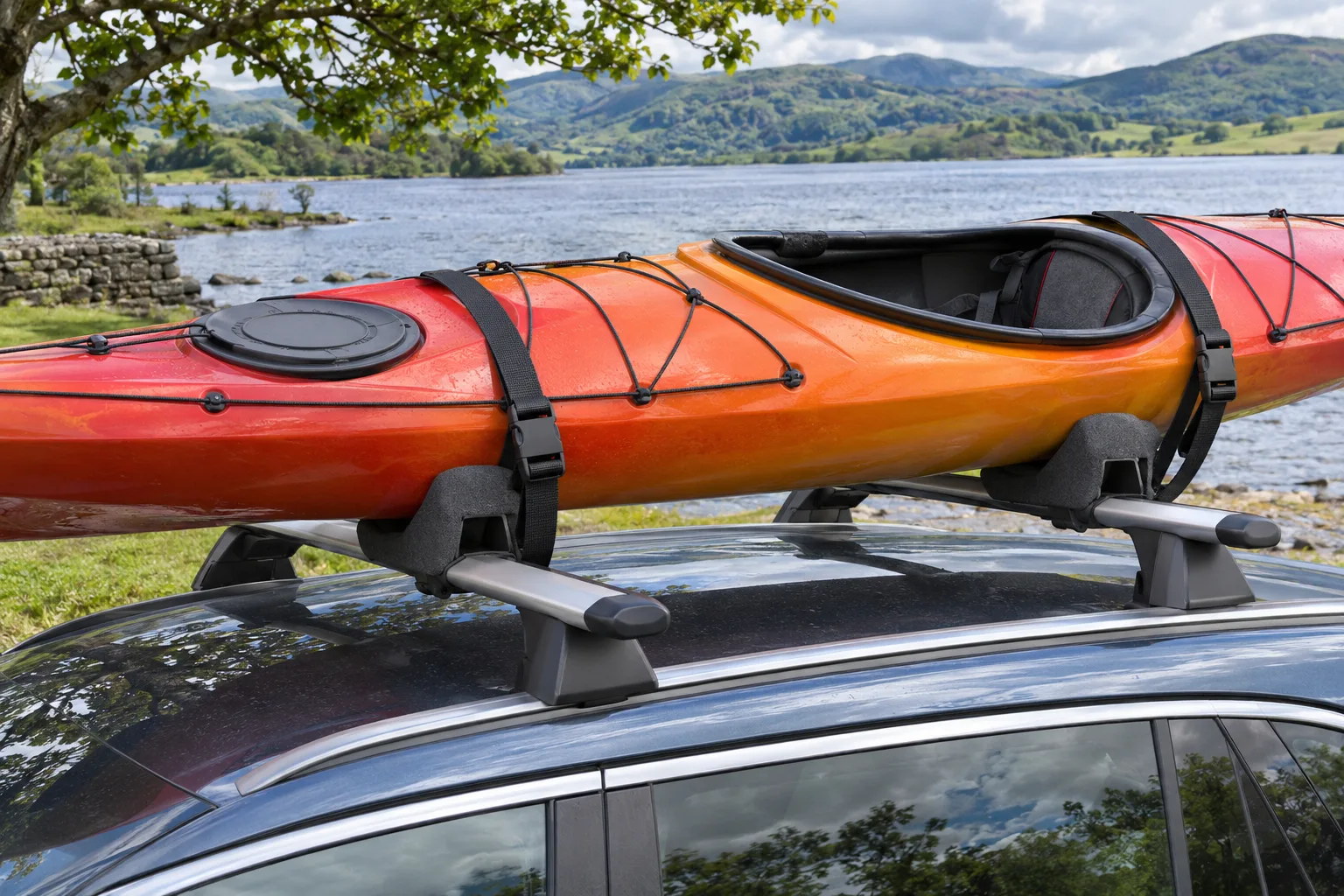
Where flat saddles work better
For one kayak, a properly matched cushioned saddle setup is my first option when it offers broad, stable hull support and a loading route the driver can repeat. It uses more roof space, but that cost may be irrelevant if the kayak is the only item on the bars. Rear loading can be especially helpful where the car and carrier permit a protected slide onto the rear supports.
A useful choice for a heavier or awkward hull
A heavy boat still has to be raised to roof level, and the complete roof-load calculation still applies. An overweight kayak still exceeds the applicable roof limit. The saddles’ benefit is horizontal support and, for some systems, the ability to move the boat gradually rather than lift it into an angled holder in one motion. Adjust the pads to the hull as instructed and confirm the boat cannot rock on a keel or hard fitting.
Flat carrying is also easy to confuse with improvised padding. Cushioned saddles are purpose-built contact supports; a towel over the crossbars is neither a fitting specification nor a restraint plan. If a boat maker recommends a particular orientation or support spacing, honour that before deciding between styles. An inflatable kayak can need its own transport and pressure guidance, and may be simpler to deflate for travel. Our inflatable versus hard-shell kayak comparison explains the wider storage and transport trade-off.
When to pass on a flat carrier
If you need two boats and have limited usable bar width, two horizontal positions may be impractical even when the weight limit allows them. A saddle assembly can also interfere with another roof accessory or demand a rear loading path blocked by a hatch, spare wheel or spoiler. Check the actual vehicle geometry before paying for rollers that cannot reach the boat. A dealer demonstration with the boat dimensions is more useful than a generic photograph.
Final choice and pre-trip checklist
Pick J-cradles for roof-space efficiency with lighter, compatible kayaks that you can load from the side. Pick cushioned flat saddles for one boat when hull support and a feasible horizontal or rear-loading route matter more than remaining bar width. If neither passes the fit, load and handling checks, change the transport plan rather than forcing a choice between two unsuitable carriers.
Before ordering, work through these checks in sequence:
- Identify the exact kayak: record its weight, width, hull features and any transport instructions.
- Identify the exact vehicle and bars: confirm a maker-approved roof-rack fit, usable bar length and permitted load.
- Compare carrier limits: check boat width, weight, support contact, crossbar fittings and required bar spacing.
- Plan the lift: rehearse the side or rear loading path, allowing for the actual car height and any protruding fittings.
- Plan restraints: obtain the specified straps and any required bow-and-stern lines and identify approved attachment points.
- Check the loaded vehicle: measure height and clearance, remove loose gear, inspect strap routes and schedule a safe early recheck.
These questions prevent the expensive mistake: selecting a carrier from a picture of how the kayak sits, while leaving compatibility and loading for the day of the trip. The best roof rack is the one that fits the complete system and that you can use correctly every time.
Frequently Asked Questions
Is a J-cradle better than a flat kayak rack for two kayaks? It can be, because angled carrying uses less bar width. Both kayaks, both carriers, the bars and the vehicle must still pass their individual fit and combined-load checks.
Are flat saddles the same as putting a kayak directly on roof bars? No. Saddles are shaped, cushioned supports designed for a particular hull and carrier system. Bare bars provide different contact points and need their own manufacturer-approved transport method.
Which style is easier for one person to load? A suitable saddle with a protected rear-loading aid may reduce the lift, while a small kayak on a low car may be easy to side-load into a J-cradle. Try the actual boat-and-vehicle movement safely before relying on solo loading.
Can I use a J-cradle with a heavy fishing kayak? Only if its exact weight, width, hull shape and fittings meet the carrier instructions and the full roof system meets the vehicle limit. A heavy, broad boat may also be difficult to lift into the cradle safely.
Do I need front and rear lines for a kayak on the roof? Follow the carrier and boat makers’ instructions. Some systems require bow and stern tie-downs to suitable vehicle points; the strap arrangement is product-specific.
What roof-load number should I use? Use the lowest applicable limit from the exact vehicle, roof-bar system and carrier instructions. Include the bars, carriers, kayaks and other roof cargo in the calculation.