Transport and store a paddleboard badly and it will punish you with bent fins, mildew, rail dings or a roof-rack panic five minutes from the beach. The right method depends on one simple split: inflatable SUPs are easiest when dried, loosely folded and carried in a proper bag, while hard boards need padding, straps and a storage spot where nothing can fall on them.
In This Article
- How to Transport and Store a Paddleboard: The Quick Answer
- Choose the Right Transport Method
- How to Strap a Paddleboard to a Car
- Dry and Clean the Board Before Storage
- Store an Inflatable Paddleboard at Home
- Store a Hard Paddleboard Without Dings
- Travelling by Train, Bus or on Foot
- Mistakes That Damage Boards
- What I Would Buy First
- Frequently Asked Questions
How to Transport and Store a Paddleboard: The Quick Answer
If you own an inflatable SUP, the neatest routine is to rinse it, dry it, remove the fin, let a little pressure out, then fold it into its bag without crushing the same crease every time. If you own a hard board, treat it more like a long, fragile piece of furniture: padded roof bars for the journey, then a wall rack, ceiling sling or padded side storage at home.
The big mistake is thinking the board is tough because it survived a few knocks on the water. Most damage happens away from the water: a hot car park, an over-tight cam strap, a damp bag in the cupboard, a shed hook pressing into the rail, or a fin left attached while the board is shoved into the boot.
For most UK paddlers, I would start with a decent SUP bag, two wide cam straps, foam roof-bar pads and a drying towel. That is about £45-£90 if you already have roof bars, or £120-£250 if you need vehicle-specific bars from Halfords or a Thule-style setup. A wall rack adds another £35-£90, depending on whether you buy a basic Amazon UK pair or a heavier wooden/metal rack.
This guide sits alongside our wider advice on how to choose a paddleboard, but the focus here is narrower: getting the board to the water and storing it without shortening its life.
Choose the Right Transport Method
There is no single best way to move a paddleboard. The best option is the one that suits your board type, car, distance from the water and how much faff you will put up with after a paddle.
Inflatable SUP in its backpack
For inflatable boards, the backpack is still the easiest option for most local trips. A typical 10ft 6in all-round inflatable weighs 8-11kg, and the full bag with pump, paddle, leash and buoyancy aid can creep towards 14-17kg. You can walk that from a car park to the river. You will not enjoy carrying it across town.
Budget boards often come with thin rucksack straps and floppy bags. They work, but after a few longer carries they feel cheap. A better padded SUP backpack costs about £45-£80 from Decathlon, Amazon UK or specialist paddle shops, and it is worth it if your launch spot is more than a few minutes from the car.
The best habit is to pack the bag in the same order every time:
- Board first: loosely folded, fin box protected and valve closed.
- Pump down one side: not jammed across the board where it creates pressure marks.
- Paddle in sections: rinsed and dried so the adjuster does not seize.
- Leash and fin in a pouch: small parts disappear fast in boot clutter.
- Buoyancy aid at the top: easy to grab before you walk to the water.
Inflated board on roof bars
Carrying an inflated SUP on roof bars is quicker if you paddle often. You avoid the pump session at the start and the slow deflation at the end. It also makes sense if you have a rigid board, where roof transport is usually the only realistic car option.
Use proper roof bars, not a bare roof unless you are only doing a very short low-speed trip with a soft-rack system. Foam pads cost around £10-£25 from Decathlon, Lomo, Amazon UK or paddle shops. Wide cam straps are usually £8-£20 a pair. Avoid ratchet straps unless you are very controlled with tension; they can crush rails and mark inflatable boards.
The board should sit deck-down or deck-up depending on shape and rack, but the key is contact. It must not rock side to side when you pull it. If it moves in the car park, it will move more at 50mph.
Trolley or shoulder strap
A SUP trolley is useful for hard boards, heavier inflatables and long canal walks. Cheap trolleys start around £35-£50 on Amazon UK. Better balloon-wheel versions for soft ground and shingle can be £80-£150. The cheap ones are fine on tarmac, but they rattle and tip on rutted paths.
For an inflatable, a shoulder carry strap is the lower-cost fix. Decathlon’s rigid/inflatable SUP carry strap is usually around £14.99, and similar straps on Amazon UK sit around £12-£25. They make a short walk much easier, though they do not replace a trolley if you are carrying family kit as well.
Van or estate car
If the board fits inside, protect both the board and the car. Remove the fin, slide the board in nose first, and pad any contact points. A hard board sticking between seats is asking for a rail ding when someone moves a bag or closes a door.
Do not leave an inflated board in a hot car for hours. Air expands as temperature rises, and a fully inflated SUP in a sealed vehicle can put extra stress on seams. After a summer paddle, I would rather let a little pressure out than gamble on the boot turning into a greenhouse.
How to Strap a Paddleboard to a Car
Roof transport is where most people get nervous. That is fair. A paddleboard is long, light and good at catching wind. The answer is not brute force; it is even support, clean strap angles and a final check that feels boringly secure.
The Canal & River Trust’s paddling safety guidance says paddlers should make sure their craft is suitable and check local waterway rules before setting out. I would apply the same mindset before the drive: a safe paddle starts before the board touches water.
The car loading sequence
Use one continuous process, not a half-loaded board while you hunt for straps.
- Fit roof bars and pads first. Check the bars are locked, centred and rated for the load. Most SUPs are light, but the bars still need proper vehicle fittings.
- Remove the fin. A fin left attached can crack the box, catch on a strap or scrape the roof.
- Lift with two people if possible. Hard boards are awkward rather than heavy. One person at each end saves rails, mirrors and tempers.
- Centre the board on the bars. Keep the overhang balanced and avoid resting the widest point on one narrow pressure spot.
- Run two cam straps over the board. One strap near each roof bar. The buckle should sit away from the rail, ideally with a small pad under it.
- Tighten by hand. Pull until the board no longer shifts, then stop. If the rail visibly compresses, you have gone too far.
- Tie off loose strap ends. Flapping straps are noisy and can mark paintwork.
- Do a shake test. Hold the board and move it side to side. The car should move with it.
For motorway trips or long hard boards, add bow and stern lines. They are cheap, usually £8-£20, and they stop the board yawing in crosswinds. Use proper bonnet/boot anchor loops if your car has nowhere sensible to tie off.
Soft racks are a compromise
Inflatable soft racks, often £50-£80 from HandiWorld, Aquaplanet or Decathlon marketplace sellers, are useful if you do not have fixed roof bars. I would use them for occasional trips, not as the best long-term answer for weekly paddling. They can work well, but they depend on clean strap routing through the cabin and careful tightening.
If rainwater drips down the straps into the car, that is normal with some soft racks. Annoying, but normal.
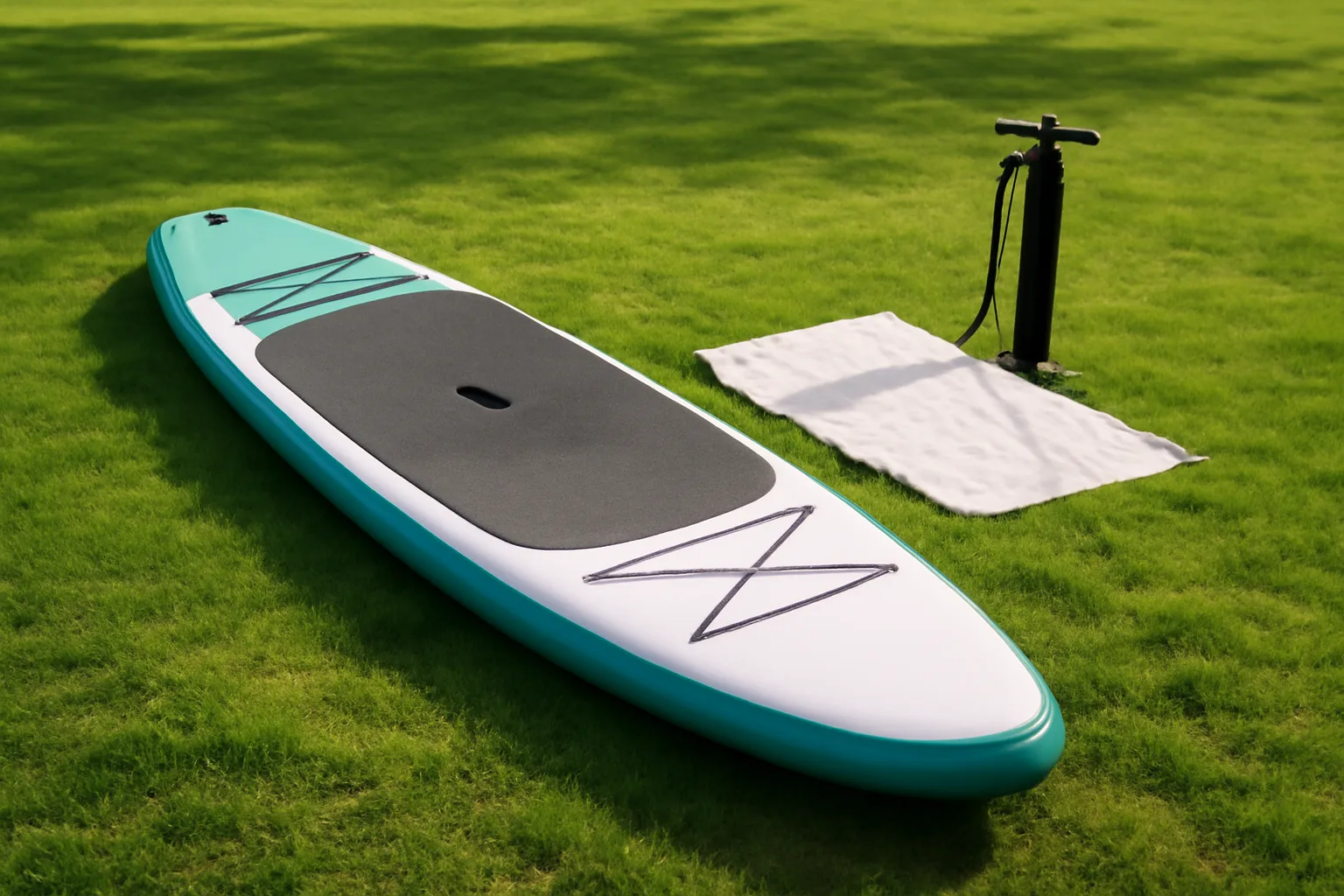
Dry and Clean the Board Before Storage
Storage starts at the launch spot. If the board goes away wet and gritty, the bag becomes a damp sanding sleeve.
Give the board a quick rinse when you can, especially after salt water, silty canals or weedy lakes. You do not need a full spa treatment after every paddle. You do need to remove grit from the fin box, leash plug, valve area and deck pad.
The five-minute clean-down
Keep a cheap microfibre towel in the boot. A big drying towel from Decathlon or Amazon UK costs about £8-£20 and earns its keep quickly.
- Rinse the fin box: grit here makes fins stiff and can damage the slot.
- Wipe the deck pad: mud dries into the texture and is harder to remove later.
- Dry around the valve: trapped water here often ends up inside the folded board.
- Check the seams: look for lifting edges, bubbles or fresh scuffs.
- Air the leash: a wet coiled leash left in a bag starts to smell grim.
For salt water, rinse the paddle as well. Adjustable paddle shafts can seize if salt dries inside the clamp. I have seen people blame the paddle when the real issue was six months of sea water and no rinse.
Store an Inflatable Paddleboard at Home
Inflatable boards are forgiving, but they still hate damp, heat and sharp folds. The best storage method depends on how often you paddle.
Short-term storage between regular paddles
If you paddle every week, you can store the board lightly inflated. Let it down from full pressure, keep it out of direct sun, and support it along its length. A 12-15 PSI board does not need to sit at full pressure in a shed all week.
Indoors is better than a shed if you have space. UK sheds swing from cold and damp in winter to hot and stuffy in summer. That is not kind to glued seams, deck pads or cheap bags.
If the board must live in a shed, put it in a breathable bag or cover and keep it off the concrete floor. A pair of padded wall hooks costs about £20-£45. A freestanding rack is more like £50-£120, but it avoids drilling into rented walls.
Long-term winter storage
For winter, clean the board properly, dry it fully and fold it loosely. Do not cinch the compression straps as tight as possible just because the bag allows it. That saves cupboard space but creates hard creases.
Leave the valve closed once the board is dry. Store the pump hose detached rather than bent sharply in the bag. Keep the fin flat or in a pouch so it does not warp under the board.
This is also the moment to check your board against our SUP board weight limit guide. If the board has been flexing under load all summer, storage is not the only reason it may be looking tired.
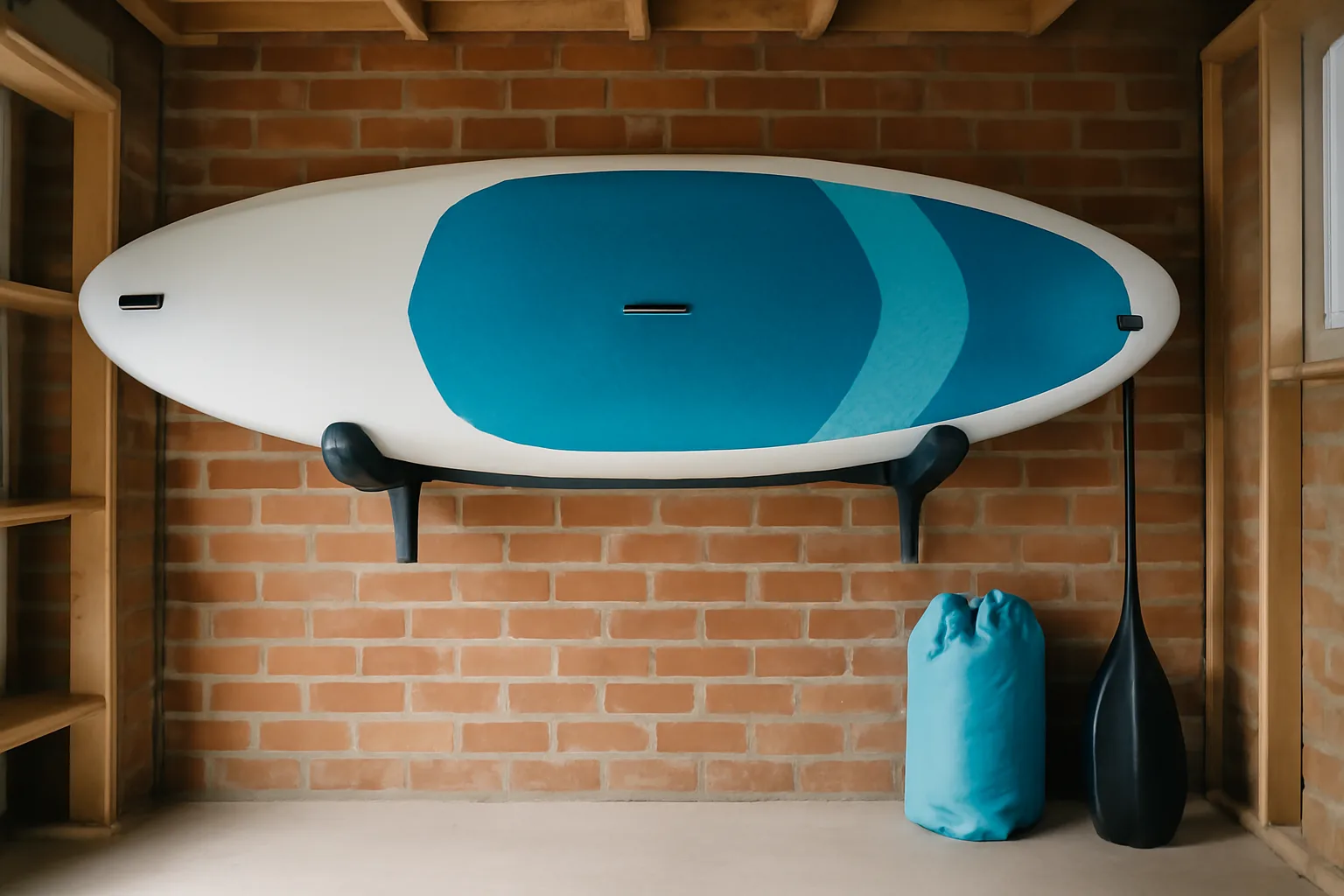
Store a Hard Paddleboard Without Dings
Hard boards are less faff on the water and more demanding at home. They do not fold, they do not like falling over, and a small knock on a rail can let water into the core if ignored.
Wall rack, ceiling sling or padded floor storage
A wall rack is usually the best answer. Basic foam-padded metal arms cost around £30-£60 on Amazon UK. Nicer wooden racks can be £70-£150 from surf and SUP specialists. Mount into studs or masonry, not just plasterboard. A 12kg board falling off the wall is not a subtle event.
Ceiling slings work in garages where wall space is gone. They keep the board clear of bikes, lawnmowers and footballs, but they need careful installation. Cheap pulley systems start around £25-£40; heavier-duty versions can be £60-£100.
If the board must sit on the floor, store it on its rail with padding under pressure points, not flat under a pile of camping gear. Keep it away from radiators, boiler cupboards and sunny conservatory glass.
Repair small damage before storage
Do not store a hard board with an open ding. Dry it, repair it or get it checked. A small rail chip can become a waterlogged board if it spends winter in a damp garage.
For kit choices, our guides to paddleboard bags and waterproof bags for paddling cover buying decisions in more depth. Here, the rule is simple: padding prevents damage; waterproofing protects accessories; ventilation prevents smells.
Travelling by Train, Bus or on Foot
Public transport is easiest with an inflatable board, but you still need to be realistic. A packed SUP bag is large enough to annoy people on a busy train and heavy enough to make a long platform change feel like punishment.
Check the operator’s luggage rules before travelling. Some trains are fine with large sports bags when quiet. Some bus drivers will take one look and decide today is not your day.
For train trips, I would pack lighter than usual:
- Three-piece paddle: easier to fit inside the bag cleanly.
- Compact pump: slower than a big dual-action pump, but less bulky.
- Dry bag for wet kit: around £10-£30 from Decathlon, Go Outdoors or Amazon UK.
- Separate buoyancy aid carry: clipping it outside the SUP bag saves space but catches on things.
- Small repair kit: patches, valve key and fin screw if your setup needs one.
If you are paddling canals, check licence requirements before the trip. The Canal & River Trust explains that portable unpowered craft, including paddleboards, need a small craft licence on its waterways. Paddle UK membership can include a waterways licence for many managed waterways, which may work out cheaper if you paddle often.
On foot, a trolley beats heroic carrying. A £40 trolley that saves your back is better value than a premium carbon paddle you are too tired to use properly.
Mistakes That Damage Boards
Most transport and storage mistakes are small, repeated ones. They do not look dramatic on day one. Then a season later the board has pressure marks, a bent fin, a peeling deck pad or a bag that smells like an old towel.
Over-tightening straps
This is the classic roof-rack error. People worry the board will fly away, so they crank the straps until the rail compresses. Use wide cam straps and hand tension. The board should be secure, not strangled.
Leaving boards in heat
Inflatable boards and direct heat are a poor mix. Avoid leaving a fully inflated board in a hot car, against a sunny window or under a dark cover in full sun. Let a little pressure out if the board will sit around between sessions.
Folding the same crease every time
Inflatables are designed to fold, but repeated hard creases are still not ideal. Vary the fold slightly and avoid trapping the fin box or valve area under heavy pressure.
Storing wet kit in sealed bags
A wet board in a sealed bag will smell. A wet leash and buoyancy aid are worse. The safety kit matters as much as the board, so dry it properly. If you are reviewing your setup, our buoyancy aid guide explains fit and use in more detail.
Ignoring the paddle
The paddle gets forgotten because it is not the expensive-looking bit. Rinse it, dry it and loosen the clamp before long storage. Aluminium paddles are cheap, often £25-£45, but a seized adjuster is still irritating when the sun is out and everyone else is ready.
What I Would Buy First
If you are starting from scratch, do not buy every accessory in one go. Buy the items that prevent the most common damage and make paddling less annoying.
My first purchases would be:
- Wide cam straps: £8-£20 a pair from Decathlon, Lomo, Amazon UK or Go Outdoors.
- Roof-bar pads: £10-£25 for basic foam pads; worth it even with tough boards.
- Large drying towel: £8-£20; boring, cheap and used every trip.
- Dry bag: £10-£30 for keys, phone pouch, layers and wet bits.
- Wall hooks or rack: £20-£90 depending on board weight and wall type.
- Carry strap or trolley: £15 for a shoulder strap, £35-£150 for a trolley.
I would not rush into an expensive electric pump unless you paddle often. A decent 12V pump is usually £60-£130 from Amazon UK, Decathlon or specialist SUP shops. Lovely to have, yes. But straps, pads and dry storage protect the board every single time.
The same applies to premium bags. If your board already has a usable backpack, spend the first upgrade money on transport and storage basics. Once you know your routine, you can decide whether a better wheeled bag belongs on the list.
For most people, the best setup is modest: board in a ventilated bag, accessories dry, straps kept in the car, rack ready at home. It is not glamorous. It is why the board still looks good three summers later.
Frequently Asked Questions
Can I leave an inflatable paddleboard inflated all summer? You can leave it lightly inflated between regular paddles, but do not store it at full pressure in direct sun or a hot shed. Let some air out and support it properly.
Is it safe to put an inflatable paddleboard on roof bars? Yes, for sensible journeys, if you use padded roof bars, wide cam straps and moderate tension. Remove the fin and check the board cannot move before driving.
Should I store a paddleboard folded or rolled? Fold an inflatable loosely along its natural fold lines, avoiding hard repeated creases. Hard boards should be stored supported on a rack, sling or padded rail edge.
Can I store a paddleboard in a shed? Yes, but keep it dry, ventilated, off the floor and away from sharp tools or heavy items. UK sheds can get damp, so air the bag and check for mildew during winter.
Do I need a paddleboard bag? Inflatable boards are much easier with a proper backpack bag. Hard boards benefit from a padded day bag for car transport and storage, but a wall rack matters more at home.
How much does paddleboard storage gear cost? Basic straps, pads and a towel can be under £50. Add a wall rack and trolley and the total is usually £100-£220, depending on quality and board type.