The Bluefin Cruise 10’8 is the best inflatable paddleboard here for most UK paddlers. It bridges the gap between a first all-round board and something worth keeping as skills improve. Choose the Aqua Marina Breeze for compact beginner use, Niphean for value, the wide iTAOSTAR for stability and capacity, or the Bluefin Cruise Carbon 12′ when touring pace and stiffness justify a premium package.
Quick picks: best inflatable paddleboards
- Best compact beginner board: Aqua Marina Breeze 9’10.
- Best-value all-rounder: Niphean 10’6.
- Best overall: Bluefin Cruise 10’8.
- Best for extra stability and capacity: iTAOSTAR C03AP 12′.
- Best premium touring option: Bluefin Cruise Carbon 12′.
Quick navigation
- How we chose
- Comparison at a glance
- Five boards reviewed
- Choose your progression stage
- Size, load and construction
- Package, safety and care
- Frequently asked questions
How we chose
We compared current UK packages by length, width, intended use, stated load guidance, fin arrangement, construction claims and included equipment. The shortlist is a progression ladder rather than five near-identical beginner boards: compact first-board handling at one end, a stiffer 12-foot touring package at the other.
Dimensions, accessories and load figures can vary between retailer options. Check the selected variation before ordering and treat a stated maximum load as a ceiling, not an ideal operating target. We have not treated price alone as proof of stiffness, durability or support.
We also separated features that help immediately from features that matter after progression. Extra width can calm the first few sessions but slow an efficient stroke. Extra length can improve tracking but makes the board harder to turn and carry. A premium paddle and pump add value, yet they cannot rescue a board whose shape or working load is wrong for the paddler.
Comparison at a glance
| Board | Best for | Type | Main compromise |
|---|---|---|---|
| Aqua Marina Breeze 9’10 | Best compact beginner board | Compact all-round | Less room for larger paddlers |
| Niphean 10’6 | Best-value all-rounder | All-round | Less established specialist support |
| Bluefin Cruise 10’8 | Best overall | Premium all-round | Higher commitment than entry-level boards |
| iTAOSTAR C03AP 12′ | Best for extra stability and capacity | Wide high-capacity | Width and length reduce agility |
| Bluefin Cruise Carbon 12′ | Best premium touring option | Touring | Expensive and unnecessary for casual use |
A shorter all-round board is not automatically easier for everyone, and a 12-foot board is not automatically a touring board. Rider size, outline, width, stiffness and fin setup all affect how the board behaves. Match the board to the paddler and water, not the largest accessory list.
Five inflatable paddleboards reviewed
1. Aqua Marina Breeze 9’10: best compact beginner board
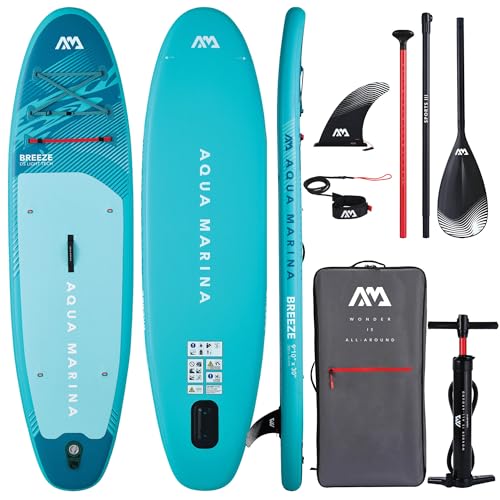
The Breeze is the compact choice for a smaller adult, teenager or paddler who values easier storage and carrying. Its all-round outline is intended for recreational use rather than distance touring, and the shorter length should feel manageable when learning basic turns on sheltered water.
The trade-off is usable space and load headroom. Taller or heavier paddlers may find a compact board busier underfoot, particularly once water, clothing and a dry bag are included. A small board is not automatically the most stable choice for every beginner.
- Buy it if: compact handling suits the rider and storage space.
- Skip it if: you are tall, heavy or want to carry substantial gear.
- Main compromise: easier transport with less deck space and glide.
2. Niphean 10’6: best-value all-rounder

The Niphean occupies the useful middle ground: familiar all-round dimensions, a complete package and enough deck space for general recreational paddling. It is the value choice for occasional lake, calm-river and sheltered-coast sessions where specialist touring performance is unnecessary.
The product page covers more than one size, so confirm the intended variation. Brand support and replacement-part continuity are less clear than with an established SUP specialist, and included accessories should be judged as starter equipment rather than the last paddle or pump you will ever buy.
- Buy it if: you want a conventional all-round package at a lower commitment.
- Skip it if: dealer support and long-term progression matter more.
- Main compromise: strong package value from a less established SUP name.
3. Bluefin Cruise 10’8: best overall

The standard Cruise is the most convincing bridge between beginner stability and longer-term use. At 10 feet 8 inches it offers more glide and deck room than the compact Breeze while remaining an all-round shape rather than a specialist touring board. Bluefin also provides clearer product context than many generic packages.
It costs more and carries more bulk than an entry-level kit. The stronger package does not remove the need to check inflation pressure, fin fitting, rider load and leash choice. Buyers focused entirely on distance will still benefit from a longer, narrower touring design.
- Buy it if: you want one dependable all-rounder with progression room.
- Skip it if: compact weight or maximum touring speed is the priority.
- Main compromise: the balanced choice is neither the cheapest nor the fastest.
4. iTAOSTAR C03AP 12′: best for extra stability and capacity

The iTAOSTAR combines 12-foot length with a 35-inch-wide platform. That makes it the stability-and-space option for larger paddlers, nervous starters, gentle fitness use or carrying more kit. The extra deck area may also suit relaxed family sessions when the total load remains within the selected board guidance.
Width creates drag and makes an efficient close paddle stroke harder. A long, wide board also catches more wind and is cumbersome off the water. Despite its length, this is a capacity-led recreational board rather than the automatic choice for fast touring.
- Buy it if: initial steadiness and usable deck space dominate.
- Skip it if: you want quick acceleration, easy cadence or compact carrying.
- Main compromise: generous stability at the cost of glide and agility.
5. Bluefin Cruise Carbon 12′: best premium touring option

The Cruise Carbon 12 is the progression end of this shortlist. Its longer outline is intended to track and carry speed more efficiently than a short all-rounder, while the reinforced construction aims to reduce flex under load. It suits a paddler who already knows they want longer outings rather than occasional beach use.
It is a substantial financial and physical commitment. The package is heavier, takes more room and offers little benefit if most sessions involve short, slow paddles close to the launch point. Carbon wording does not mean a rigid carbon board; it describes reinforcement within an inflatable construction.
- Buy it if: regular distance paddling justifies a stiffer 12-foot package.
- Skip it if: you are testing the sport or mainly paddle short sheltered sessions.
- Main compromise: touring capability with premium cost and carrying weight.
Choose your progression stage
First sheltered sessions
Choose the Breeze when compact storage fits a smaller rider, or the Niphean when a conventional 10’6 all-round package offers better headroom. Beginners should prioritise predictable balance, manageable carrying and suitable safety equipment rather than chasing a high maximum-load claim.
Regular all-round paddling
The Bluefin Cruise 10’8 is the strongest fit once you expect to paddle regularly but do not want to specialise. Our inflatable versus solid paddleboard guide explains when storage convenience still outweighs rigid-board performance.
Capacity or distance
Choose the iTAOSTAR when width and deck space matter; choose the Cruise Carbon when tracking and touring efficiency matter. Those are different needs. Our touring paddleboard guide goes deeper on shapes for sustained distance.
Size, load and construction
Working load, not maximum load
Add the rider, clothing, water, dry bag and any passenger. A board used near its stated maximum can sit low, flex and feel sluggish. Leave useful headroom and compare guidance for the exact size. Our SUP weight-limit guide explains the calculation.
Length, width and outline
Length supports glide and tracking, while width supports initial stability but adds drag. Outline matters too: a parallel touring shape behaves differently from a rounded all-round board. Do not buy a 12-foot board solely because the number sounds advanced.
Stiffness, pressure and seams
Drop-stitch density, rail construction, reinforcement and correct inflation all influence stiffness. Follow the pressure printed on the board or stated in its manual; do not apply a generic pressure range. Inspect seams and the valve before every launch, and stop using a board with unexplained bulging, separation or persistent pressure loss.
Package, safety and care
A usable package should include a compatible fin, paddle, pump with gauge, carry bag and repair materials. Check every component at home. An electric pump is convenient, but the selected model must reach the board’s specified pressure; our paddleboard pump guide compares the options.
- Buoyancy aid: use a properly fitted paddlesports model.
- Leash: match the release system to the environment and snag risk.
- Communication: keep a phone or distress method attached to you in waterproof protection.
- Conditions: check wind, tide and local restrictions before launching.
- Clothing: dress for the water temperature and the possibility of immersion.
The RNLI paddleboarding guidance covers buoyancy aids, leashes, communication and weather. Rinse the board after saltwater use, dry it before storage and keep it away from prolonged heat and sunlight. Our transport and storage guide covers longer-term care.
Frequently Asked Questions
Which inflatable paddleboard is best overall?
The Bluefin Cruise 10’8 is the best all-round choice here because it balances beginner-friendly dimensions, package quality and room to progress.
What size inflatable paddleboard suits a beginner?
Many adults suit a 10’6 to 10’8 all-round board, but rider weight, height, gear and intended water matter more than one universal size.
Is a 12-foot paddleboard suitable for beginners?
It can be, but the reason matters. A wide 12-foot board prioritises stability and capacity; a narrower touring board prioritises tracking and glide and may feel less agile.
Does a higher maximum pressure mean a better board?
No. Construction, rail design and correct inflation all matter. Use only the pressure specified for the exact board and never exceed its stated limit.
How much load headroom should I leave?
Avoid treating the maximum load as a target. Include the rider and all equipment, then leave enough capacity for the board to sit properly and respond predictably.
Can inflatable paddleboards be used at sea?
Only in suitable conditions with appropriate skill, equipment and local knowledge. Offshore wind, tide, waves and cold water can quickly overwhelm an inexperienced paddler.
The bottom line
The Bluefin Cruise 10’8 is the inflatable paddleboard we would choose for most paddlers. Buy the Breeze for compact beginner handling, Niphean for value, iTAOSTAR for stability and capacity, and the Cruise Carbon 12 only when regular touring makes its extra stiffness and length worthwhile.