The OutdoorMaster Shark 2S is the best paddleboard pump here for most regular paddlers. Its rechargeable power avoids tying inflation to a car socket, while automatic shut-off reduces the need to watch the gauge continuously. The AIRBANK is the smaller rechargeable alternative, WindGallop is the cheaper 12V choice, and the two manual pumps cover simplicity and backup use.
Quick picks: the best paddleboard pumps
- Best overall: OutdoorMaster Shark 2S — rechargeable electric, stated maximum 20 PSI.
- Best compact rechargeable: AIRBANK Puffer Pro — rechargeable electric, stated maximum 20 PSI.
- Best budget electric: WindGallop 20 PSI — 12v electric, stated maximum 20 PSI.
- Best manual pump: Outdoor Revolution Dual-Action — manual dual-action, stated maximum 15 PSI.
- Best-value manual backup: Trail Portofino SUP Pump — manual hand pump, stated maximum Check exact gauge range.
Quick navigation
- How we chose
- Pump comparison
- Five pumps reviewed
- Electric versus manual
- PSI, valves and power
- Frequently asked questions
How we chose
This is specification-led research; the pumps were not physically evaluated. We checked the exact UK variants for pump type, stated maximum pressure, power source, automatic shut-off, inflation and deflation functions, included adaptors and whether each model offers a distinct reason to buy. Availability was checked through current product data rather than inferred from similar model names.
Inflation times are highly conditional. Board volume, starting pressure, target PSI, temperature, hose condition and power supply all affect the result. Battery capacity does not translate into a guaranteed number of boards, and a stated maximum pressure does not mean every board should be inflated to that figure.
- Board pressure: follow the PSI printed on the board or stated in its manual.
- Power: rechargeable pumps work away from the car; 12V models need a suitable live socket and cable reach.
- Valve fit: most iSUPs use an HR-style valve, but pin depth and adaptor fit still need checking.
- Backup: a manual pump remains useful when batteries, cables or sockets fail.
Paddleboard pump comparison at a glance
| Pump | Best for | Type | Stated maximum | Main compromise |
|---|---|---|---|---|
| OutdoorMaster Shark 2S | Best overall | Rechargeable electric | 20 PSI | Premium price |
| AIRBANK Puffer Pro | Best compact rechargeable | Rechargeable electric | 20 PSI | Less battery capacity than larger premium units |
| WindGallop 20 PSI | Best budget electric | 12V electric | 20 PSI | Requires a suitable 12V socket |
| Outdoor Revolution Dual-Action | Best manual pump | Manual dual-action | 15 PSI | Physical effort at higher pressure |
| Trail Portofino SUP Pump | Best-value manual backup | Manual hand pump | Check exact gauge range | Slower and more effort than electric |
Treat maximum PSI as a capability limit, not an inflation target. The correct target comes from the paddleboard manufacturer.
The five best paddleboard pumps reviewed
1. OutdoorMaster Shark 2S: best overall
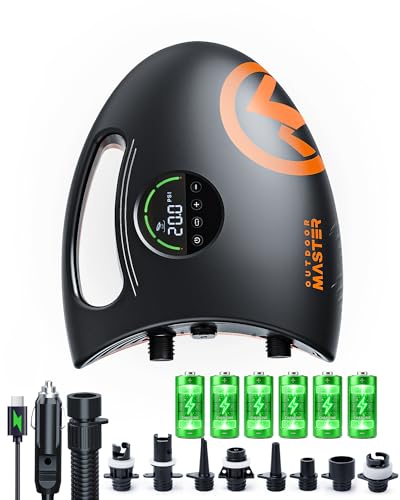
- Type: Rechargeable electric.
- Stated maximum: 20 PSI.
The Shark 2S is the strongest all-rounder for paddlers who inflate frequently or carry more than one inflatable. Its integrated rechargeable battery frees you from the car socket, and the two-stage system is designed to move high air volume first before building pressure. Automatic shut-off is useful once the correct target has been selected.
Its price is difficult to justify for occasional summer use, and the battery still needs charging before a trip. Like every electric pump, it makes noticeable noise and needs unobstructed ventilation while working. Do not treat the seller’s multi-board figures as guaranteed performance.
- Buy it if: you paddle regularly and want rechargeable convenience with deflation.
- Skip it if: you inflate only occasionally or already have a reliable 12V setup.
- Main compromise: premium cost and the need to manage battery charge.
2. AIRBANK Puffer Pro: best compact rechargeable

- Type: Rechargeable electric.
- Stated maximum: 20 PSI.
The Puffer Pro is the more compact rechargeable choice. It targets paddlers who want cordless inflation but do not want the bulk of the larger Shark 2S. Preset pressure and automatic shut-off reduce supervision, while the hose and valve connection still need checking before the pump is started.
Its smaller battery specification means it is not the obvious option for a group inflating several large boards. Claims about speed and board count depend on target pressure and conditions. Let the unit cool according to its instructions rather than immediately repeating high-pressure cycles.
- Buy it if: portability matters more than maximum battery reserve.
- Skip it if: you need the strongest option for several boards in succession.
- Main compromise: lower battery headroom than larger rechargeable pumps.
3. WindGallop 20 PSI: best budget electric

- Type: 12V electric.
- Stated maximum: 20 PSI.
WindGallop is the budget electric route. It uses a 12V car connection instead of an internal battery, so there is nothing to recharge or degrade between seasons. A 20 PSI stated maximum covers common iSUP requirements, but your board’s own target remains the only figure that matters.
The trade-off is dependence on the vehicle. Check the car manual, socket rating and whether the socket remains powered in the required ignition position. Keep the cable away from traffic and never run the pump in standing water.
- Buy it if: you normally inflate beside your car and want a low-cost automatic pump.
- Skip it if: you launch away from parking or need cordless operation.
- Main compromise: car-socket dependence and cable management.
4. Outdoor Revolution Dual-Action: best manual pump
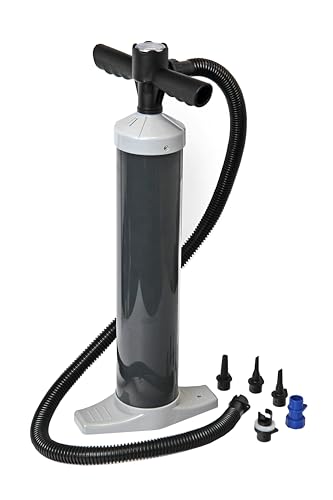
- Type: Manual dual-action.
- Stated maximum: 15 PSI.
The Outdoor Revolution is the main manual recommendation because its dual-action design moves air on both strokes at lower pressure. That helps fill the board quickly before the final high-pressure phase. The built-in gauge provides a target reference, although small hand-pump gauges are not always easy to read while pumping.
Its stated 15 PSI limit suits boards whose specified pressure does not exceed that figure. It is not appropriate when the board explicitly requires a higher target. Manual pumping becomes harder near full pressure, but it avoids batteries, cables, noise and cooling pauses.
- Buy it if: you want dependable manual inflation for a board rated at 15 PSI or below.
- Skip it if: your board requires more than 15 PSI or pumping effort is a concern.
- Main compromise: physical effort and a lower maximum than electric picks.
5. Trail Portofino SUP Pump: best-value manual backup

- Type: Manual hand pump.
- Stated maximum: Check exact gauge range.
The Trail Portofino is the sensible inexpensive backup to keep with a board. It includes a gauge and is marketed for common paddleboard valves, making it more useful than a generic high-volume airbed pump that cannot reach iSUP pressure. It also avoids relying on a car socket or charged battery.
Before buying, confirm the exact pressure range and valve fit against your board. It is a backup and value choice rather than the quickest route to the water. Inspect the hose, seals and gauge connection before every trip because a small air leak makes the final pressure much harder to reach.
- Buy it if: you need a simple spare or occasional-use pump at a modest price.
- Skip it if: you inflate frequently and value speed or automatic shut-off.
- Main compromise: more time and effort than an electric pump.
Electric versus manual paddleboard pumps
Choose electric when saving energy before paddling matters, when you inflate often, or when several boards share one launch. Rechargeable models suit remote launch points; 12V pumps offer better value when the car is always nearby. Both types still need a sound hose connection and correct pressure setting.
Choose manual for low cost, independence and dependable backup. Dual-action mode moves air on both strokes at low pressure; many purpose-built pumps switch to single-action for the harder final stage. A manual pump also gives direct feedback if the valve or hose is leaking.
If you are still choosing the board itself, our guide to the best inflatable paddleboards explains how board size and construction affect the complete setup. Our paddleboard buying guide covers the wider decision.
PSI, valves and power checks
Follow the board’s pressure
Never assume that a pump’s maximum should be used. Inflate to the range printed around the valve or stated by the board maker. Under-inflation can leave the board flexing; over-inflation can damage seams or the drop-stitch structure. Heat also raises internal pressure, so do not leave a fully inflated board baking in a closed car.
Check the valve before starting
Most modern iSUPs use a push-and-twist high-pressure valve, but adaptor dimensions and centre-pin depth vary. Seat the hose firmly, confirm the valve pin is in the inflation position and stop if air escapes around the connector. Never force a poorly fitting adaptor.
Use the right power source
For 12V pumps, follow the vehicle and pump manuals. Some products require the engine running; others warn against it. Use the specified socket and fuse rating, keep the cable fully extended and do not use damaged plugs. Rechargeable pumps should be charged and stored within the maker’s temperature guidance.
Care, storage and launch safety
- After use: brush off sand, let the hose and adaptors dry, and store them without sharp bends.
- Before travel: inspect the cable, battery, hose, seals, gauge and valve adaptor.
- During inflation: keep air inlets clear and allow cooling pauses stated in the manual.
- At launch: check the valve cap is secure and listen for leaks before loading the board.
A correctly inflated board is only one part of preparation. Check weather, water conditions, leash choice and buoyancy aid before launching. The Met Office publishes safe-paddling weather advice, while our guide covers weather, tides and paddling safety.
For longer-term care, see how to transport and store a paddleboard. Loading and pressure do different jobs, so also check the board’s stated capacity using our SUP weight-limit guide.
Frequently Asked Questions
What PSI should I inflate my paddleboard to?
Use the range printed on the board or stated in its manual. Do not use the pump’s maximum pressure as the target.
Is an electric paddleboard pump worth it?
It is useful for frequent inflation, several boards or conserving energy before paddling. Occasional users may prefer a manual pump.
Can I run a 12V SUP pump from any car socket?
Not automatically. Check the pump’s current requirement and the vehicle socket rating, fuse and ignition instructions.
Will one rechargeable pump inflate several boards?
Possibly, but board count varies with battery condition, board volume, starting pressure, target PSI and temperature.
Do all SUP pumps fit every paddleboard?
No. Many use similar high-pressure valves, but adaptor fit and centre-pin depth can differ. Confirm compatibility before relying on a pump.
Should I keep a manual pump as backup?
Yes if space permits. It provides an independent option when a battery, cable, socket or electric pump fails.
The bottom line
Choose the Shark 2S for the best rechargeable all-round package, AIRBANK for compact cordless use, WindGallop for low-cost 12V inflation, Outdoor Revolution for the strongest manual recommendation, or Trail Portofino as a value backup. Confirm the board’s PSI and valve before buying, and never substitute the pump’s maximum rating for the board maker’s target.