If your paddling takes you onto tidal water, exposed estuaries, sea lochs or busy harbour approaches, a handheld VHF radio is one of the few bits of safety kit that can call the Coastguard and nearby boats at the same time. For sheltered canals, small lakes and club nights close to shore, it is usually overkill. The useful answer sits in the middle: buy one when your phone is no longer a reliable rescue plan.
In This Article
- VHF Radio Paddling Guide: Do You Actually Need One?
- Where VHF Makes Sense on UK Water
- What a Marine VHF Radio Can and Cannot Do
- Handheld VHF Radios to Consider
- Licensing, Channels and UK Rules
- How to Carry and Use VHF on a Paddleboard or Kayak
- VHF vs Phone, PLB and Personal Locator Beacons
- Bottom Line: Who Should Buy One?
- Frequently Asked Questions
VHF Radio Paddling Guide: Do You Actually Need One?
Most paddlers do not need to start with a VHF radio. A decent buoyancy aid, suitable clothing, a leash where appropriate, a phone in a waterproof pouch and sound judgement matter more on normal beginner water. If you are still working through basic launch, landing and capsize practice, read our guides to choosing a buoyancy aid for kayaking and what to wear kayaking in the UK first.
A VHF radio becomes useful when other people on the water can hear you. That is the whole point. On the coast, Channel 16 is monitored by HM Coastguard and many vessels. On a remote lake with no marine traffic, VHF may be less useful than a phone, PLB or satellite messenger.
The question is not “is VHF good safety kit?” It is “will anyone relevant hear this radio where I paddle?”
A simple decision rule
Buy or borrow a handheld VHF if you regularly paddle:
- Sea kayak routes where wind, tide, fog or boat traffic can change the day quickly.
- Open coastal SUP trips where drifting offshore is a real risk.
- Harbours, estuaries and tidal rivers with commercial or leisure vessels nearby.
- Group trips where leaders need a reliable way to call for help if one paddler is separated.
- Kayak fishing sessions beyond easy shouting distance of shore.
Skip it for short canal paddles, supervised club sessions on sheltered water, small inland lakes with good phone signal, or any trip where you would not know what to say on the radio. Training beats owning another gadget.
Where VHF Makes Sense on UK Water
VHF is at its best on coastal water because the rescue system, harbour authorities and other vessels already use it. If you paddle around Anglesey, the Solent, Firth of Clyde, Cornwall, Pembrokeshire, the Norfolk coast or Scottish sea lochs, it is far more useful than it would be on a quiet park lake.
This is also where UK weather makes the case for carrying one. A gentle forecast can become messy when wind against tide builds short, steep chop. If your trip planning already includes tide tables, shipping channels or headlands, VHF belongs on the kit list alongside a map case, spare layer and dry bag. Our weather and tides guide for paddlers is the better starting point if that still feels new.
Best scenarios for paddlers
The radio earns its keep in three common situations.
- You need immediate help. A Mayday or Pan-Pan call can reach HM Coastguard and nearby vessels in one transmission.
- You need local information. Harbour control, marinas and safety boats may use VHF for traffic and event instructions.
- Your phone is awkward. Wet hands, cold fingers, poor signal and a phone sealed in a case all make emergency calling slower.
On several UK sea kayak trips, I have found VHF most useful before anything goes wrong: listening to traffic, checking which channel a harbour uses, and understanding how busy the water is. It is not exciting. That is a good thing.
What a Marine VHF Radio Can and Cannot Do
A marine VHF radio is a short-range line-of-sight transmitter. Handheld sets usually transmit at 1W, 5W or 6W. In real paddling use, range depends on antenna height, battery condition, weather, cliffs, headlands and whether anyone is listening.
Do not buy one expecting mobile-phone-style coverage. A kayaker sitting low on the water has a tiny antenna height compared with a yacht mast. In open coastal water, a handheld can still be excellent because Coastguard aerials and nearby vessels are higher. Behind cliffs, in narrow wooded rivers or far inland, it may be poor.
What VHF does well
- Broadcasts to many listeners. A distress call is not a private phone call; nearby boats may hear it too.
- Works with wet hands. Proper marine radios are designed for spray, dunking and gloved use.
- Gives simple priority channels. Channel 16 is the emergency and calling channel most paddlers need to understand.
- Can float and flash. Many paddler-friendly models are buoyant, bright, waterproof and easier to recover after a capsize.
What VHF does badly
VHF will not tell rescuers your exact position unless you can describe it clearly or use a DSC/GPS-equipped model correctly. It will not work well if it is buried in a hatch. It will not help if the battery is flat because it lived in the garage since last summer.
It also does not make a poor trip plan sensible. If wind is building offshore or the tide race is beyond your level, the right call is still to change the plan. A radio is a way to ask for help, not permission to paddle into avoidable trouble.
Handheld VHF Radios to Consider
For paddlers, I would buy a floating handheld model before getting clever with features. Waterproofing, simple controls, bright casing and a secure clip matter more than Bluetooth or a giant menu system. A radio you can operate with cold hands is worth more than one with a spec sheet you never use.
Here are realistic UK options at current street prices.
- Standard Horizon HX210E, about £96-£110. This is the budget pick I would start with. Cactus Navigation lists it at about £95.95, while Force 4 often has it around £109.95. It floats, is rated IPX7, has 6W output and keeps the controls simple enough for occasional paddlers.
- Icom IC-M25 Euro, about £156-£160. A lighter, paddler-friendly radio with a good reputation. Suffolk Marine Safety lists it at £160, and RadioTrader shows the IC-M25 around £156. It is a strong choice if you want something slim for a buoyancy aid pocket.
- Cobra HH500, about £166-£185. Norfolk Marine lists it at £166.49, with the regular price around £184.99. The Bluetooth calling feature is clever, but for paddling I would not pay extra for that unless you specifically want it for boat use as well.
- Icom IC-M37E, about £195. A pricier step up with more battery and a chunkier feel. It suits paddlers who also sail, safety-boat, coach or spend longer days afloat.
My pick for most UK paddlers is the Standard Horizon HX210E. It is not fancy, which is part of the appeal. It floats, it is affordable enough to actually buy, and you can put the saved £50 towards training, a better dry bag or cold-water gloves. If you want a slimmer unit for a compact buoyancy aid pocket, the Icom IC-M25 is the nicer carry.
Before buying, check the radio uses UK/international marine channels and comes from a UK marine retailer rather than a vague marketplace listing. A £45 unbranded “walkie-talkie” is not the same thing.
Licensing, Channels and UK Rules
In the UK, the radio equipment itself needs the right licence, and the operator normally needs training to transmit legally. The RYA explains handheld VHF licensing for sets used across more than one vessel, and says the Marine Radio Short Range Certificate is the minimum qualification to operate marine VHF equipment on a UK flagged vessel.
That does not mean you should leave a radio at home until every bit of admin is perfect. In a genuine distress situation, use whatever means you have to save life. For normal paddling, though, do it properly: get the licence sorted, take the SRC course if you plan to transmit, and practise before you need it.
The channels most paddlers hear about
- Channel 16: distress, urgency, safety and calling. Do not use it for casual chat.
- Local harbour channels: useful near harbour entrances, marinas and controlled areas.
- Group working channels: only after you know what is allowed and have moved away from Channel 16.
GOV.UK’s VHF DSC procedures for small boat users cover how DSC and Coastguard calling work, but the paddling-specific lesson is simpler: the radio has to be on your person. A radio inside a front hatch is not rescue kit if you are separated from the boat.
Expect to pay about £60-£90 for an online SRC course and about £76 for the RYA exam fee, depending on the training centre and package. That can feel annoying when the radio itself costs £100, but it is the part that teaches you not to freeze when you press transmit.
How to Carry and Use VHF on a Paddleboard or Kayak
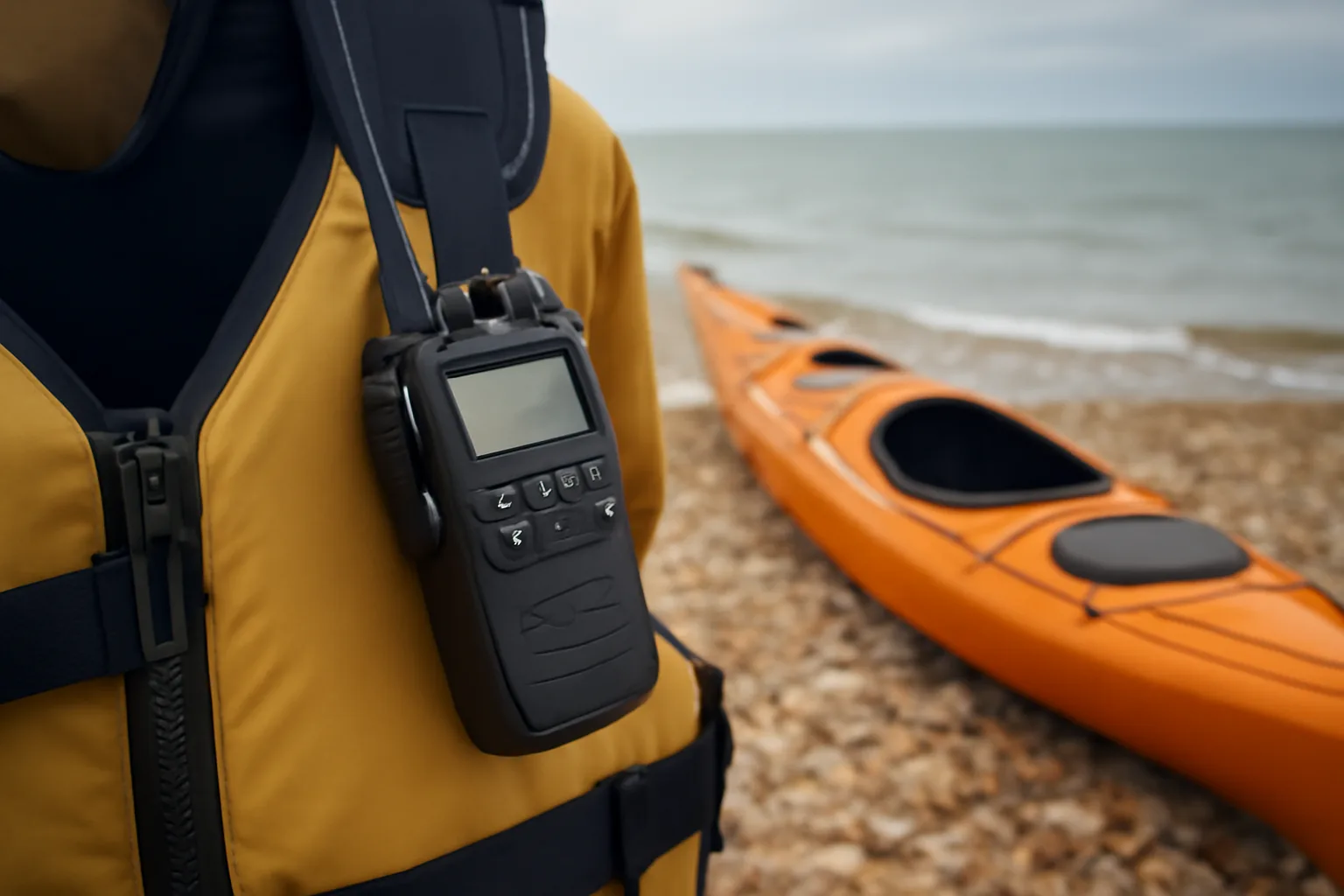
The best place for a handheld VHF is high on your buoyancy aid, attached with a short leash or lanyard, with the antenna clear enough to work. You should be able to reach it with either hand. If you have to unzip three things, rotate your torso and fish around under a cag, you will not use it calmly.
For kayaking, a shoulder strap or chest-mounted radio pocket usually works. For SUP, use a buoyancy aid with a proper front pocket or shoulder attachment rather than clipping the radio to a waist belt where it will be under water and awkward after a fall.
Setup before leaving shore
Run this quick check before launch.
- Charge it fully. Do not trust last month’s battery indicator.
- Lock the keypad if needed. Accidental button presses are common when a radio rubs against a buoyancy aid.
- Set the volume and squelch. You need to hear traffic without constant hiss.
- Check Channel 16 access. Know where the emergency/calling shortcut button is.
- Brief the group. Decide who carries radios, who leads communication, and what happens if the group splits.
I also like to keep the radio on the same side every trip. Small habits help when you are cold, tired or sorting out another paddler.
What to say in an emergency
Do not try to sound like a ship’s officer. Be clear, slow and useful.
For immediate danger to life, the classic structure is:
- Mayday, Mayday, Mayday.
- This is… your name or group name, repeated clearly.
- Your position. Use a known landmark, lat/long, what3words only if requested, or a clear description.
- The problem. Capsize, injury, missing paddler, offshore drift, hypothermia concern.
- People involved. Number of paddlers, boats, injuries and visible clothing colours.
- What help you need. Rescue, medical help, tow, advice or Coastguard coordination.
Write a tiny prompt card and keep it in your map case if that helps. There is no prize for doing it from memory while your hands are shaking.
VHF vs Phone, PLB and Personal Locator Beacons
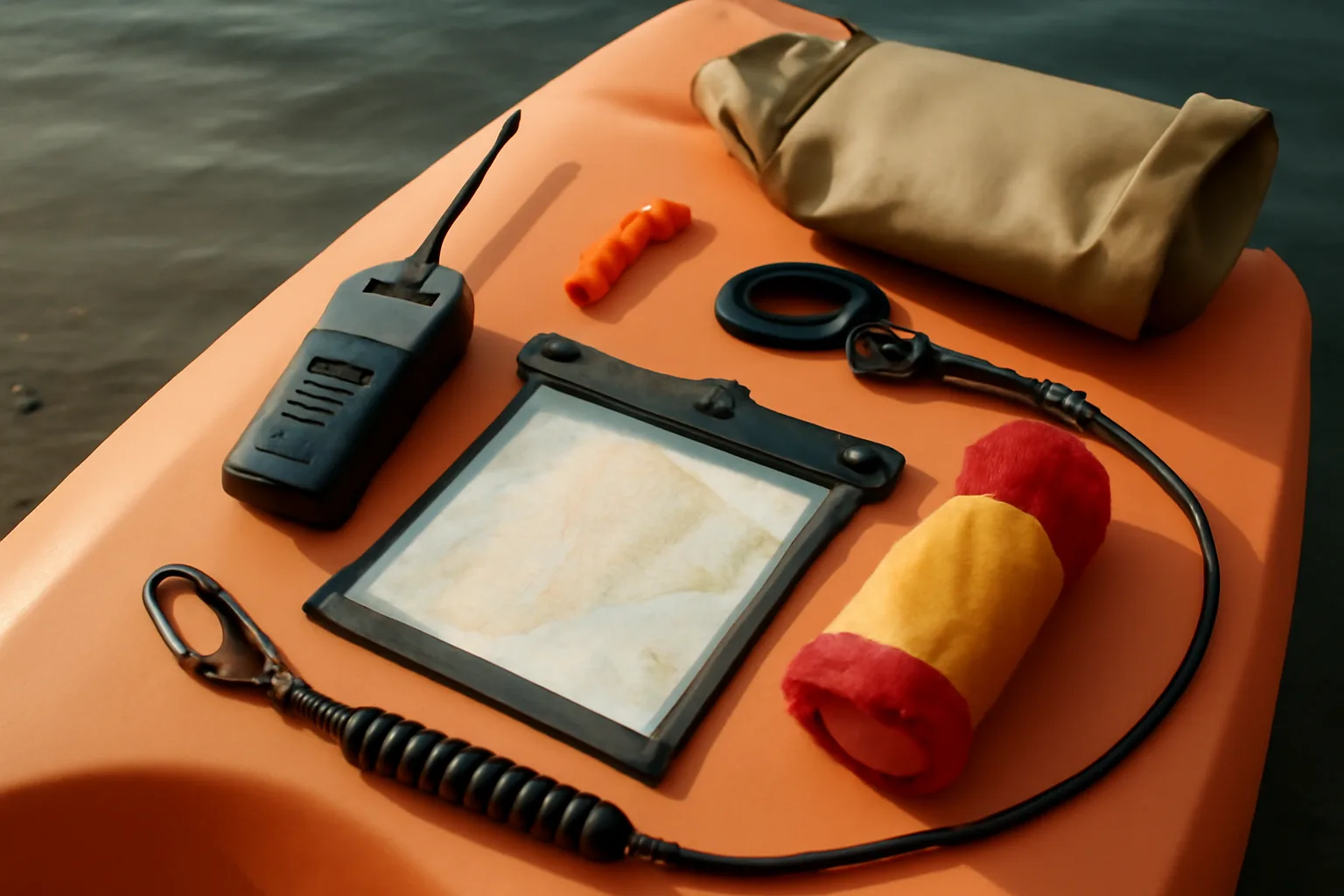
VHF is not the only way to call for help. For many paddlers, the right answer is a phone first, then VHF or PLB depending on the water.
A phone in a waterproof pouch is cheap and familiar. Budget £10-£25 for a decent pouch, or £25-£45 for a more robust case. It is ideal for canals, lakes with signal, arranged shore support and ordinary incidents where you can speak to 999 and ask for Coastguard, police, ambulance or fire as needed.
A PLB costs more, usually £220-£330, and needs registration. It is excellent when you need a distress beacon that does not rely on local listeners, but it does not let you talk through the problem. A satellite messenger is similar: useful for remote trips, not a replacement for real-time marine communication in busy coastal water.
Which one should you carry?
- Sheltered inland paddling: phone in waterproof case, whistle, group plan.
- Coastal day trips near traffic: VHF plus phone.
- Remote sea kayak trips: VHF, phone and PLB if consequences are high.
- Club or coached sessions: at least one competent leader with suitable communication kit.
The important bit is redundancy. If your only rescue plan depends on a phone screen working after a capsize, that is thin. If your only rescue plan is a VHF buried in the kayak, that is thin too.
This is also where basic kit still matters. A £100 radio will not compensate for cold hands if you skipped gloves, so pair it with sensible clothing and read our cold-water paddling gloves guide if winter or shoulder-season trips are on the cards. A good dry bag setup also keeps spare layers and phone backup usable.
Bottom Line: Who Should Buy One?
Buy a handheld VHF radio if you paddle coastal water often enough that “I will just use my phone” no longer feels like a serious safety plan. Sea kayakers, SUP touring paddlers, kayak anglers, club leaders and anyone crossing harbour approaches should strongly consider one.
Do not buy one as a badge of seriousness. If your paddling is sheltered, social and close to easy exits, spend the money on coaching, clothing, a better buoyancy aid or a course. You can always add VHF later.
If I were buying one paddler-owned radio today, I would choose the Standard Horizon HX210E at about £100 and put it in a buoyancy aid pocket every coastal trip. If comfort and pocket size matter more than price, I would move to the Icom IC-M25 at about £160. I would only go pricier if the radio was also doing sailing, safety-boat or coaching duty.
The real test is simple: can you reach it, switch to Channel 16, and say clearly where you are when the day has stopped being tidy? If not, the next purchase should be practice, not another accessory.
Frequently Asked Questions
Do I need a VHF radio for kayaking? You need one if you regularly kayak on coastal, tidal or busy marine water where HM Coastguard, harbour control or nearby vessels may hear you. For sheltered inland paddling with good phone signal, it is usually optional rather than essential.
Can paddleboarders use marine VHF radios? Yes, but the radio must be carried on your body, not strapped to the board where it can float away. A buoyancy aid with a secure front or shoulder attachment is the most practical setup.
Do I need a licence for a handheld VHF radio in the UK? The equipment needs the correct Ofcom ship or ship portable radio licence, and normal transmitting use requires proper operator training such as the RYA SRC. In a genuine distress situation, use any available method to call for help.
What is the best handheld VHF radio for paddlers? The Standard Horizon HX210E is the best-value pick for many UK paddlers at roughly £96-£110. The Icom IC-M25 is slimmer and nicer to carry, but usually costs nearer £156-£160.
Is a VHF radio better than a phone? On coastal water, VHF can be better because one call can reach Coastguard and nearby vessels. On inland water with strong mobile signal and no marine listeners, a phone may be more useful.
Where should I carry a VHF radio when paddling? Carry it high on your buoyancy aid, attached with a short leash, with the controls reachable by either hand. Do not store it in a hatch or dry bag you cannot reach after a capsize.