You can paddle in a straight line all afternoon and still feel clumsy the moment you need to turn around near a buoy, a pontoon, or a narrow river bend. The board slows, the paddle splashes wide, and suddenly the nose is pointing everywhere except where you wanted it. SUP turning techniques are not difficult, but they do need the right order: start with sweep turns, add reverse strokes, then practise pivot and step-back turns only when your balance is ready.
In This Article
- The Three Turns Worth Learning First
- Before You Practise Turns
- Sweep Turn Technique
- Reverse Sweep and Check Turns
- Pivot Turns
- Step-Back Turns
- Turning in Wind, Chop and Current
- Common Turning Mistakes
- Practice Session Plan
- Bottom Line
- Frequently Asked Questions
The Three Turns Worth Learning First
Most paddlers only need three SUP turning techniques for normal UK paddling: the sweep turn, the reverse sweep, and the step-back turn. The pivot turn sits between them because it is more about board trim and footwork than brute paddle power.
If you are still new to SUP, start with sweep turns. They work on flat water, rivers, sheltered estuaries, and around moorings. Reverse sweeps help when you need a tighter correction. Step-back turns are useful and fun, but they also put you closer to falling in, so treat them as a skill to build rather than a party trick for the first session.
The order I would practise is:
- Sweep turn from a normal parallel stance.
- Reverse sweep to stop or tighten the turn.
- Small pivot turn with one foot only slightly back.
- Full step-back turn on calm water.
- Same turns in light wind once the basics feel tidy.
That progression keeps you in control. It also stops you learning the bad habit of swinging the paddle hard while your feet stay frozen.
Before You Practise Turns
If basic board control still feels hit-and-miss, start with our stand up paddleboarding for beginners guide before drilling tighter turns. For open-water sessions, the Scottish Fire and Rescue Service water sport safety advice is a useful reminder on buoyancy aids, weather and telling someone where you are going.
Turning is easier when the board is set up properly. If the fin is too small, the board may slide rather than carve. If you stand too far forward, the nose grips and the tail refuses to swing. If you stand too far back, the board feels twitchy before you even start.
Pick Safe Water
Practise on flat, quiet water with room around you. A sheltered lake, canal basin, or calm harbour area is better than a tidal river on your first go. Avoid practising near swimmers, moored boats, anglers, weirs, or busy slipways.
The UK has had serious SUP safety incidents, and the Marine Accident Investigation Branch has published stand up paddleboarding safety findings after the Haverfordwest Town Weir tragedy. You do not need to be frightened of paddling, but you do need to respect moving water, cold water, and weirs.
Set Your Stance
Start in a relaxed parallel stance with your feet either side of the carry handle. Knees soft, hips loose, eyes looking where you want to go. If you stare at the nose of the board, you will usually wobble more.
The first thing you notice when practising turns is that your upper body wants to do all the work. Resist that. Good SUP turning comes from the paddle, hips, and board trim working together.
Use the Right Paddle Length
A paddle that is much too long makes low sweeping strokes awkward. A paddle that is too short forces you to hunch. If your strokes feel cramped, sort that before drilling turns. Our guide to how to choose the right paddle length explains the setup side in more detail.
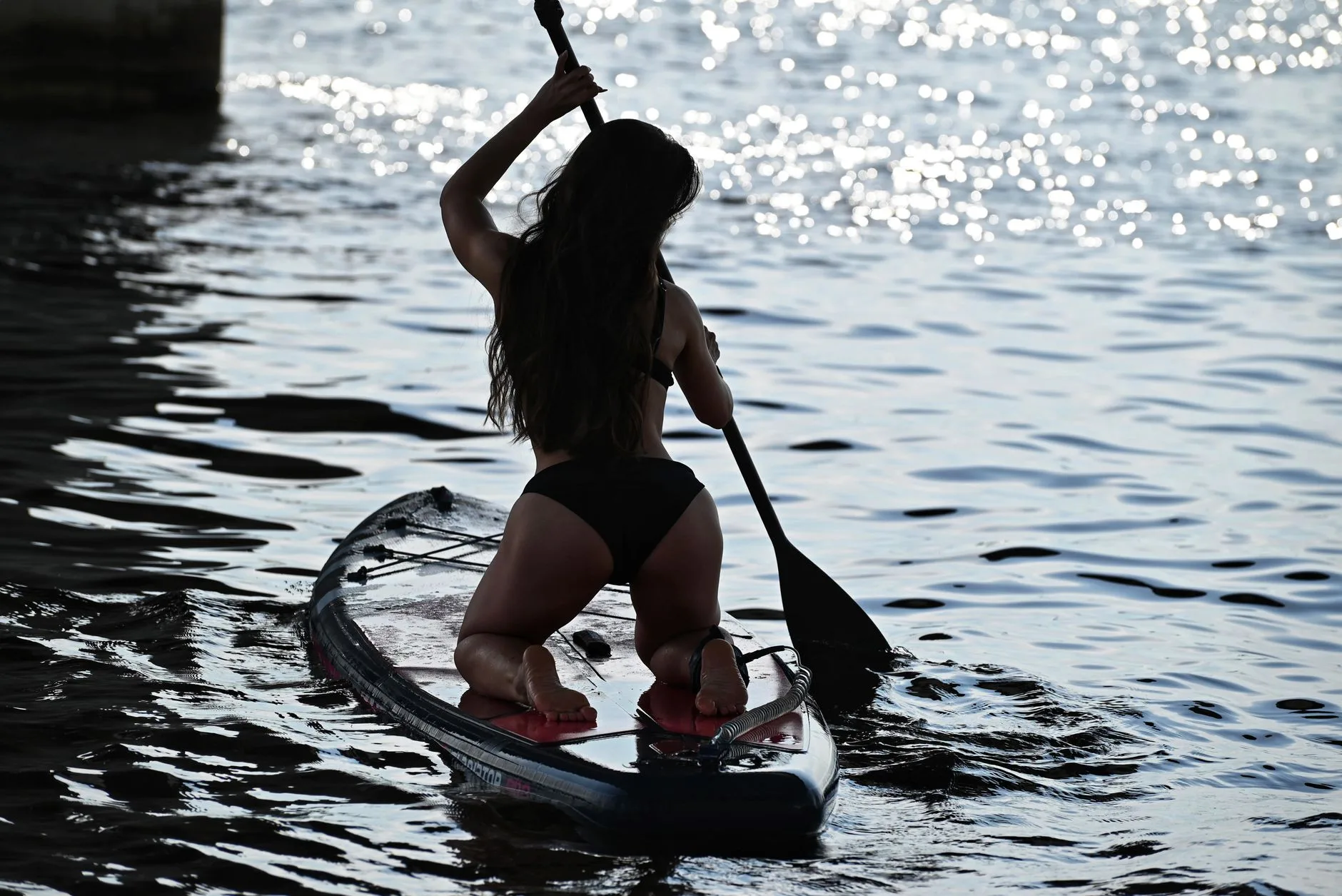
Sweep Turn Technique
The sweep turn is the foundation. It is the turn you use when you have space and want a smooth change of direction without stepping back on the board.
How to Do a Forward Sweep Turn
Put the paddle blade in the water near the nose on the side opposite the direction you want to turn. If you want to turn left, sweep on the right. Draw the blade in a wide arc away from the board, then back towards the tail.
Keep the shaft low rather than vertical. A normal forward stroke drives the board ahead; a sweep stroke draws a big curve that rotates the board. The blade path should look like a wide letter C.
Key points:
- Reach forward: start near the nose to get a longer turning arc.
- Keep the blade buried: half-in, half-out strokes feel splashy and weak.
- Use your torso: rotate through your shoulders and hips rather than pulling only with your arms.
- Look into the turn: your board tends to follow your head and shoulders.
On a stable touring board, one or two big sweeps can turn you neatly around a buoy. On a long race-style board, expect a wider turning circle.
When to Use It
Use the sweep turn for relaxed direction changes, turning back along a canal, avoiding reeds, or setting up for a landing. It is not the quickest turn, but it is controlled and predictable.
If you read our SUP paddle stroke technique for beginners, think of the sweep as the wide, turning cousin of the forward stroke.
Reverse Sweep and Check Turns
A reverse sweep starts near the tail and sweeps towards the nose. It turns the board towards the paddle side and can also slow the board down.
This is useful when you are approaching a pontoon too quickly or need to correct a line without taking several forward strokes. It feels odd at first because the board loses speed, but that is the point.
How to Do a Reverse Sweep
Set the blade in the water near the tail, on the side you want to turn towards. Sweep the blade forward in a wide arc towards the nose. Keep your knees soft because the board may pause and swing at the same time.
The reverse sweep is not glamorous, but it is a proper control stroke. Once you have it, you stop relying on frantic little paddle jabs near the nose.
The Check Stroke
A check stroke is a smaller version used to stop the board turning too far. If the nose is swinging left and you want to slow it, place the blade gently on the left side and let it act like a brake.
This is particularly useful in wind because gusts can push the nose around faster than expected.
Pivot Turns
The pivot turn lifts some of the nose out of the water so the board rotates more easily. You do this by moving weight slightly towards the tail.
Do not jump straight into a full step-back stance. Start with a small trim change: one foot 20-30cm behind the handle, the other still near the middle. The tail sinks a little, the nose becomes lighter, and the board turns with less effort.
Small Pivot Turn Drill
- Start in parallel stance on flat water.
- Take one small step back with your rear foot.
- Keep your front foot near the handle.
- Do one wide sweep stroke on the opposite side.
- Step forward again before paddling away.
That small movement teaches board trim without making you feel as if you are balancing on the tail. Based on owner feedback from inflatable touring boards, this is where many paddlers make the biggest progress: not from harder strokes, but from moving weight back just enough.
Board Shape Matters
Wide all-round boards pivot more forgivingly than narrow touring boards. A 10ft 6in all-round inflatable will usually turn more easily than a 12ft 6in touring board, but the longer board will track better in a straight line.
If you are choosing a board and turning feels important, our how to choose a paddleboard guide covers the shape trade-offs.
Step-Back Turns
The step-back turn is the quick turn people notice. You move one foot back towards the tail, sink the tail, lift the nose, then sweep the board around. It is useful for buoy turns, surf-style manoeuvres, and tight spaces.
It is also the turn most likely to put you in the water while learning. That is fine if you are dressed for it and practising somewhere safe. Less fine if you are fully clothed beside a January canal towpath.
How to Practise the Step-Back
Start from a slow glide. Move your back foot towards the tail in one controlled step, keeping your front foot near the centre line. Bend your knees. Keep your paddle in the water as a brace.
Once the nose lightens, take a wide sweep stroke on the opposite side. If the tail sinks too much, step forward. If the board wobbles, use a low brace rather than waving the paddle in the air.
Do not rush the step. A smooth small step beats a dramatic lunge.
Common Step-Back Positions
- Half step-back: rear foot just behind the handle. Best for learning.
- Surf stance: feet offset along the board. Useful for tighter turns.
- Tail-pad stance: rear foot near the tail. Fastest turn, highest swim risk.
On many inflatable boards, the sweet spot is not right on the very end. Move back until the nose lifts, then stop. If the tail is fully sinking and you are wobbling, you have gone too far.
Turning in Wind, Chop and Current
Flat-water turning is only half the story. UK paddling often means breeze, boat wash, tide, or river flow.
In wind, the nose tends to blow downwind. A sweep turn may work one way and feel stubborn the other way. Shorter, repeated strokes can be better than one huge sweep. Keep your stance lower and avoid stepping back unless the water is calm enough.
In chop, keep the paddle blade in the water longer. It gives you a third point of contact and settles the board. This is also where a lower brace becomes useful.
In current, do not practise tight turns near weirs, bridge pillars, sluices, or moored boats. Moving water changes the consequences of a mistake. If your wider paddling involves wind and chop, read how to paddle a SUP in wind and choppy water before treating turning as a standalone skill.
Common Turning Mistakes
Most turning problems come from trying to force the board instead of setting it up.
- Standing too stiff: locked knees make every wobble worse.
- Using arm strength only: the paddle stroke should come from body rotation.
- Looking down: your head pulls your balance forwards and sideways.
- Starting too far back: a full step-back before you are ready makes the board twitchy.
- Sweeping too close to the rail: a narrow stroke drives forwards more than it turns.
- Practising in wind too soon: bad conditions hide whether your technique is working.
The fix is usually boring but effective: slow down, widen the sweep, bend your knees, and look where you want the board to go.
Practice Session Plan
You can build useful SUP turning technique in 20 minutes if you practise deliberately.
- Paddle 50m to settle your stance.
- Do five sweep turns to the left and five to the right.
- Do five reverse sweeps each side.
- Practise small pivot turns with one foot slightly back.
- Rest, then try two or three half step-back turns.
- Finish with normal paddling so you do not end the session tense.
Repeat that over a few calm sessions and the board will start to feel much less stubborn. The goal is not to spin like a race paddler. It is to turn around cleanly, land neatly, avoid hazards, and feel in charge of the board.
Bottom Line
Start with the sweep turn. Add reverse sweeps so you can slow and correct the board. Then practise small pivot turns before committing to full step-back turns.
For most UK paddlers, that is enough. A clean sweep turn and a controlled half step-back will handle canal bends, lake buoys, sheltered harbours, and awkward pontoon approaches. The full step-back turn can come later, preferably somewhere warm enough that falling in is funny rather than miserable.
Frequently Asked Questions
What is the easiest SUP turn to learn first? The forward sweep turn is the easiest SUP turn to learn first because it works from a normal parallel stance and does not require stepping back on the board.
How do you do a step-back turn on a paddleboard? Move one foot back towards the tail, keep your knees bent, use the paddle as a brace, then sweep on the opposite side once the nose starts to lift.
Why does my paddleboard turn slowly? Long boards, large fins, stiff stance, and narrow paddle strokes all make a paddleboard turn slowly. Use a wider sweep and move a little weight back.
Can beginners practise pivot turns? Beginners can practise small pivot turns on calm water, but full tail-heavy pivot turns should wait until basic balance and sweep strokes feel comfortable.
Should I step back on an inflatable SUP? Yes, but only gradually. Many inflatable SUPs turn well with a half step-back; you do not always need to stand right on the tail pad.