On a grey spring morning at Richmond Lock, or halfway along the Kennet & Avon near Bath, paddle drips feel far more annoying than they look from the bank. A few drops running down the shaft can soak fleece cuffs, chill your fingers and make a relaxed cruise feel fiddly. That is where paddle drip guards earn their place: small rings or collars that sit on the paddle shaft and interrupt water before it reaches your hands.
In This Article
- Why Paddle Drips Reach Your Hands
- What Paddle Drip Guards Do
- Choosing Drip Rings for Kayak and Canoe Paddles
- How to Fit Paddle Drip Guards
- Finding the Best Position on the Shaft
- Grip Comfort, Sleeves and Cold Hands
- Common Problems and Fixes
- Care, Replacing Rings and Budget Choices
- Safety and Dry Kit Around Water
- Frequently Asked Questions
Why Paddle Drips Reach Your Hands
Water follows the shaft because a paddle is lifted again and again through wet air, spray and blade wash. Each stroke leaves droplets on the blade and lower shaft. Some fall away, but some travel inward along the shaft, especially on a low-angle touring stroke where the paddle is not held very steeply.
Owners tend to notice this most on calm canals, sheltered estuaries and lochs, because there is less splash to blame. You look down and find the cuff of your cag or hoodie is wet, even though the boat has stayed dry. On a windy sea day, paddle drips are mixed in with spray; on the Lancaster Canal in February, they feel much more personal.
Several things make drips worse:
- A smooth shaft with little texture, so water beads and runs easily.
- A relaxed low-angle stroke, common in touring kayaks and recreational sit-on-tops.
- Cold weather clothing with absorbent cuffs.
- Paddling into a breeze, where blown droplets reach the upper hand.
- A paddle that is feathered in a way that sends water towards the grip area.
- Kids using adult paddles, where hand position sits closer to the wet part of the shaft.
Technique matters too. A high, splashy recovery throws more water about. A blade pulled out late, behind your hip, often brings a ribbon of water up with it. If you are working on the basics, the guide to holding a kayak paddle correctly is the better place to tune your stroke; drip guards then tidy up the remaining nuisance.
What Paddle Drip Guards Do
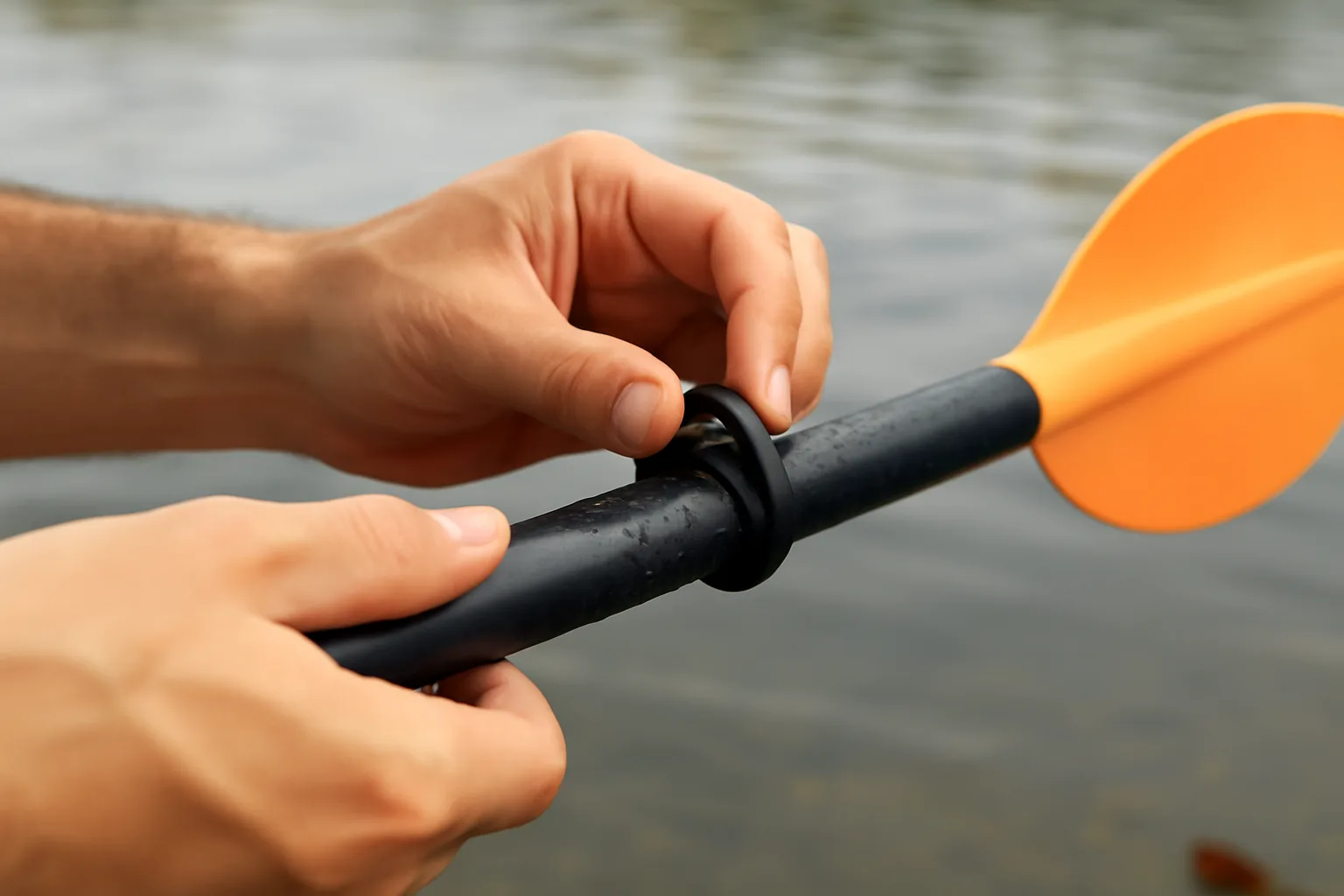
Paddle drip guards, often called drip rings, are small collars fitted near each blade on a double kayak paddle. Canoe paddlers may use a single drip stop above the blade, though many canoeists prefer to accept a little water and focus on clean recovery.
The idea is simple: water runs along the shaft, meets a raised lip, gathers, then falls off before it reaches your hands. The ring does not make paddling dry in every condition, and it will not stop rain, spray or water running from gloves. It does reduce the steady sleeve-soaking trickle that annoys many beginners and touring paddlers.
Drip rings versus splash guards
A drip ring is not the same as a large splash guard. Most kayak rings are narrow rubber or plastic collars, usually a few centimetres across. They are meant to shed water, not protect the whole cockpit.
Some budget paddles arrive with basic rings already fitted. Better touring paddles may include neater rubber rings that slide smoothly and stay put. Split paddles sometimes use removable rings that can be fitted after the paddle is assembled.
What they cannot fix
Drip guards have limits. If your hands are wet because water is pouring over the deck, because you are launching in surf, or because rain is running down your sleeves, rings will not solve the whole problem.
They also do not correct a badly matched paddle. If the paddle is too long, you may be lifting more water than needed with each recovery. For size decisions, use a dedicated paddle sizing guide rather than treating drip guards as a cure for everything. The article on choosing the right paddle length covers that part without mixing it up with drip ring placement.
Choosing Drip Rings for Kayak and Canoe Paddles
Most UK paddlers will be choosing between rubber rings, plastic clip-on guards and replacement rings from the paddle maker. The right choice depends on shaft diameter, shaft shape and whether the paddle splits into two pieces.
Rubber rings
Rubber rings are common because they grip the shaft, flex over small shape changes and are cheap to replace. A pair often costs around £3 to £8 from UK paddling shops, Decathlon-style sports retailers or online marketplaces. They are usually the best option for recreational and touring kayak paddles.
Look for rubber that feels firm rather than floppy. Very soft rings can fold under water flow and move during the session. Very hard rings may be difficult to fit over a shaft ferrule or oval grip area.
Clip-on guards
Clip-on guards suit paddles where you cannot slide a ring over the end, or where the blade shape prevents fitting from below. They are handy on some one-piece paddles, though clips can create a small raised edge that catches on roof rack straps or cockpit lines.
In practice, clip-on models are easiest to live with if they close securely and have a smooth inner surface. A rough inner seam can mark a carbon or glass shaft, so inspect it before snapping the guard in place.
Shaft size and shape
Most rings are sold by shaft diameter or as a general kayak paddle size. Standard shafts often sit around 28–30 mm, while small shafts can be narrower. Ovalised grip areas complicate the fit. A ring that feels snug on the round part may distort over an oval section.
Before ordering, measure the shaft with a tape or callipers if you have them. If the ring has to pass over a split paddle ferrule button, check that it can stretch enough without tearing. For families, the same ring that fits an adult aluminium shaft may be loose on a smaller junior paddle. If the paddle itself is still being chosen, the guide to kids paddle sizing will help avoid a poor match from the start.
Material and shaft finish
Drip rings behave slightly differently on aluminium, fibreglass and carbon shafts. Aluminium often has a smooth painted or anodised finish, so rings may slide unless they are tight. Textured composite shafts may hold rings better, but soft rubber can leave faint marks over time.
There is no need to choose a paddle material based on drip rings alone. If you are comparing weight, stiffness and durability, read paddle materials compared separately, then pick rings that suit the shaft you own.
How to Fit Paddle Drip Guards
Fitting drip guards is a small job, but it is easy to get wrong if you rush it on a cold bank with numb fingers. Do it at home or beside the car before launching.
- Clean the paddle shaft with fresh water and a cloth, removing grit and dried salt.
- Separate a two-piece paddle if it has a central ferrule.
- Wet the inside of the ring with a little clean water to help it slide.
- Slide one ring onto each half of the paddle from the blade end if the shape allows.
- Position both rings roughly the same distance from the blades.
- Reassemble the paddle and check that the rings sit outside your normal hand positions.
- Rotate each ring so any thicker lip or groove faces the blade.
- Tug gently to confirm the rings grip rather than drifting freely.
Avoid washing-up liquid unless you truly need it, as it can leave the shaft slippery for longer than expected. A tiny amount of plain water is usually enough. If a ring refuses to pass over a ferrule button, do not force it with tools; nicked rubber often splits later.
Fitting to one-piece paddles
One-piece paddles can be awkward because you may have to stretch the ring over the blade shoulder. If the blade is wide or has a pronounced ridge, a clip-on ring may be safer than dragging rubber over an edge. Warm water can soften rubber slightly, but boiling water can distort it or damage glued parts, so keep heat gentle.
Matching both sides
Measure from the blade shoulder rather than guessing from the centre of the paddle. A small mismatch is not a disaster, but uneven rings can make one side drier than the other and may irritate anyone who likes their kit symmetrical.
A tape measure, marker pen and one minute of patience usually beat adjusting by eye. Use a temporary mark, not a knife scratch.
Finding the Best Position on the Shaft
The useful test is not how tidy the rings look on dry land; it is where the water falls during your normal stroke. Too close to the blade and the ring may sit in turbulent water and shed poorly. Too close to your hand and it may drip onto your knuckles or rub your grip.
For many touring kayak paddles, a starting point of about 10–20 cm inboard from the blade shoulder works well. Low-angle paddlers often prefer the ring a touch closer to the hand than high-angle paddlers, because the shaft spends more time near horizontal. Sea kayakers may shift them outward slightly to keep the catch and recovery clean.
The bank-side adjustment test
Use this short routine on a calm bit of water:
- Paddle for five minutes at your normal pace.
- Keep your hands where they naturally sit, rather than forcing a neat textbook grip.
- Watch where droplets fall after each recovery.
- Move each ring 1–2 cm at a time, not in big jumps.
- Repeat until most water falls outside your hands and cockpit edge.
This test works best on a canal, lake or sheltered marina where wave splash is not confusing the result. It is also a good moment to notice if your hands are sliding inwards. If they are, the paddle may be too long, too heavy or held too tensely.
Feather angle and drip direction
Feathered paddles can alter how water travels. With a high feather angle, one blade may shed water differently from the other. If only one sleeve gets wet, check that the rings are the same distance from the blades and that your control hand is not rolling the shaft in a way that sends drips inward.
Split paddles with adjustable feather settings are handy here. Try a moderate feather angle and see if drip behaviour improves. Do not change feather angle only for dry hands, though; comfort, wrist position and wind handling matter more.
Grip Comfort, Sleeves and Cold Hands
Wet hands are not only irritating. In cold weather they make you grip harder, and hard gripping tires forearms. On a long loop around a reservoir or a slow return against tide, that can turn a pleasant outing into a chore.
Drip guards help by reducing the constant trickle, but the whole hand system matters: cuffs, gloves, shaft texture and stroke rhythm.
Clothing cuffs
Cotton hoodies and loose fleece cuffs soak up water quickly. Once wet, they carry cold water towards your wrists. A paddling cag with adjustable latex, neoprene or hook-and-loop cuffs gives much better control, though not everyone wants full paddling clothing for a short summer hire.
For casual paddles, try:
- Thin synthetic layers instead of cotton cuffs.
- A lightweight waterproof with snug wrist closures.
- Neoprene wrist bands under a loose jacket cuff.
- Gloves that shed water rather than absorb it.
- Rolling sleeves clear of the paddle grip in warm weather.
If spare layers or a phone are coming with you, pack them in a proper dry bag rather than hoping the cockpit stays dry. The guide to dry bags for paddling explains sizes and closures for UK day trips.
Gloves and pogies
Gloves can either help or make the problem worse. Thick fabric gloves may hold drips against the skin. Neoprene gloves keep warmth when damp but can feel clammy. Pogies, which attach around the shaft and let your bare hands hold the paddle inside a cover, are popular with some winter kayakers because they shield wind and spray.
Drip rings can sit near pogies, but do not let them jam against the opening. Leave enough clearance that the pogie does not push the ring inward during strokes.
Grip pressure
A common beginner reaction to wet hands is to clamp the paddle. That creates wrist tension and often worsens splash because the stroke becomes stiff. Aim for relaxed fingers, with the control hand guiding the shaft rather than crushing it.
If the shaft is slippery even when dry, consider grip tape made for paddles or a paddle with a textured grip area. Avoid bulky tape that traps water under your fingers.
Common Problems and Fixes
Drip rings are small, but they can cause oddly persistent annoyances. Most problems come from poor position, wrong size or rings fitted the wrong way round.
The rings slide while paddling
A sliding ring is usually too loose for the shaft or has been lubricated too much during fitting. Remove it, wash away any soap or grease and refit when dry. If it still moves, replace it with a smaller ring or a firmer rubber model.
A temporary wrap of thin self-amalgamating tape under the ring can add grip, but use care on expensive shafts. Do not build a thick lump under the ring, as it may create a pressure point or trap grit.
Water still reaches the hands
Move the rings in small increments and watch the drip path. If water is flying over the ring rather than running along the shaft, your recovery may be splashy or the blade may be leaving the water late. A cleaner exit near the hip usually reduces this.
If water runs from your forearms downwards, the source is probably rain, spray or wet clothing rather than the paddle shaft. Drip guards cannot stop water that starts above your hands.
The rings catch on the deck or lines
Rings placed too close to the blade can catch deck elastics, fishing rod holders or the edge of a sit-on-top during awkward strokes. Move them inward slightly, but keep enough distance from your hands.
On compact recreational kayaks, deck clutter makes this more likely. Keep loose lines tidy and check that a rescue or tow line is not snagging the ring.
One side feels different
Measure both sides again. Also check that the paddle halves are fully seated in the ferrule. A split paddle not clicked together properly can make one ring appear wrong even if the measurement is fine.
If the paddle has asymmetrical blades or a pronounced dihedral, the two sides may shed water a little differently. That is normal, as long as your hands stay mostly dry.
Care, Replacing Rings and Budget Choices
Drip guards live a hard life for such small parts. They get dragged over sand, left in car boots and exposed to salt, sun and frost. A little care keeps them useful.
Rinse them after sea paddling, especially around the Clyde, North Wales, Cornwall or any salty estuary. Salt crystals under a ring can scratch a shaft. After rinsing, slide the ring a few centimetres now and then so the shaft underneath can dry.
Replace rings when you see:
- Splits or cracks in the rubber.
- A loose fit that returns after cleaning.
- Hardening or shiny patches from age.
- Missing clips or distorted lips.
- Grit embedded in the inner surface.
Budget rings are fine for many paddlers. A £5 pair that fits well is better than an expensive brand-name ring in the wrong size. If you own a high-end carbon paddle, buying the maker’s replacement rings may be wise because they are more likely to match the shaft diameter and finish.
Avoid cable ties as drip guards. They create a sharp edge, can scratch the shaft and do a poor job of shedding water. Foam sleeves are not ideal either; they absorb water and can make the drip problem messier.
For club boats and hire fleets, keep a few spare pairs in the kit box. Drip rings are often lost when paddles are split for transport, and replacing them before a novice session saves complaints about wet cuffs later.

Safety and Dry Kit Around Water
Dry hands are a comfort issue, but they link to safety in cold UK conditions. Cold fingers make zips, buckles and deck lines harder to handle. If wet hands cause you to grip too tightly, fatigue arrives sooner.
Check the forecast before heading out, even for sheltered canals or lakes. The Met Office safe paddling weather advice is useful for wind, temperature and changeable conditions. For inland waterways, the Canal & River Trust canoeing safety advice covers sensible basics around other craft, locks and route planning.
Think of drip guards as one small part of a dry-hands plan:
- Wear a buoyancy aid suited to paddling.
- Carry spare warm layers in a sealed dry bag.
- Keep a towel or buff accessible for cold stops.
- Use gloves or pogies when water and air temperatures are low.
- Practise opening hatches, clips and phone cases with damp fingers.
- Turn back early if cold hands start affecting control.
For paddleboarders using a single-blade SUP paddle, drip guards are less common, but sleeve drips still happen during kneeling paddling or when switching sides often. SUP paddlers should pay close attention to leash choice, wind and self-rescue; the RLSS paddleboarding safety guidance is a useful reference.
The main judgement call is simple: if a small ring keeps your hands warmer and your grip relaxed, fit one. If it rubs, catches or annoys you, move it or remove it. Good paddling kit should disappear into the background.
Frequently Asked Questions
Do paddle drip guards really work? Yes, they reduce water running along the paddle shaft towards your hands. They will not stop rain, wave splash or water coming from wet gloves, but for steady shaft drips they can make paddling much more comfortable.
Where should drip rings sit on a kayak paddle? Start around 10–20 cm inboard from each blade shoulder, then adjust on the water. The best position is where droplets fall away before reaching your hands, without the rings catching on the boat or deck lines.
Can I add drip guards to any paddle? Most kayak paddles can take them, but shaft diameter, blade shape and ferrule design matter. Split paddles are usually easier. One-piece paddles may need stretch-fit rubber rings or clip-on guards.
Why are my sleeves still wet after fitting drip rings? The rings may be too close to your hands, too loose, or fitted backwards. Wet cuffs can also come from rain, splash, gloves or a splashy stroke, so watch where the water starts before moving the rings.
Are drip guards useful on canoe paddles? They can help on some single-blade paddles, especially for beginners or cold-weather touring, but many canoeists rely on a clean recovery and suitable cuffs instead. A small, secure drip stop above the blade is the usual option.
How much should I spend on paddle drip guards? Most paddlers only need a pair costing about £3 to £8. Pay more if you need a brand-specific size for a carbon or shaped shaft, but fit matters more than price.