You’ve been flat-water paddling for a year, you’ve done a couple of sheltered river trips, and now you’re watching YouTube videos of people surfing waves and running rapids in tiny plastic boats that look nothing like your touring kayak. Whitewater kayaking is a completely different discipline — and the boats are designed for a completely different job. Getting the right one for your ability and the rivers you want to run is the difference between progressing safely and having an expensive, terrifying time.
In This Article
- What Makes a Whitewater Kayak Different
- Types of Whitewater Kayak
- Best Whitewater Kayaks 2026 UK
- Choosing the Right Size
- Essential Safety Gear
- Where to Paddle Whitewater in the UK
- Getting Started: Courses and Progression
- Maintaining Your Whitewater Kayak
- Frequently Asked Questions
What Makes a Whitewater Kayak Different
If you’ve paddled a touring or sea kayak, a whitewater boat feels like sitting in a bathtub. They’re short (typically 1.7-2.8m compared to 3.5-5m for touring kayaks), wide, and have hull shapes designed for manoeuvrability rather than speed.
Key Design Features
- Short length — allows quick turning and spinning in turbulent water. A touring kayak’s length that gives you straight-line speed becomes a liability in rapids where you need to change direction instantly
- Rocker — the curve of the hull from bow to stern. Whitewater kayaks have significant rocker, meaning the ends curve upward. This lets the bow ride over waves rather than ploughing through them
- Volume distribution — how much buoyancy is in the bow, cockpit, and stern. High-volume boats float higher and are more forgiving. Low-volume boats sit deeper and are more responsive but less forgiving of mistakes
- Planing hull — the bottom is flat or slightly concave rather than V-shaped. This lets the boat surf waves and slide sideways across currents — essential techniques in whitewater
- Thigh braces and outfitting — much tighter fitting than a touring kayak. You wear the boat rather than sitting in it. This connection between body and boat is what allows you to roll, brace, and control the kayak in turbulent water
Types of Whitewater Kayak
Playboats
Short (1.7-2.2m), low volume, designed for freestyle moves — surfing waves, spinning, performing aerial tricks. These are the boats you see in YouTube highlight reels doing cartwheels and loops on standing waves.
- Best for: Experienced paddlers who want to play on specific features (waves, holes, pour-overs)
- Not for: Running rivers from top to bottom. Playboats are slow, sit low in the water, and aren’t designed for covering distance
- Typical weight: 15-20kg
- Price range: £600-1,200
- Key models: Pyranha Jed, Dagger Jitsu, Jackson Rockstar
Creek Boats
Longer (2.4-2.8m), high volume, designed for running steep, technical rivers with drops, narrow channels, and powerful hydraulics. Creek boats have rounded bows that resurface quickly after drops, high sides that shed water, and enough volume to punch through holes and waves.
- Best for: Running grade 3-5 rivers, steep creeks, and any water where staying upright and moving downstream matters more than doing tricks
- Not for: Playing on waves (too long and cumbersome) or flat-water cruising (too slow compared to touring boats)
- Typical weight: 18-25kg
- Price range: £700-1,400
- Key models: Pyranha 9R II, Dagger Phantom, Liquidlogic Remix XP
River Runners
The all-rounders. Medium length (2.2-2.6m), moderate volume, designed to handle a range of river conditions from gentle grade 2 to pushy grade 4. They’re fast enough to cover distance, manoeuvrable enough to navigate rapids, and stable enough for intermediate paddlers to feel confident.
- Best for: Paddlers who want one boat for everything. River days, easy creeks, and the occasional play wave
- Not for: Extreme creeking (not enough volume) or dedicated freestyle (not responsive enough)
- Typical weight: 16-22kg
- Price range: £600-1,200
- Key models: Pyranha Ripper, Dagger Katana, Jackson Nirvana
Crossover / Half-Slice
A newer category that blends playboat and river runner. The stern is low-volume (like a playboat) for surfing and stern squirts, while the bow is higher volume (like a river runner) for running rapids safely. Popular with intermediate-advanced paddlers who want playful boats that can still handle proper river running.
- Best for: Intermediate paddlers who want to develop freestyle skills while still running rivers
- Price range: £700-1,200
- Key models: Pyranha Ozone, Dagger Rewind, Jackson Antix
Best Whitewater Kayaks 2026 UK
Best for Beginners: Pyranha Ripper 2
The Ripper has been the UK’s most popular river runner for years, and the Mark 2 version refined everything that made the original great. Stable, forgiving, but responsive enough that you won’t outgrow it in six months. The Stout version (higher volume) suits heavier paddlers or anyone who wants extra stability.
- Type: River runner
- Length: 2.38m (Medium)
- Volume: 247 litres (Medium)
- Weight: 19kg
- Price: About £800-950
- Where to buy: Desperate Measures, Peak UK Shop, System X, or your local whitewater retailer
- Why it’s the pick for beginners: The Ripper forgives mistakes that would punish you in a playboat or creek boat. It rolls easily, braces intuitively, and tracks well enough to build confidence on grade 2-3 rivers. After trying four different boats during a progression course at the National Watersports Centre in Nottingham, the Ripper was the one every instructor recommended for someone transitioning from flat water
Best Creek Boat: Pyranha 9R II
The go-to creek boat for UK paddlers running steep Welsh and Scottish rivers. High volume, fast, and incredibly reassuring in powerful water. The bow design sheds water quickly after drops and the hull speed lets you punch through holes that would stop shorter boats dead. For a related angle, see our Best Fishing Kayaks 2026 UK: Pedal, Paddle & Motorised guide.
- Type: Creek boat
- Length: 2.72m (Large)
- Volume: 315 litres (Large)
- Weight: 22kg
- Price: About £900-1,100
- Where to buy: Desperate Measures, UK Kayaking, Peak UK
- Why it’s the creek pick: The 9R II runs hard water with a confidence that’s hard to describe until you’ve felt it. The boat feels like it wants to keep moving downstream regardless of what the river throws at you
Best Playboat: Pyranha Jed
If surfing waves and learning freestyle moves is your goal, the Jed is the current benchmark. Short, responsive, and designed to initiate tricks with minimal effort. The Jed series has been through several iterations and the current version balances pop (how easily it launches off waves) with user-friendliness.
- Type: Playboat
- Length: 1.83m (Medium)
- Volume: 182 litres (Medium)
- Weight: 16kg
- Price: About £800-1,000
- Where to buy: Whitewater specialist retailers
- Why it’s the play pick: The Jed is the boat most UK freestyle paddlers learn on and many never move away from. It’s forgiving enough for your first cartwheel attempts but capable enough for competition-level freestyle
Best All-Rounder: Dagger Katana
A versatile river runner that handles everything from gentle grade 2 floats to committing grade 4 rapids. The Katana is slightly more stable than the Ripper and edges more gradually, making it an excellent choice for paddlers who want one boat for every situation.
- Type: River runner
- Length: 2.46m (Medium)
- Volume: 256 litres (Medium)
- Weight: 20kg
- Price: About £750-900
- Where to buy: UK Kayaking, Desperate Measures, Amazon UK (occasionally)
- Why it’s the all-rounder: If you can only own one whitewater kayak and want to paddle everything from summer river trips to winter flood runs, the Katana covers more ground than any other single boat. Less playful than the Ripper but more capable in bigger water
Choosing the Right Size
Why Size Matters
Whitewater kayaks come in 2-4 sizes (Small, Medium, Large, sometimes XL). The right size depends on your weight, height, and how you want the boat to feel.
Weight-Based Sizing
- Too small — you sit deep in the water, the boat is harder to roll, and it gets pushed around by currents. Dangerous in powerful water because the low buoyancy means waves wash over the deck
- Too big — the boat feels loose and unresponsive. Your thigh braces don’t grip, edges feel vague, and the extra volume makes the boat catch wind
- Just right — your hips and thighs fit snugly, the deck sits about 3-5cm above the water when you’re seated, and the boat responds instantly to weight shifts
Each manufacturer publishes a weight range for each size. Stay within the recommended range — ideally in the middle third. If you’re between sizes, go larger for creek boats (more volume = more safety) and smaller for playboats (less volume = easier tricks).
Height and Leg Length
If you’re over 6’1″ (185cm), check the cockpit length carefully. Some whitewater kayaks are a tight fit for tall paddlers — your knees may not fit under the deck properly, which affects your ability to roll and brace. Pyranha and Dagger generally accommodate taller paddlers better than Jackson in equivalent sizes.
Essential Safety Gear
Whitewater kayaking has genuine risks. The safety gear isn’t optional — it’s the difference between a swim you laugh about later and something serious.
Non-Negotiable
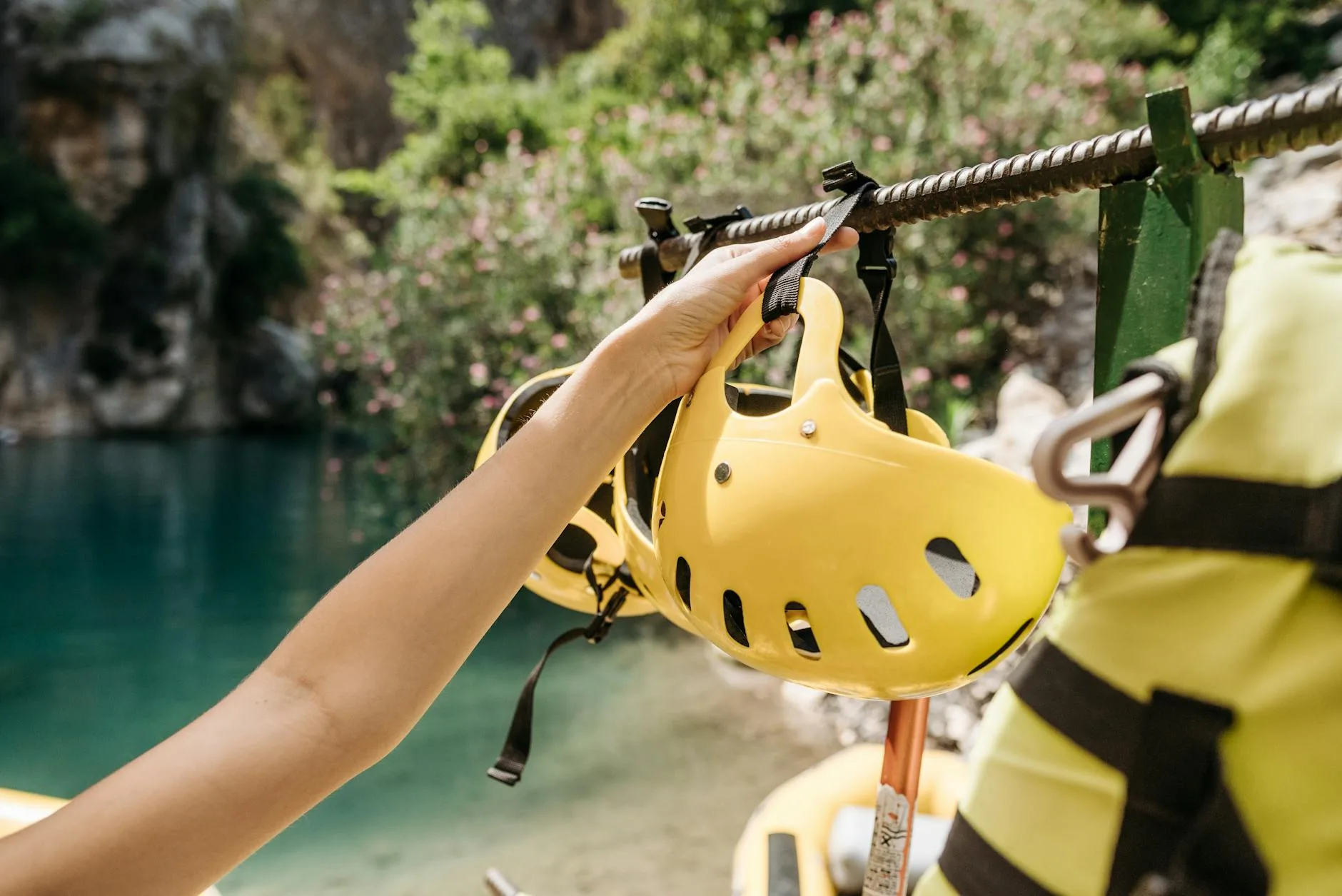
- Helmet — a CE-certified whitewater helmet that covers your temples and the back of your head. Sweet Protection, Shred Ready, and WRSI are the main brands. About £50-120
- Buoyancy aid (PFD) — a kayaking-specific PFD with 50N buoyancy minimum. Must allow full arm movement for paddling. About £60-150
- Spray deck — a neoprene skirt that seals around the cockpit rim and your waist, preventing water entering the boat. Must have a release tab for wet exits. About £40-100
- Paddle — a proper kayak paddle in the right length (typically 192-200cm for whitewater). Fibreglass or carbon blades, not aluminium — the extra responsiveness matters in turbulent water. About £80-250
- Appropriate clothing — wetsuit or drysuit depending on water temperature. UK rivers below 10°C (October-April) require a drysuit. A wetsuit is acceptable for summer paddling on warmer rivers. The RNLI recommends never paddling alone in cold water without thermal protection
Strongly Recommended
- Throw bag — a rescue rope in a bag that you can throw to a swimmer. Every group should carry at least one. About £30-50
- Whistle — attached to your buoyancy aid. Three blasts = distress. Simple and effective
- Knife — a blunt-tip river knife on your PFD for cutting entanglements. About £15-30
Where to Paddle Whitewater in the UK
Top UK Venues
- National Watersports Centre, Nottingham — artificial whitewater course. Consistent, controlled conditions. Perfect for learning and progression. Open year-round
- Lee Valley White Water Centre, London — Olympic legacy venue. Two courses from beginner to advanced. Excellent coaching available
- Cardiff International White Water — artificial course in Cardiff Bay. Good for beginners and intermediate paddlers
- River Dee, North Wales — the classic UK river trip. Grade 2-3 sections accessible to competent beginners with experienced company
- River Tryweryn, North Wales — dam-released river with guaranteed water levels. Grade 2-4 depending on the section. The UK’s most popular natural whitewater venue
- Scottish Highlands — the Tay, Tummel, and Findhorn offer world-class whitewater when water levels are right. More remote and demanding — for experienced paddlers
Finding Water
RLSS water safety guidance (formerly British Canoeing) maintains a venue finder and provides river access advice. River levels in the UK are rain-dependent — unlike alpine rivers with snowmelt, UK whitewater comes and goes with the weather. Check river gauge apps (SEPA for Scotland, NRW for Wales, EA for England) before driving anywhere. Our Best Inflatable Kayaks 2026: UK Rivers & Lakes Tested guide is useful alongside this.
Getting Started: Courses and Progression
Don’t Skip the Course
Whitewater kayaking has a steep learning curve and real consequences for getting it wrong. A beginner course at an artificial centre teaches you the fundamental skills in a controlled environment — rolling, bracing, ferry gliding, eddy turns, and reading water.
The Progression Path
- Pool sessions — learn to roll in a warm swimming pool. This takes 4-8 sessions for most people. Don’t go near whitewater until you can roll reliably on both sides
- Artificial whitewater centre — 1-2 coached sessions to apply your pool skills in moving water. Learn to read features, catch eddies, and ferry glide across currents
- Grade 2 rivers with experienced friends or a club — gentle rapids, easy rescue. Build mileage and confidence
- Grade 3 rivers — more powerful water, more commitment. You should have a reliable roll and be comfortable swimming in rapids
- Grade 4+ and steep creeks — advanced skills, dedicated training, and careful risk assessment. Not for beginners regardless of confidence
Clubs
Joining a kayak club is the fastest way to progress. Clubs provide coaching, equipment for trying before buying, safety cover, and — crucially — river knowledge that takes years to build alone. British Canoeing (Paddle UK) has a club finder on their website. Most clubs charge £30-60 per year and run weekly pool sessions and regular river trips.
Maintaining Your Whitewater Kayak
After Every Session
- Drain the boat — tip it upside down and let all the water run out. Water left sitting in the hull adds weight and promotes mildew
- Check the outfitting — hip pads, thigh braces, and back band. Make sure nothing has shifted. Loose outfitting means poor boat control on your next session
- Inspect for damage — look for deep scratches, cracks, or punctures. Polyethylene (the plastic most whitewater kayaks are made from) is tough but not indestructible
Seasonal Maintenance
- UV protection — store out of direct sunlight. UV degrades polyethylene over time, making it brittle. A garage, shed, or UV-resistant cover is essential for long-term storage
- Oil-canning repair — if the hull has developed flat spots from pressure or heat, fill the boat with warm water and leave it in the sun (controlled exposure) to let the plastic reform. Alternatively, use a heat gun very carefully
- Cockpit rim — check the rim for warping. A warped rim means your spray deck won’t seal properly. Minor warping can be heat-corrected; severe warping means a new boat
When to Replace
Polyethylene kayaks last 5-10 years with regular use, longer if stored properly. Signs it’s time:
- The hull is noticeably thinner from years of scraping over rocks — hold it up to light and look for thin spots
- Structural cracks that can’t be repaired — especially around the cockpit rim or footrest area
- The plastic has gone chalky and brittle from UV degradation
- Your paddling has progressed beyond what the boat can do — upgrading is the fun reason to replace
Frequently Asked Questions
Can I use a whitewater kayak for flat water? Technically yes, but you’ll hate it. Whitewater kayaks are slow, unstable at speed, and uncomfortable for anything longer than about 30 minutes of flat-water paddling. They’re designed for short, intense sessions in turbulent water. After trying to paddle my whitewater boat on a flat canal once, I gave up after 20 minutes — it was like cycling through sand. For flat water, use a touring or recreational kayak — and for whitewater, use a whitewater boat. Trying to compromise between the two means you’re bad at both.
How much does a decent whitewater kayak cost? A new whitewater kayak costs £600-1,400 depending on the type and brand. River runners sit in the £600-1,000 range, creek boats £700-1,400, and playboats £600-1,200. The second-hand market is strong — a well-maintained used boat costs 40-60% of new price. I bought my first river runner second-hand for £350 and it lasted three seasons before the hull thinned out. Facebook Marketplace, UK River Guidebook forums, and club noticeboards are good places to find used boats.
Do I need to know how to roll before trying whitewater? Not for a beginners’ course at an artificial centre — instructors will teach you to wet exit (safely exit an upside-down kayak) as the first skill. But before paddling on natural rivers, you should have a reliable roll on both sides. Swimming in rapids is dangerous and gets worse as the difficulty increases. Invest in pool sessions until your roll is automatic.
Is whitewater kayaking dangerous? It carries real risk — more than flat-water paddling, comparable to mountain biking or climbing. The main hazards are entrapment (getting stuck against or under obstacles), cold water immersion, and impacts with rocks. Proper training, appropriate safety gear, paddling within your ability, and never paddling alone mitigate these risks substantially. Thousands of UK paddlers run whitewater safely every week.
What’s the difference between a playboat and a creek boat? Playboats are short (under 2m), low volume, and designed for tricks on specific features — surfing waves, performing aerial moves. Creek boats are longer (2.4m+), high volume, and designed for running steep, powerful rivers safely. A playboat in a steep creek is dangerous. A creek boat on a play wave is like surfing on a shipping container. They’re tools for completely different jobs.