The best Greenland paddle for most UK kayakers is the LINGVUM Full Carbon 220–230cm. It combines the narrow Greenland profile with a light 650g quoted weight, 10cm of length adjustment, a two-piece joint and a carry bag. That makes it the easiest option here to size, transport and use as either a main touring paddle or a compact spare.
The choice becomes more specific once height, kayak width and material preference enter the picture. The 210–220cm carbon model suits shorter paddlers and narrower sea kayaks; the 215–225cm version is the safest middle-length alternative; the 220–230cm version gives taller paddlers more reach; and the two cedar choices trade low weight for warmer feel and a more traditional flex. This guide compares those differences rather than pretending six near-identical lengths suit everybody.
In This Article
- Our direct answer
- Paddles at a glance
- Six recommendations
- How to choose
- Greenland vs Euro paddles
- Sizing and technique
- Care and safety
- Final verdict
- Frequently asked questions
Best Greenland Paddles: Our Direct Answer
Choose the LINGVUM Full Carbon 220–230cm if you want one modern Greenland paddle with the fewest practical compromises. The manufacturer lists a full-carbon shaft and blade, 650g weight, 10cm adjustment and a quick cam-lock joint. It is long enough for many touring kayaks while still splitting into two pieces for a car boot or deck storage.
Do not buy it solely because carbon sounds premium. A shorter paddler in a narrow kayak may find 220cm the upper end rather than the starting point, in which case the 210–220cm carbon paddle is the better fit. A paddler who values the feel of wood more than minimum weight should choose the 215cm WONITAGO cedar model or the 225cm LINGVUM cedar model instead.
The UK Amazon selection is unusually narrow: several listings are length variants of the same carbon design, and the cedar products share a similar two-piece format. That is useful if you know the length you need, but it makes sizing more important than chasing a brand name. If none of these dimensions suits your body and boat, buy from a specialist paddle maker rather than forcing the wrong fit.
The Best Greenland Paddles at a Glance
Start with usable length, then decide between carbon and cedar. The table separates products by the actual decision they solve.
| Greenland paddle | Our award | Length | Quoted weight | Main compromise |
|---|---|---|---|---|
| LINGVUM Full Carbon | Best overall | 220–230cm | 650g | May be long for smaller paddlers |
| Carbon Greenland Paddle | Best shorter carbon | 210–220cm | 700g ±50g | Sparse brand support |
| Carbon Greenland Paddle | Best middle length | 215–225cm | 700g ±50g | Same basic design as other lengths |
| Carbon Greenland Paddle | Best maximum reach | 220–230cm | 700g ±50g | Long loom may not suit every grip |
| WONITAGO Cedar | Best compact cedar | 215cm | 0.9–1.0kg | Heavier than carbon |
| LINGVUM Cedar | Best long cedar | 225cm | 0.9–1.0kg | Varnish needs inspection |
Weights and dimensions above are listing specifications, not independent measurements. Wood varies naturally, and the cedar listings explicitly allow a weight range. Check the chosen variation at checkout because neighbouring lengths may sit under similar product titles.
Our Six Greenland Paddle Recommendations
LINGVUM Full Carbon 220–230cm — Best Overall

This is the strongest all-round package in the current selection. Its 220–230cm range covers ten centimetres through a cam-lock ferrule, so you can shorten it for a narrower boat or extend it when extra reach feels more comfortable. The listing states 650g, which is lighter than either cedar option here.
A two-piece paddle will never have the uninterrupted feel of a one-piece carved paddle, but the split format is far easier to transport and carry as a spare. The included bag also keeps the long, narrow blade faces from rubbing against other kit.
The catch is sizing. A 220cm minimum is not automatically correct for every paddler. Shorter paddlers and low-volume sea kayaks should compare it with the 210–220cm model before buying.
- Buy it if: you want the lightest quoted weight and useful length adjustment.
- Skip it if: your measured starting point is below 220cm.
- Main compromise: excellent portability, but less traditional feel than cedar.
Carbon Greenland Paddle 210–220cm — Best for Shorter Paddlers

This shorter carbon option is the sensible starting point for smaller paddlers, narrow sea kayaks and anyone whose current Euro paddle already feels too long. The listing gives a 210–220cm range, a 78mm blade width, an 84cm loom and a quoted weight of 700g, plus or minus 50g.
Those figures matter more than the generic product branding. A 78mm blade is properly narrow by Euro-paddle standards, while the adjustable ferrule lets you test positions within the range. The bag and two-piece construction make it practical for travel.
The concern is after-sales confidence. The listing provides specifications but little brand history. Inspect the ferrule, blade edges and carbon finish carefully on arrival, and return it if there is play, cracking or an uneven joint.
- Buy it if: 210–220cm matches your body and narrow touring kayak.
- Skip it if: you want established specialist-brand support.
- Main compromise: useful dimensions with limited brand reassurance.
Carbon Greenland Paddle 215–225cm — Best Middle Length
The 215–225cm version is the safest length compromise when 210cm feels short but a 230cm upper setting would never be used. It shares the quoted 700g ±50g weight, 78mm blade width, 84cm loom, paddle bag and adjustable ferrule of the neighbouring carbon variants.
For a first Greenland paddle, that middle range gives room to experiment without making the paddle excessively long. Start near the shorter end, practise a relaxed canted stroke, then extend only if your kayak width or hand position calls for it.
Do not treat adjustment as a substitute for correct loom dimensions. Overall length can change, but the 84cm loom does not. Paddlers wanting a much shorter traditional loom should look to a specialist maker.
- Buy it if: you want the most neutral carbon length range.
- Skip it if: an 84cm loom is clearly wider than your comfortable grip.
- Main compromise: adjustable length, fixed loom geometry.
Carbon Greenland Paddle 220–230cm — Best for Maximum Reach
This version uses the same published 78mm blade width and 84cm loom but moves the adjustment range to 220–230cm. It is the better choice for taller paddlers, wider kayaks or buyers who already know they prefer a long Greenland paddle.
The 700g ±50g quoted weight remains competitive for a touring paddle, and the two-piece build is far easier to store than a 230cm one-piece wooden paddle. It can also be stowed as a spare if your kayak deck rigging has enough secure contact points.
More reach is not automatically more efficient. An overlong paddle can make the stroke feel slow and encourage the hands to travel too far from the body. Choose this variant because the range suits you, not because it is the biggest number.
- Buy it if: you already know you need 220–230cm.
- Skip it if: you are guessing and could trial a shorter paddle first.
- Main compromise: maximum reach can become excess leverage.
WONITAGO Cedar 215cm — Best Compact Cedar
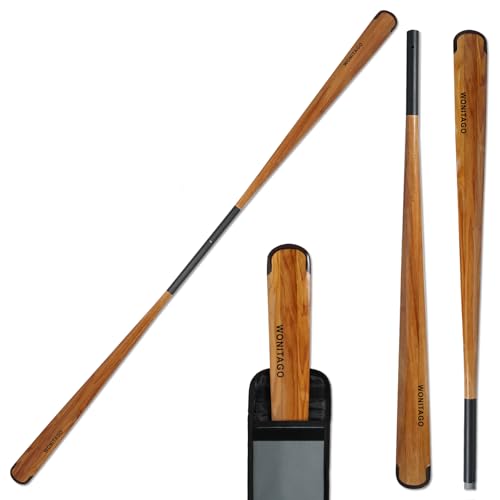
WONITAGO is the more compact wooden choice. The listing specifies a 215cm overall length, 87.5cm blades, 8.5cm blade width and a weight between 0.9 and 1.0kg. It uses western cedar, a carbon-fibre connector, protective blade-tip edges and a varnished surface.
Wood feels different from carbon. It is heavier here, but many paddlers prefer its warmer surface and less clinical feedback. The fixed 215cm length also removes the temptation to keep changing setup rather than learning one stroke.
This is still a two-piece manufactured paddle, not a custom one-piece carving. Check that both halves align cleanly and inspect the varnish and edge protection after rocky launches. The fixed length must suit before you order.
- Buy it if: you want cedar feel in a manageable 215cm length.
- Skip it if: minimum weight matters more than material feel.
- Main compromise: warmer wood with roughly 250–350g more quoted weight.
LINGVUM Cedar 225cm — Best Long Cedar
The 225cm LINGVUM suits paddlers who want cedar but need more reach than the WONITAGO offers. Its listing describes western cedar, a varnished finish, protective blade tips, a carbon connector, a two-piece build and a carry bag. The quoted weight sits between 0.9 and 1.0kg.
That extra 10cm may help with a wider kayak or a paddler who already uses a longer low-angle stroke. It may also be unnecessary weight and leverage in a narrow sea kayak. Compare the dimensions with your existing paddle and cockpit before choosing it.
Varnish reduces routine oiling, but it does not make wood maintenance-free. Rinse salt away, dry the paddle out of direct heat and inspect chips before water reaches the timber beneath the coating.
- Buy it if: you want a 225cm cedar paddle with a travel joint.
- Skip it if: 215cm is already enough reach.
- Main compromise: traditional material in a less traditional split construction.
How to Choose the Right Greenland Paddle
Choose length before material
Overall height alone does not settle paddle length. Kayak width, seat height, torso length, loom width and preferred stroke all affect fit. Traditional body-based methods are useful starting points, but a modern touring kayak may place your hands and waterline differently from a low-volume skin-on-frame boat.
If possible, borrow a paddle or choose an adjustable range that straddles your likely size. Our kayak paddle length guide explains the boat-width trade-off, while the blade-shape guide helps if you are moving from a conventional Euro blade.
Check the loom, not just total length
The loom is the central grip section. If it is too wide, your hands sit farther apart than intended; if too narrow, the shoulders and wrists may feel cramped. The three generic carbon listings quote an 84cm loom, which is wider than some traditional custom paddles. That may suit some modern paddlers, but it is not a universal advantage.
Carbon or cedar
- Carbon: lower quoted weight, little surface maintenance and easy travel joints, but a firmer feel and higher sensitivity to hidden impact damage.
- Cedar: warmer in the hands and naturally individual, but heavier in these listings and dependent on sound varnish or oil protection.
- One piece: continuous feel and no ferrule, but awkward storage and transport.
- Two piece: practical for cars, flights and deck storage, but the joint must remain clean and free from movement.
Greenland vs Euro Paddles
The stroke feels different
A Euro blade presents a broad face and produces a firm catch quickly. A Greenland blade is long and narrow, so resistance builds more progressively. That does not make one universally faster or safer. The better tool depends on technique, conditions and the need for acceleration, manoeuvring or sustained touring.
Claims that a Greenland paddle will cure shoulder pain or automatically use less energy go too far. A lighter catch may feel kinder for some paddlers, but poor technique, excessive reach or the wrong loom can still create discomfort. Anyone with persistent pain should seek appropriate clinical advice rather than treating equipment as a diagnosis.
Wind, bracing and rolling
The narrow blade presents less area above the water, which many touring paddlers value in wind. It also offers a long working surface for sculling and extended-paddle manoeuvres. Those benefits require practice: a different brace or roll is not automatically reliable because the blade shape changed. Learn in controlled water with competent instruction.

Sizing and Technique
Start with a relaxed canted stroke
A Greenland blade is commonly held with a slight forward cant so its upper edge leads through the stroke. Keep the grip relaxed, rotate through the torso and let the blade load progressively. Trying to reproduce a hard Euro-blade catch usually creates noise and flutter rather than useful power.
The fundamentals in our guide to holding and using a kayak paddle still apply: neutral wrists, controlled reach and torso involvement matter more than pulling hard with the arms. Our paddling cadence guide also explains why rhythm should follow conditions rather than an arbitrary stroke count.
Practise before committing offshore
Use sheltered water to learn the catch, sweep, draw and brace. Carry the paddle you already trust until the new one feels predictable. A Greenland paddle can be carried as a deck spare, but it must be secured properly and accessible without compromising your rescue setup.
Care and Safety
Inspect the joint and blade edges
- After salt water: rinse the paddle and ferrule with fresh water, separate the halves and dry them before storage.
- Before launch: check that the joint locks fully and has no unexpected movement.
- For carbon: stop using a paddle with cracks, crushing or a sharp damaged edge until it has been assessed.
- For varnished cedar: repair chips before moisture spreads beneath the finish.
- During storage: support the paddle flat or horizontally and avoid prolonged heat or direct sunlight.
The paddle is only one part of the system
Paddle choice does not replace trip planning or rescue skills. Paddle UK’s 2026 PaddleSafe guidance advises wearing a buoyancy aid, telling someone your plan, carrying a phone in a waterproof pouch, checking conditions and staying within your limits. For sea trips, its sea-kayaking guidance also covers weather, tides, calling for help and rescue practice.
Pair that advice with a properly fitted kayaking buoyancy aid and practise deep-water re-entry in suitable conditions. A spare paddle is valuable only if you can reach it and stay with the kayak.
Which Greenland Paddle Should You Buy?
For most buyers, choose the LINGVUM Full Carbon 220–230cm if that range matches your body and kayak. It has the lowest quoted weight here, useful adjustment, a two-piece build and a bag. The 215–225cm carbon paddle is the better neutral-length alternative, while the 210–220cm version suits smaller paddlers or narrower boats.
Choose the WONITAGO Cedar 215cm for a shorter wooden option and the LINGVUM Cedar 225cm when you want the same material with extra reach. None is a substitute for a custom paddle when loom width or exact sizing is the priority. Fit beats material, and it also beats buying the longest model because it looks more capable.
Frequently Asked Questions
Is a Greenland paddle suitable for a normal sea kayak? Yes. The paddle does not require a traditional kayak, but its length and loom still need to suit your body, seat height and kayak width.
Is carbon better than cedar? Carbon is lighter in this comparison and needs less surface maintenance. Cedar feels warmer and may provide a more traditional character. Neither compensates for poor sizing.
What length Greenland paddle should I buy? Treat 210–230cm as a broad market range, not a rule. Body dimensions, kayak width, loom width and technique all matter. Trial an adjustable paddle or borrow one if possible.
Can a Greenland paddle be used as a spare? Yes. A two-piece model can work well as a deck spare if it is secured, accessible and compatible with your deck rigging and rescue plan.
Does a Greenland paddle prevent shoulder pain? No equipment can promise that. Some paddlers prefer the progressive catch, but technique and fit remain critical. Persistent pain needs suitable medical assessment.
How should I maintain a wooden Greenland paddle? Rinse salt away, dry it out of direct heat, inspect the finish and repair varnish chips promptly. Follow the maker’s instructions before applying oil or another coating.