The Trymaker Thick Kayak Seat is the best kayak-seat upgrade here for most compatible sit-on-top and inflatable kayaks. Choose the cheaper Deluxe Padded Seat for value, the MBMYZDH when a tall back matters, the FREEIN for a firm inflatable platform or the NEW-Vi when a sit-in cockpit only has room for a slim cushion. “Universal” still does not mean every seat fits every kayak.
Quick picks: the best kayak seats
- Best overall: Trymaker Thick Kayak Seat.
- Best value: Deluxe Padded Kayak Seat with Storage Bag.
- Best high-back support: MBMYZDH Thickened Kayak Seat.
- Best inflatable option: FREEIN 4-inch Drop-Stitch Seat.
- Best for sit-in kayaks: NEW-Vi Gel Cushion.
Quick navigation
- How we chose
- Comparison at a glance
- Five kayak seats reviewed
- Which kayak seat should you buy?
- Fit, attachment and stability
- Posture, comfort and care
- Frequently asked questions
How we chose
We compared the exact UK products by seat type, stated padding, back height, strap layout, attachment hardware, storage and intended craft. The shortlist deliberately covers complete sit-on-top seats, a raised inflatable option and a cushion-only upgrade rather than pretending one shape works equally well in every cockpit.
This is a specification-led guide. We have not claimed hands-on testing, and seller language about lumbar support, pain relief, waterproofing or all-day comfort is not treated as medical or independent performance evidence. Comfort depends on hip position, backrest angle, leg support, paddling technique and the fit between the seat and the boat.
Comparison at a glance
| Seat | Best for | Type | Attachment | Main compromise |
|---|---|---|---|---|
| Trymaker Thick Kayak Seat | Best overall | Full padded seat | Four straps; compatible anchor points required | Premium price and bulky storage |
| Deluxe Padded Kayak Seat with Storage Bag | Best value | Full padded seat | Four straps; detachable rear bag | Generic fit and modest structure |
| MBMYZDH Thickened Kayak Seat | Best high-back support | Tall-back padded seat | Four straps; mounting hardware included | Tall back can restrict torso rotation |
| FREEIN 4-inch Drop-Stitch Seat | Best inflatable option | Inflatable raised seat | Two straps; check height and stability | Raises the paddler noticeably |
| NEW-Vi Gel Cushion | Best for sit-in kayaks | Cushion-only upgrade | No backrest; check cockpit clearance | Adds base comfort but no back support |
Check the exact variation before ordering. Strap length, clip type, base width and anchor position matter more than the word “universal”. A seat that cannot be tensioned against the correct points will slide, fold or force you into an awkward position.
The five best kayak seats
1. Trymaker Thick Kayak Seat: best overall

The Trymaker is the strongest all-round replacement for a compatible sit-on-top or inflatable kayak. It combines a thick padded base, a reinforced high back, four adjustable straps and a rear storage bag. That gives it more structure than a thin budget seat and lets the backrest angle be tuned once all four clips are secured.
Its thickness and tall profile are not automatically better for everyone. Performance-oriented paddlers may find a high back interferes with torso rotation, while a raised base changes the paddler’s centre of gravity. Measure the seating well, anchor spacing and strap reach before buying.
- Buy it if: you want a complete comfort-led upgrade for longer recreational paddles.
- Skip it if: your kayak lacks suitable front and rear anchor points or has a tight sit-in cockpit.
- Main compromise: supportive construction adds price, bulk and seat height.
2. Deluxe Padded Kayak Seat: best value

This generic Deluxe Padded Seat covers the essentials for considerably less: a contoured back, padded base, four adjustable straps and a detachable rear bag. It is the sensible value choice for replacing a flat, unsupportive sit-on-top seat without paying for the thickest construction.
The trade-off is fit certainty. Generic dimensions and clips need careful checking, and the rear bag should be treated as splash-resistant storage unless the seller explicitly states a tested waterproof rating. Put phones, keys and medical items in a proper dry bag.
- Buy it if: you want a complete replacement seat at a modest price.
- Skip it if: you need a precisely shaped seat for a narrow or highly moulded seating well.
- Main compromise: good value with a less tailored fit and simpler structure.
3. MBMYZDH Thickened Kayak Seat: best high-back support
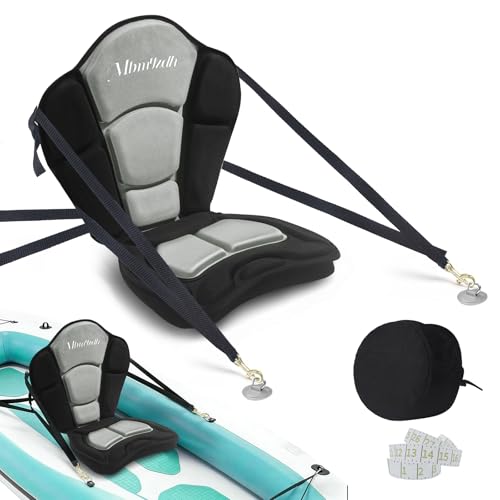
The MBMYZDH is the support-focused option. Its listed 46cm high back, padded base, four adjustable straps and detachable bag suit slower recreational paddling and fishing where an upright backrest is often valued more than unrestricted rotation. The included pad eyes and screws may help on craft designed to accept suitable fittings.
Do not drill a kayak simply because hardware is supplied. Hull material, internal access, sealing and manufacturer guidance all matter. A tall back can also clash with a buoyancy aid or encourage the paddler to lean back rather than sit actively.
- Buy it if: a tall back and substantial padding are your main priorities.
- Skip it if: you use a low-backed buoyancy aid poorly matched to the seat or rely on strong torso rotation.
- Main compromise: more back coverage can reduce freedom of movement.
4. FREEIN Drop-Stitch Seat: best inflatable option

The FREEIN takes a different approach: a firm 10cm drop-stitch platform rather than conventional foam padding. It packs down when deflated, uses two adjustable straps and can provide a more defined sitting surface in compatible inflatable kayaks and paddleboards.
The extra height is the critical issue. Raising the paddler can make entry easier and keep them farther from a wet deck, but it can also reduce stability and change paddle reach. Inflate it to the maker’s stated pressure and test the setup on sheltered water before a longer outing.
- Buy it if: your compatible inflatable craft benefits from a firm, packable raised seat.
- Skip it if: the boat already feels lively or your paddle is barely long enough.
- Main compromise: a drier, firmer platform raises the centre of gravity.
5. NEW-Vi Gel Cushion: best for sit-in kayaks

The NEW-Vi is a cushion, not a replacement backrest. That makes it the most relevant choice for a sit-in kayak where a full high-backed seat could obstruct the cockpit, thigh braces or spraydeck. It adds removable base padding while leaving the existing back band or seat structure in place.
Even a cushion changes hip height and clearance. Make sure it cannot slide under load, interfere with the wet-exit route or make the cockpit too tight. The listing’s pain-relief claims should not be treated as medical evidence; persistent numbness or pain needs attention to fit, posture and professional advice.
- Buy it if: you need a slim removable base cushion rather than a complete seat.
- Skip it if: you need back support or the extra thickness compromises cockpit clearance.
- Main compromise: added base padding without structural back support.
Which kayak seat should you buy?
Choose the Trymaker if you have a compatible sit-on-top or inflatable kayak and want the most complete comfort-led upgrade. The Deluxe Padded Seat is the better-value full replacement, while the MBMYZDH suits paddlers who specifically want a tall back. Pick the FREEIN only when raised inflatable seating suits the craft, and use the NEW-Vi when a sit-in cockpit needs a cushion rather than a new backrest.
Seat choice begins with the kayak type. Our guide to inflatable versus hard-shell kayaks explains why deck shape and rigidity change the seating experience. If you are buying the boat as well, compare the current kayaks under £500 before spending heavily on an accessory for the wrong hull.
Fit, attachment and stability
For a strap-on seat, inspect the kayak for two appropriate front and two rear anchor points. Measure the spacing, compare it with the strap range and check that the clips can close fully without twisting. Tension opposing straps evenly so the base stays flat and the backrest supports without folding forwards.
Never assume supplied screws make drilling safe. Follow the kayak manufacturer’s advice and use fittings designed for the hull material. An incorrect hole can leak, pull out under load or weaken the craft. For inflatables, use only existing reinforced attachment points.
Any thicker or higher seat raises your hips. That can improve knee angle and keep you away from deck water, but it also raises the centre of gravity. The same principle appears in our guide to kayak load limits: weight position matters as well as the headline capacity. Test every new setup on calm, sheltered water and practise getting out before heading farther.
A seat must not obstruct a safe exit. Sit-in paddlers should check thigh-brace contact, spraydeck access and cockpit clearance, then revisit the steps in our kayak wet-exit guide.
Posture, comfort and care
Comfort is not the same as leaning against the tallest possible backrest. Aim for a neutral, active position with the pelvis supported, knees comfortably engaged and shoulders relaxed. The backrest should prevent collapse without pinning the torso. The British Canoeing Awarding Body boat-body-blade guide shows how posture, connection and paddle movement work together.
Numbness can come from pressure points, restricted leg position, poor foot support or long periods without a break. Adjust footrests and straps before adding more padding. On longer outings, land safely, move around and reassess the setup rather than tightening the backrest repeatedly.
After use, remove the seat where practical, rinse away salt and grit, open the storage bag and let every layer dry. Check webbing, stitching, clips and anchor points for wear. Store foam and inflatable seats uncompressed and away from strong heat. For the rest of the boat, our kayak storage guide covers support and weather protection.
Carry essential safety equipment independently of a seat bag. A suitable buoyancy aid remains necessary; our buoyancy-aid guide explains fit and movement. The back of the aid and the top of the seat should not fight for the same space.
Frequently Asked Questions
What is the best kayak seat for most people?
The Trymaker is the best overall option here for compatible sit-on-top and inflatable kayaks. Its thick base, high back and four-strap adjustment provide a complete upgrade, but measurements still come first.
Are kayak seats universal?
No. “Universal” usually means broadly compatible with common anchor layouts, not guaranteed to fit every kayak. Check seat width, strap reach, clip type and front and rear attachment points.
Can I put a high-back seat in a sit-in kayak?
Usually not without careful fit checks. A tall back may obstruct the cockpit, spraydeck, buoyancy aid or wet exit. A slim cushion that retains the original back band is often more suitable.
Will a thicker kayak seat make the boat less stable?
It can. Raising your hips raises the centre of gravity, which may make the kayak feel less stable. Test any thicker or inflatable seat on sheltered water before a longer trip.
How should a kayak seat be adjusted?
Secure all straps to proper anchor points, centre the base and tension opposite straps evenly. Set the backrest to support an upright active posture without forcing you to lean backwards.
How do I stop a kayak seat becoming mouldy?
Rinse it after salt or dirty water, remove it where possible and dry the foam, webbing, storage bag and folds fully before storage. Avoid leaving a damp seat compressed inside the kayak.
The bottom line
The Trymaker Thick Kayak Seat is the best overall upgrade here for a compatible sit-on-top or inflatable kayak. Choose the Deluxe Padded Seat for value, MBMYZDH for a tall back, FREEIN for a raised inflatable platform or NEW-Vi for cushion-only sit-in comfort. Measure first, preserve a safe exit and test the changed stability before paddling farther.