You’re sitting in your kayak for the first time, paddle in hand, and you do what feels natural — you shove the blade into the water and pull. The kayak lurches to one side, spins in a circle, and you end up facing the way you came. Meanwhile, the person who lent you the kayak is on the bank trying not to laugh. Sound familiar? The difference between that chaotic first paddle and smooth, efficient movement on the water comes down to understanding four basic strokes.
Mastering kayak strokes isn’t about brute strength — it’s about technique. A five-foot-nothing paddler with good stroke technique will cover more water with less effort than a gym regular who muscles through every stroke. Once you’ve got these four strokes down, you can navigate flat water, rivers, and coastal paddles with confidence. And the best part: they’re all learnable in an afternoon.
In This Article
- Why Proper Stroke Technique Matters
- Before You Start: Paddle Grip and Posture
- The Forward Stroke
- The Reverse Stroke
- The Sweep Stroke
- The Draw Stroke
- Combining Strokes for Real-World Paddling
- Common Mistakes Beginners Make
- Practising Your Strokes
- When to Learn More Advanced Strokes
- Essential Gear for Getting Started
- Frequently Asked Questions
Why Proper Stroke Technique Matters
Bad technique doesn’t just look clumsy — it wastes energy, strains your shoulders, and makes the kayak fight you instead of working with you. Paddlers who rely on arm strength rather than torso rotation typically last about 30-45 minutes before their arms burn out. Paddlers with good technique can go all day.
Efficiency on the water
A well-executed forward stroke uses your core muscles — the big muscle groups in your torso and back — rather than your relatively small arm muscles. This is the single biggest revelation for new paddlers. Your arms are essentially connectors between the paddle and your body; the power comes from your trunk rotating. Once this clicks, everything changes.
Safety considerations
Being able to manoeuvre your kayak confidently matters for safety. If you can only go forward and can’t turn or move sideways, you’re at the mercy of wind, current, and other water users. International Canoe Federation recommends all paddlers learn these four basic strokes before venturing onto open water, and it’s sound advice. The ability to stop, turn, and move laterally keeps you in control when conditions change.
Before You Start: Paddle Grip and Posture
Before learning any strokes, you need to hold your paddle correctly and sit properly. Get these wrong and every stroke will be inefficient no matter how hard you try.
How to hold your paddle
If you haven’t already, read our detailed guide on how to hold and use a kayak paddle correctly — it covers grip width, blade orientation, and feathering in detail. The quick version:
- Hold the paddle above your head with both hands — your elbows should form roughly 90-degree angles
- That’s your grip width — mark it with tape if it helps you find the same position each time
- Check the blade orientation — most paddles have asymmetric blades with a longer edge on top. The concave (scooped) side should face you during the stroke
- Keep your grip relaxed — white-knuckling the shaft causes fatigue and blisters within minutes
Sitting posture
- Sit upright with your backrest providing light support, not something you’re leaning into
- Feet on the foot pegs with slightly bent knees pressing against the thigh braces (this gives you contact points for control)
- Hips slightly forward in the seat — you want an active posture, not a reclined one
- Core engaged — not tensed, just switched on. Think of sitting tall rather than slouching
I spent my first few kayaking trips slouched back in the seat like I was watching telly. Once a more experienced paddler corrected my posture and showed me how to engage my core rotation, my forward stroke improved overnight. It felt like someone had fitted a bigger engine.
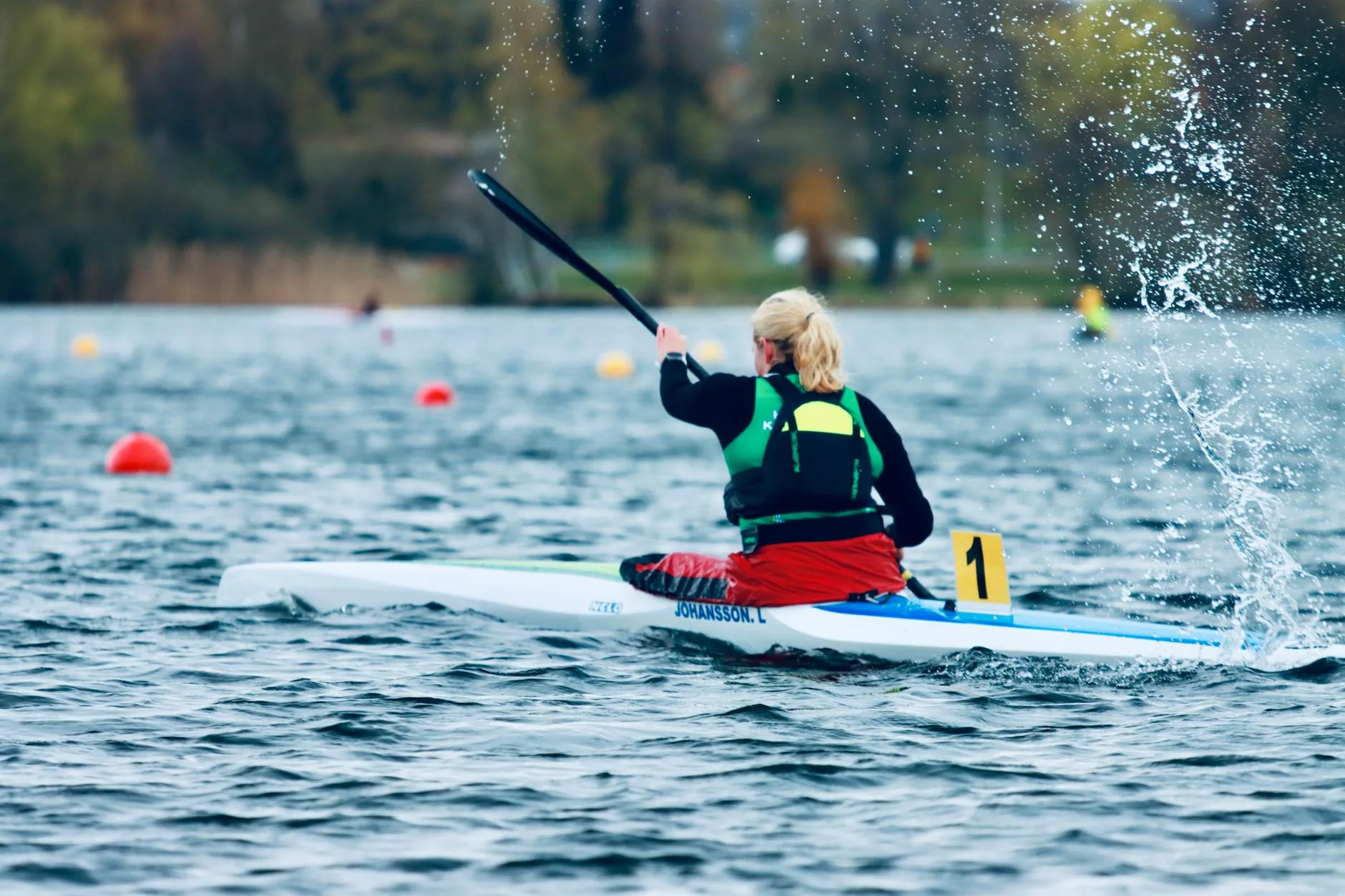
The Forward Stroke
This is the stroke you’ll use 90% of the time. It looks simple — and it is, once you break it down — but doing it well is the difference between efficient travel and exhausting flailing.
The three phases
The forward stroke has three distinct phases:
Catch
The catch is where the blade enters the water. Rotate your torso so your shoulder reaches forward and plant the blade fully in the water near your feet. The blade should be completely submerged before you start pulling. Think of spearing the water cleanly, not slapping it.
Power phase
This is where the work happens, and the key revelation is: don’t pull with your arm. Instead, unwind your torso. Your lower hand stays relatively fixed while your upper body rotates back. Your top hand pushes forward at eye level while your torso unwinds. The kayak moves past the stationary blade in the water.
The power phase should happen alongside your body — from your feet to your hip. That’s the sweet spot where you get the most efficient power transfer. Once the blade passes your hip, you’re losing efficiency rapidly.
Exit
Slice the blade out of the water when it reaches your hip. Don’t drag it past — you’re now pushing water up rather than forward, which wastes energy and actively slows you down. A clean exit sets you up for the next catch on the opposite side.
Common forward stroke errors
- Using only arms — the most common mistake. If your arms are burning but your core feels fresh, you’re doing it wrong
- Blade too shallow — if the blade isn’t fully submerged, you’re losing power. Plant it deep
- Extending too far behind — pulling the blade past your hip creates lift instead of forward motion
- Choppy, short strokes — aim for long, smooth strokes with full torso rotation
The Reverse Stroke
The reverse stroke is exactly what it sounds like — a forward stroke in reverse. You use it to stop, slow down, or back up.
How to execute it
- Rotate your torso and place the blade in the water at your hip (behind where the forward stroke ends)
- Push the blade forward through the water using torso rotation — the back of the blade leads
- Slice the blade out near your feet
- Alternate sides for straight backward movement, or repeat on one side to turn while reversing
When you’ll need it
- Approaching a bank or dock — slowing down and stopping precisely
- Backing away from obstacles — rocks, other boats, overhanging branches
- In combination with a forward stroke on the other side — this spins the kayak on the spot, useful in tight spaces
The reverse stroke doesn’t get as much practice attention as it deserves. I’ve seen paddlers who can zip along at a decent pace but can’t stop within three boat lengths. On a river with a weir ahead, that’s a serious problem. Practise it until stopping feels as natural as going. For a related angle, see our How to Launch and Land a Kayak Safely guide.
The Sweep Stroke
The sweep stroke turns the kayak. It’s a wide, arcing stroke that pushes the bow or stern around, depending on which direction you sweep.
Forward sweep (turns kayak away from the paddle side)
- Plant the blade near your toes with the blade face pointing away from the hull
- Sweep the blade in a wide arc away from the kayak, keeping your arms relatively straight
- The arc goes from your toes all the way around to the stern
- Use torso rotation — your whole body turns as the blade traces the arc
- Keep the blade close to the surface (not deep like a forward stroke)
A full forward sweep on the right side turns the kayak to the left. A partial sweep (just the first half of the arc, near the bow) is a more subtle course correction.
Reverse sweep (turns kayak towards the paddle side)
The reverse sweep is the mirror image — start at the stern and sweep forward towards the bow. A reverse sweep on the right turns the kayak to the right. It’s less intuitive than the forward sweep but equally useful.
Making turns efficient
For a quick spin, combine a forward sweep on one side with a reverse sweep on the other. The kayak will pivot on the spot. This is the fastest way to turn 180 degrees and the technique you’ll use most on rivers where you need to change direction in tight spaces.
The sweep stroke is also how you correct your course while paddling forward. Rather than doing a separate turning stroke, you can widen your forward stroke into a slight sweep to nudge the bow back on line. After a few hours of practice, this correction becomes subconscious.
The Draw Stroke
The draw stroke moves the kayak sideways — towards the paddle. It’s the stroke people forget to learn and then desperately need when they’re drifting sideways towards a rock or trying to pull alongside a dock.
Basic draw stroke
- Rotate your torso to face the direction you want to move (sideways)
- Reach out to the side and plant the blade about 60cm from the hull, with the blade face pointing at the kayak
- Pull the blade straight towards your hip using your lower hand
- Before the blade hits the hull, either slice it back out to the starting position (feathered recovery) or lift it out and start again
- Keep your top hand high — roughly forehead level — and let the shaft angle across your body
The feathered recovery
Rather than lifting the blade out and replanting it for each draw, you can rotate the blade 90 degrees at the end of the pull (so it’s edge-on to the water) and slice it back out to the starting position. This is faster, smoother, and keeps continuous sideways momentum. It takes a bit of practice to get the wrist rotation right, but it’s worth learning from the start.
When you’ll use it
- Pulling alongside another kayak for a raft-up or conversation
- Docking — sliding sideways to a jetty or bank
- Avoiding obstacles — moving laterally away from rocks, debris, or other boats without having to turn
- Positioning in moving water — edging into eddies or moving across current
I spent my first season barely using the draw stroke and wondering why docking was so stressful. Once I practised it on a calm lake for twenty minutes, pulling alongside things became almost effortless. It’s one of those skills where a small investment of practice time pays enormous dividends.
Combining Strokes for Real-World Paddling
In reality, you rarely use a single stroke type in isolation. Paddling is a constant, flowing combination of strokes blended together.
Maintaining a straight course
The forward stroke should track reasonably straight if your technique is good and your kayak tracks well. But wind, current, and subtle asymmetries in your stroke mean you’ll always need minor corrections. Options:
- Slightly wider stroke on one side — a mini sweep woven into your forward stroke
- A stronger stroke on one side — simple but less efficient
- Stern rudder — trailing the blade at the stern and using it like a rudder (a fifth stroke worth learning once you’ve mastered the four basics)
Navigating around obstacles
On a river, you’ll combine forward strokes for speed, sweep strokes for direction changes, and draw strokes for lateral adjustments — often in quick succession. The transition between strokes should be fluid, not stop-start. This is where having the basics ingrained through practice pays off. Our How to Choose a Paddleboard: Size, Shape & Type guide is useful alongside this.
Paddling in wind
Wind is the enemy of recreational kayakers. A crosswind will push you off course constantly. Counteract it by paddling with a slight sweep bias into the wind side, or use an edging technique (tilting the kayak slightly) to help it track into the wind. Headwinds are a slog — lower your stroke rate, keep strokes short and powerful, and lean slightly forward.
Common Mistakes Beginners Make
Gripping too tight
A death grip on the paddle shaft causes forearm fatigue, blisters, and reduced blade control. Your grip should be firm enough to control the paddle but relaxed enough that someone could pull it from your hands with moderate effort. The top hand in particular should have a loose grip, guiding rather than squeezing.
Sitting too far back
Leaning into the backrest like a La-Z-Boy disconnects your core from the stroke. Sit upright with the backrest for support, not comfort. Your core needs to be free to rotate.
Paddling with arms only
If your shoulders and biceps are aching but your torso feels fine, your technique needs work. The power comes from torso rotation — your arms are lever arms, not engines. A good test: if you can feel your obliques (side abdominal muscles) working, you’re using your core correctly.
Blade not fully submerged
Half-submerged blades ventilate (gulp air) and lose power. Make sure the entire blade is underwater before the power phase begins. You should see the shaft entering the water up to where the blade meets the shaft.
Lifting water on the exit
If you see water dripping or splashing off the blade as you exit each stroke, you’re leaving the blade in too long. Exit at the hip — cleanly and without dragging.
Practising Your Strokes
Where to practice
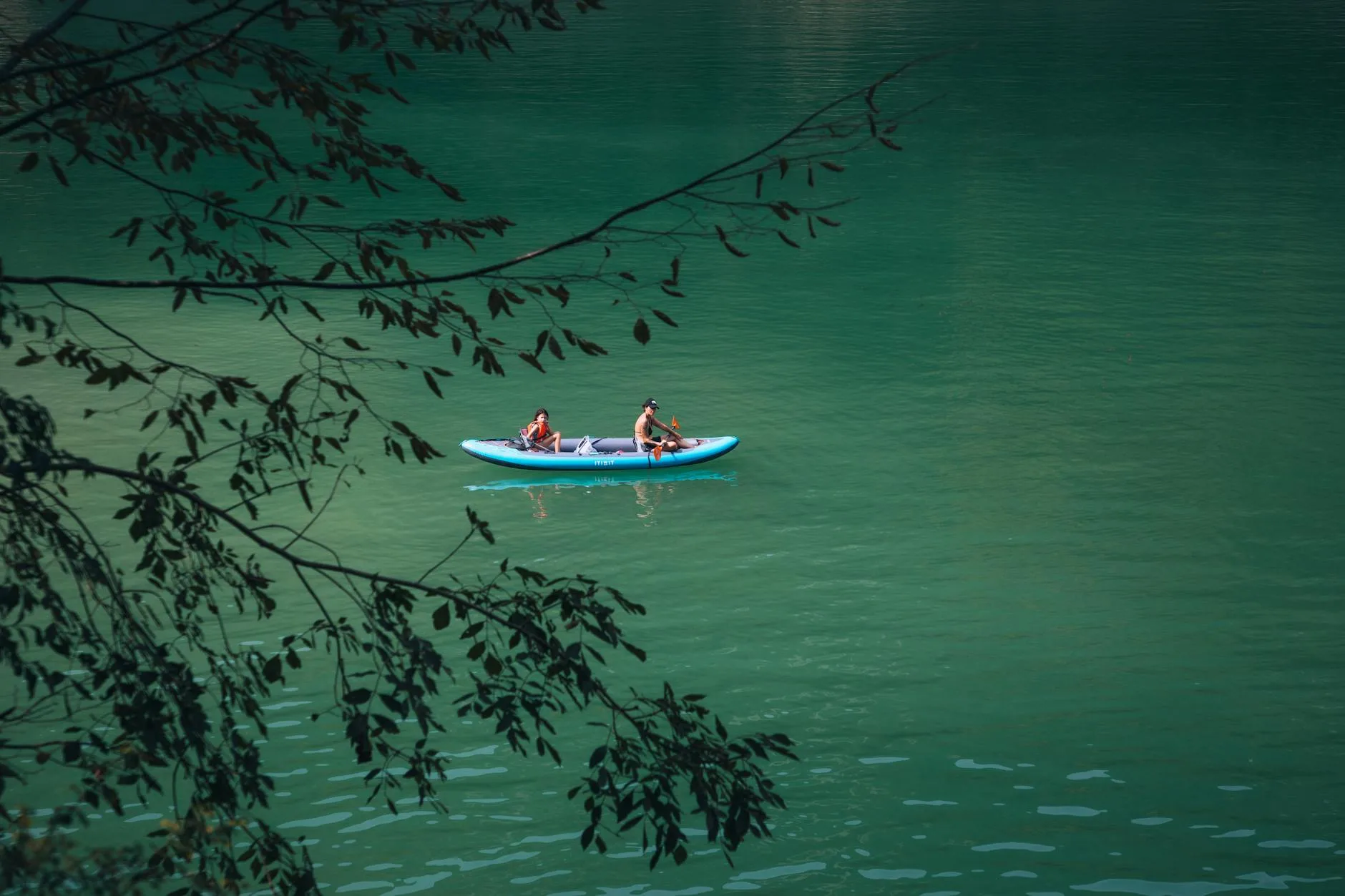
Start on flat, calm water — a sheltered lake, a canal, or a calm river section. Avoid open water, tidal areas, or fast-moving rivers until your strokes are confident. Many local canoe clubs and Canal & River Trust paddling locations offer taster sessions where you can learn in a controlled environment with qualified instructors.
Drills that work
- Straight-line drill — pick a point on the far bank and paddle to it using only forward strokes. See how straight your track is
- Spin drill — use alternating forward and reverse sweeps to spin 360 degrees as fast as possible. Then do it the other way
- Lateral movement drill — draw stroke from one side of a canal to the other and back
- Figure of eight — lay out two buoys (water bottles work) and paddle figure of eights around them, using all four strokes
How long until it feels natural?
Honestly, the basics click within a couple of hours of focused practice. Within five or six outings, the strokes become automatic and you’ll stop thinking about technique and start enjoying the water. After a season, you’ll look back at your first wobbly paddle and wonder what all the fuss was about.
When to Learn More Advanced Strokes
Once you’re comfortable with the four basic strokes, there are several more to add to your repertoire:
- Stern rudder — trailing the blade at the rear for directional control while gliding. Useful for surfing waves and running downstream
- Bow rudder — planting the blade ahead to pivot the kayak around it. Used in moving water
- High and low braces — support strokes that prevent capsizing when you feel unstable. Critical for rougher conditions
- Sculling draw — a continuous figure-of-eight motion that provides steady sideways movement
These are best learned with an instructor or on a British Canoeing course. The Star Awards scheme takes you from beginner to advanced through structured skill levels, and it’s an excellent framework for progression.
Essential Gear for Getting Started
You don’t need much to start kayaking, but getting the basics right makes a difference:
- Kayak — a stable, recreational sit-on-top or sit-inside kayak for beginners. If you’re not sure what to look for, our guide to choosing a kayak for a beginner covers the key decisions. Expect to pay about £300-500 for a decent entry-level boat from Decathlon or Go Outdoors
- Paddle — a properly sized paddle matched to your height and kayak width. Too long or short and every stroke suffers. Our paddle length guide explains how to get the right fit. Budget about £40-80 for a good aluminium-shaft beginner paddle
- Buoyancy aid (PFD) — non-negotiable. Even strong swimmers wear one. About £30-60 from Decathlon, Go Outdoors, or Amazon UK
- Appropriate clothing — layers, quick-drying materials, no cotton. A wetsuit or dry top in colder months. In summer, UV-protective layers and a hat
What to avoid buying first
Don’t rush into buying a kayak. Hire a few different types first to find out what suits your paddling style. A sit-on-top is great for casual summer paddles but you’ll want a sit-inside for touring or cooler weather. Spending £400 on the wrong kayak is an expensive mistake.
Frequently Asked Questions
How long does it take to learn basic kayak strokes? Most beginners get comfortable with forward, reverse, sweep, and draw strokes within 2-3 outings of focused practice. The forward stroke feels natural first, usually within the first hour. Sweep and draw strokes take a bit longer because they require more coordination, but by your fifth or sixth session, all four will feel automatic.
Do I need to be strong to kayak well? No. Kayaking is about technique, not strength. Proper torso rotation uses your large core muscles, which are far more powerful and fatigue-resistant than your arms. Many of the most efficient paddlers are smaller and lighter — they’ve just learned to let their technique do the work rather than muscling through every stroke.
Can I teach myself kayak strokes or do I need lessons? You can learn the basics from guides and videos, but a lesson with a qualified instructor (even just one session) will fast-track your progress enormously. An instructor can spot and correct technique errors that are invisible to you. British Canoeing clubs offer affordable beginner courses, often under £40 for a half-day session.
What’s the most important stroke to learn first? The forward stroke, without question. You’ll use it for 90% of your time on the water, and getting it right — with torso rotation rather than arm-pulling — sets the foundation for every other stroke. Once your forward stroke is solid, the others follow much more naturally.
Why does my kayak keep turning to one side? Usually because one side of your forward stroke is stronger or more efficient than the other. Most people have a dominant side. The fix is awareness — focus on matching your torso rotation and blade depth on both sides. Wind and current can also push you off course, which is where sweep stroke corrections come in.